Glasgow dispersal zone introduced to combat anti-social behaviour

 Getty Images
A dispersal zone has come into place in Glasgow city centre as part of a crackdown on crime and anti-social behaviour.
From Friday officers will be able to ask groups of two or more to leave the designated area if their behaviour is "impacting on the safety and well-being" of others.
Anyone directed away will be banned from returning for 24 hours.
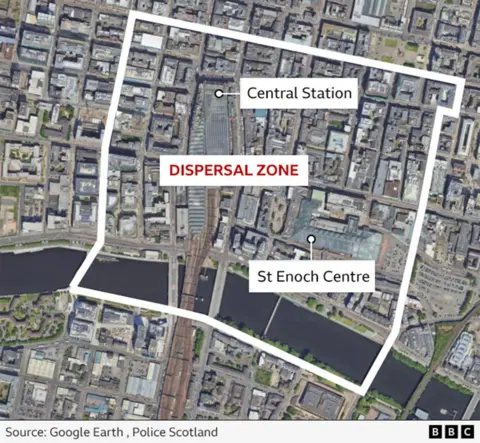
The temporary dispersal zone will cover Glasgow Central Station, St Enoch Square and Union Street, all of which have recently been identified as areas of concern.
Police Scotland said the new measures would be used proportionately and only when necessary.
Supt Jackie Dunbar said: "This is a temporary measure being introduced alongside ongoing partnership activity to address behaviour that is having a negative impact on the city centre.
"We have listened to concerns from members of the public and local businesses about antisocial behaviour and disorder and this approach is about providing reassurance and promoting a safe and welcoming city centre."
The zone will be an area bounded by St Vincent Place, Glassford Street/Stockwell Street, to the far side of the riverbank, and York Street/West Campbell Street.
The temporary measure comes into force after armed police were called to St Enoch Square at about 20:40 on Monday following reports of a teenager with a weapon.
An 18-year-old man was arrested and charged in connection with possession of a weapon, police assault, resisting arrest, breach of the peace and drug possession.
A 16-year-old female was changed in connection with police assault and resisting arrest.
Are dispersal zones an effective measure?
Dispersal zone powers are not new but were introduced in Scotland under the Antisocial Behaviour etc. (Scotland) Act 2004.
A review carried out three years later, found they had been used on 14 occasions in 11 separate areas including in Glasgow, Edinburgh, Aberdeen.
But they have also been used in smaller towns like Dumfries and Dingwall - and one was once imposed on an entire village, Mid Calder in West Lothian.
The aim was to end the "cat and mouse" problem for police officers who often found trouble makers had moved on by the time they arrived.
The new powers also gave officers a new way of dealing with behaviour that while being anti-social, was not serious enough to merit stronger enforcement action.
Failing to comply with a dispersal order became a criminal offence which could lead to arrest under the act.
The review found the dispersal zones were effective in reducing anti-social behaviour, and sometimes things improved after just a couple of weekends.
But it also noted some resentment from young people who complained there were insufficient youth services and alternative places to gather.
More recently the dispersal powers have been used alongside new Firework Control Zones in parts of Edinburgh following repeated incidents around Bonfire Night.
