NHS Wales major repairs backlog nears £1bn

 Cardiff and Vale health board
The backlog of maintenance and repairs in NHS buildings in Wales deemed at "high" or "significant risk" has reached nearly £1bn, figures reveal.
Some political parties ahead of May's Senedd election are promising new hospitals as part of their policy offer.
But whatever the complexion of the incoming Welsh government, it will face up to an ageing and potentially budget-draining legacy of health service buildings.
We have looked at a detailed breakdown of the state of 210 NHS Wales sites, ranging from community clinics to major general hospitals.
The "high" and "significant" risk backlog has grown to £917m, a 71% rise in four years, according to NHS Wales Shared Services Partnership figures.
That includes a bill of more than £616m to fix the most serious issues at 12 of Wales' 13 main hospitals.
Looking at a detailed breakdown of issues around NHS Wales buildings, published for 2024-25, the figures show:
- Ysbyty Gwynedd has a £110.5m backlog of high risk and significant maintenance and repair
- University Hospital of Wales in Cardiff (UHW) is close behind with a £106.8m backlog
- Three hospitals (Bronglais, Prince Philip and Ysbyty Gwynedd) have 40% or more of their space not considered fire safety compliant
- Ysbyty Gwynedd also has 35% of its space not regarded as health and safety compliant
- There are more than 30 NHS sites which have more than half of buildings pre-dating the birth of the NHS in 1948, mostly clinics and community hospitals
- Another 17 sites, including UHW and Bronglais hospitals, have buildings mostly between 50 and 60 years old.
A map of the main hospitals and health boards in Wales shows issues across the country.
Only the recently-opened £350m Grange hospital near Cwmbran has no maintenance problems.
It opened early during the Covid pandemic but had been first proposed in 2004 and was the first major new hospital built in 20 years.
This shows that new hospitals not only cost a great deal of money, but they can take many years to plan and build.
An annual survey shows the state of buildings across health boards and we asked for a further breakdown of these figures.
When a so-called "risk-adjusted" backlog is totalled up for all NHS buildings in Wales - which focuses on major problems where safety could be at risk - the bill comes to more than £1bn.
The largest amount is nearly £278m covering the Betsi Cadwaladr health board area.
Despite its main hospital being nearly new, Aneurin Bevan health board still has a backlog of nearly £233m. This includes issues at its two old hospitals, the Royal Gwent and Nevill Hall, with a backlog of nearly £150m.
In the Hywel Dda health board, where a proposed new hospital for west Wales could still be some years away, there is a £221m backlog, with issues at three hospitals, including Glangwili in Carmarthen which has £82m of high and significant risk repairs and maintenance.
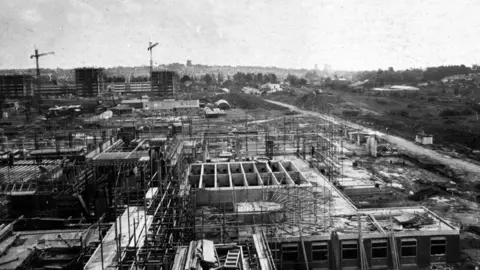
The chair of Cardiff and Vale health board has recently acknowledged that the state of UHW - which was built in 1971 - was having an impact on morale and efficiency at the hospital, with the maintenance, age and quality of buildings of "a continuing concern".
'Worryingly large'
The problem isn't confined to Wales, with NHS England having an estimated repair and maintenance backlog of £16bn.
One expert said the NHS generally was a relatively low investor in buildings, IT and machinery for much of the last 20 years.
Mark Dayan, a policy analyst at the health think tank the Nuffield Trust, said in Wales there was a "worryingly large backlog of maintenance by anyone's standards" and more than twice what the entire NHS in Wales spends a year on all buildings and permanent equipment.
"The condition of buildings and infrastructure can have a really limiting effect on healthcare.
"In particular, often, if you want to try to do things differently, so for example, if you want to reconfigure your emergency department, if you want to try to shift more planned care onto one site so you can get through it quicker."
He added: "If you're struggling at the limit of the amount of safe space you can actually use at any given time, that poses an extra problem for those practical things the NHS might want to do."
How are the parties promising to fix it?
Welsh Labour is pledging a £4bn Hospitals of the Future fund to build state-of-the-art new hospitals, including replacing Wrexham Maelor Hospital and University Hospital Wales, and a major hospital development in west Wales.
It would be funded using a mixture of conventional capital, borrowing and use of the mutual investment model.
It said a new government would work with health boards on individual hospital details and timelines after taking office in May.
The party said its landmark pledge to build new state-of-the-art hospitals would resolve many of the backlog estate issues "but we will also continue to make discretionary capital available to health boards to maintain their NHS estate".
Plaid Cymru called the maintenance backlog "eye watering" but said Labour's £4bn election pledge to tackle it and also build several new hospitals "simply doesn't add up."
The party's health spokesman Mabon ap Gwynfor said: "It's nothing more than another empty promise from Labour that once again won't be delivered."
He said the party would prioritise tackling the high-risk maintenance backlog and undertake urgent repairs to promote the safety of both staff and patients, assessing the NHS estate on a case-by-case basis.
"Within the first 100 days, a Plaid Cymru government will develop a digitisation strategy to make Wales a world leader in digital health innovation, improving efficiency in the NHS estate and begin work on a telehealth plan for Wales so that patients can better access treatment to reduce the pressure on the estate itself."
Reform UK's James Evans said: "Crumbling buildings, burst sewage pipes and rodents in hospitals are all completely unacceptable.
"Pragmatism and realism are essential for dealing with the substantial maintenance backlog across the Welsh NHS.
"Reform is the only serious and credible party on this issue, because we would prioritise the Welsh government's capital budget on clearing the maintenance backlog, instead of promising a multitude of brand-new hospitals, like other parties have."
The leader of the Welsh Conservatives, Darren Millar, said the part would make the NHS the top priority of the Welsh government.
"We will declare a health emergency, invest in extra capacity in our hospital network, including new community hospitals, diagnostic centres and surgical hubs to end corridor care and reduce excessive waiting times."
The Welsh Liberal Democrats said they would prioritise upgrading the worst parts of the NHS estate and deliver modern facilities that support faster diagnosis, shorter waiting times and better patient outcomes. That includes backing a replacement for the University Hospital of Wales.
"Crucially, we would link capital investment with reforms to social care and community services, reducing pressure on hospitals in the first place," said party leader Jane Dodds.
The Green Party called the maintenance backlog "a disgrace" and said it was undermining both patient care and staff morale.
"We will prioritise a multi-year programme to bring existing facilities up to a safe, modern standard, with transparent national reporting on progress," said a spokesman.
He said the party would also prioritise a network of local health and wellbeing centres, bringing GPs, social care, mental health and community services under one roof.

