Landmark mast marks 60 years of broadcasting

 BBC
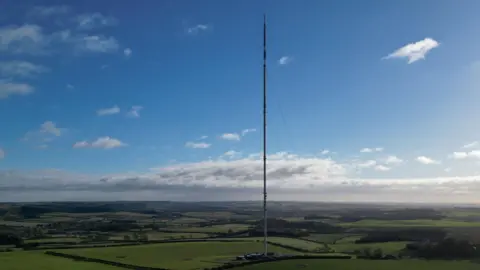
BBCOne of the UK's most recognisable broadcast structures is celebrating six decades on the air.
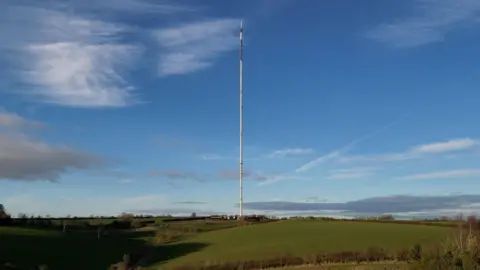
Belmont Transmitting Station, which has towered over the Lincolnshire Wolds since 1965, has played a central role in delivering television and radio services to hundreds of thousands of homes across eastern England.
After becoming operational on 20 December 1965, the mast quickly became a regional landmark and, for a time, a national one.
At 1,270ft (387m) tall, Belmont was once the tallest structure in Europe and the tallest in the UK, serving homes across Lincolnshire, Norfolk and Yorkshire.
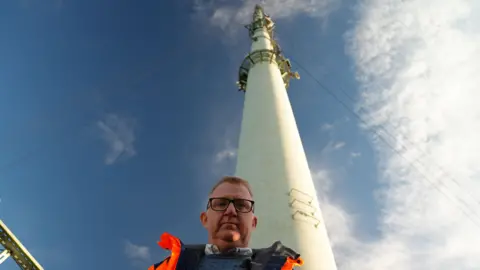
Although it lost the title during the digital switchover in 2010, when sections of the old analogue equipment were removed, the mast still stands an impressive 1,154ft (351.7m).
That makes it taller than The Shard in London, and a defining feature on the Lincolnshire skyline. Its bright red aircraft warning lights are visible for miles.
Today, Belmont continues to form a vital part of the UK's communications network.
Operated by Arqiva, it carries Freeview television, DAB digital radio, and supports growing services including smart metering networks for energy and water companies.
The site works alongside relay transmitters at Scarborough, Hunmanby and Weaverthorpe to ensure consistent coverage.
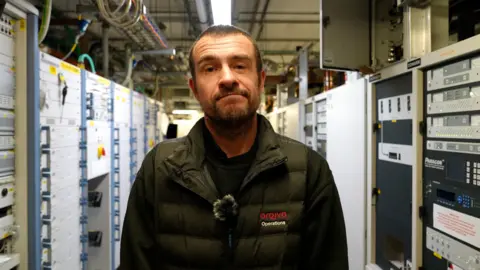
For broadcast operations manager Craig Kelly, who has worked for Arqiva for 26 years, Belmont's 60‑year anniversary marks a remarkable engineering achievement.
"When it started back in 1965, this was the tallest structure in Europe," he said.
"It's now the second-tallest structure in the UK, so it's a fantastic milestone."
Kelly said Belmont's reach remained impressive.
"The signal goes as far as North Norfolk, across to Yorkshire and South Yorkshire, and north beyond the Humber up towards Scarborough," he said.
Standing beside the tower every day, he said he was still struck by its scale.
"It's still taller than The Shard by a good few metres," he said.
"You can see it from miles around. I'm sure the locals are very proud to have such a tall structure in their backyard."
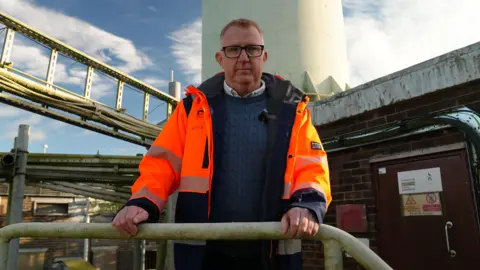
On the ground, a team of engineers works year-round to keep the site running.
One of them, Paul Clark, said: "It's a big site. We've got radio services, TV services, so it's a lot of hard work to keep everything running 24/7."
While Clark's team looks after transmitters and ground infrastructure, a specialist group handles the towering mast itself.
"They carry out annual inspections, making sure the stays are intact and that it's not going to fall over basically," he added.
Those climbers, he said, often work at extreme heights.
"We've got riggers and antenna engineers who might be fixing problems 984ft (300m) up. That's a pressured job."
Over the last 60 years, the site has continually expanded its purpose, with the introduction of smart metering systems in people's homes.
The Belmont transmitter provides connectivity between homes and energy companies, and is now doing the same for water readings too.
Ultimately, Belmont remains not just a communications hub, but an unmistakable landmark across the Lincolnshire Wolds.
It is a towering symbol of the region's broadcasting heritage, connecting communities as far away as North Yorkshire, Nottinghamshire, Derbyshire and North Norfolk, while also serving those on its doorstep in East Yorkshire & Lincolnshire.
Listen to highlights from Hull and East YorkshireorLincolnshireon BBC Sounds, watch thelatest episode of Look Northor tell us about a story you think we should be covering here.
Download the BBC News app from the App Store for iPhone and iPad or Google Play for Android devices
