With Albert Bridge now shut for a year, what is going on with London's crossings?

 BBC
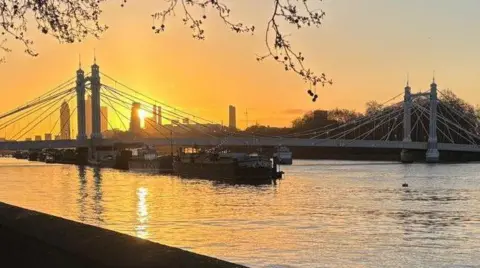
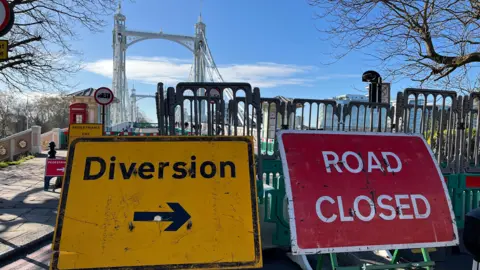
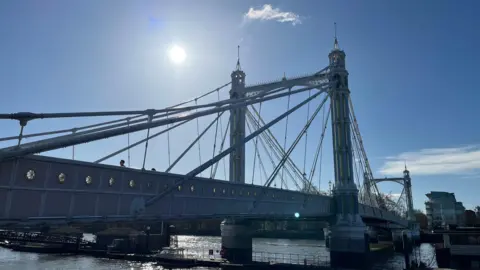
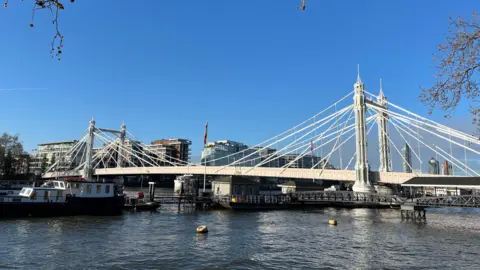
BBCWith its strings of twinkling yellow lights, Albert Bridge is arguably the most beautiful bridge in London. But it is a fragile beauty.
Opened in 1873 - before the motor car was even invented - like its near neighbour Hammersmith Bridge, it has now succumbed to the wear and tear of motor traffic and will be closed for up to a year.
The cost of the repairs will be around £8.5m.
Bridges are the jewels of many cities, but in London they have an uneasy relationship with increasing numbers of heavier vehicles.
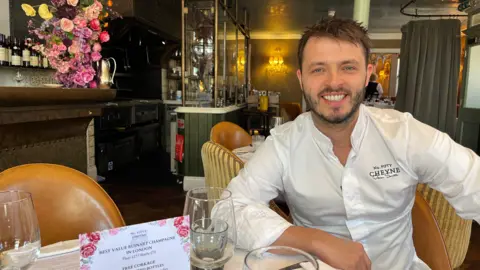
Iain Smith runs the nearby neighbourhood restaurant No. Fifty Cheyne.
He considers the closure to be an inconvenience but believes it will be business as usual.
"The most iconic day here is Sunday and 350 people turn up for a roast every week. So having the bridge closed for 52 weeks of the year, naturally people will turn up late.
"That does build pressure but that's part of being a restauranteur and making sure we still deliver a great experience to our guests," he says.
 Royal Borough of Kensington and Chelsea
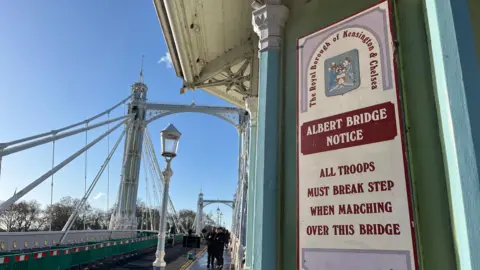
Known as "The Trembling Lady", Albert Bridge was invented to move slightly with changing temperatures.
But it was not designed to carry motor traffic.
It was transferred to the Royal Borough of Kensington and Chelsea (RBKC) in 1986.
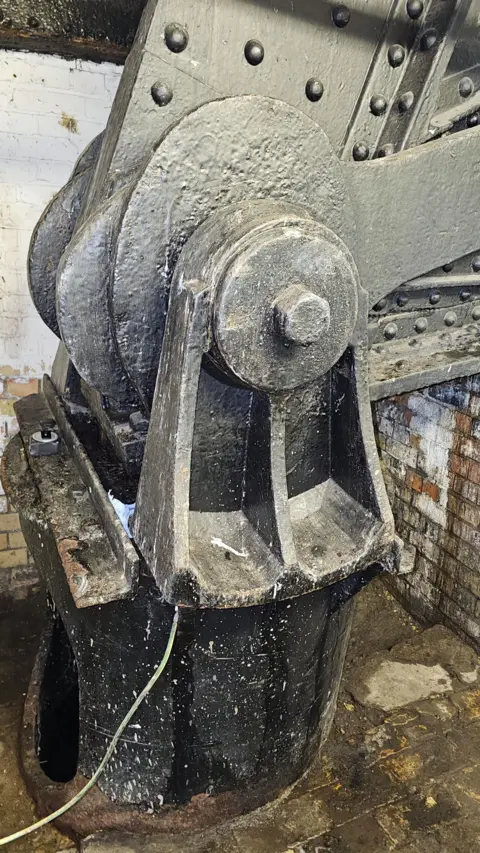
The bridge was shut after routine inspections discovered cracks in the caisson head, which is the base on which the moving part of the bridge rests.
The reality is it is a unique structure and no-one knows exactly how long the repair will take.
Gary Noble, head of highways at RBKC is optimistic.
"We are hoping to open the bridge within a year and get it open as soon as we can. We can't come up with a definitive answer as we are still collecting some data," he says.
"At the present time a year is hopefully the maximum."
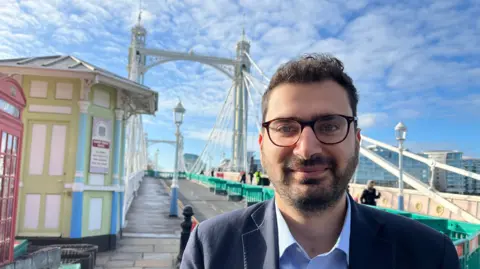
Pedestrians and cyclists can still use the bridge and will be able to throughout the repair.
Talk of excluding cars permanently has been ruled out so far.
Johnny Thalassites, a Conservative councillor at RBKC, says "the advice we have received is it will be open within a year", and the council is "working to that".
"As a council we are giving our engineers all the support that they need to deliver on that.
"We will keep residents updated as much as we can - we really understand how difficult this is for commuters and local people. It's a big impact and we don't underestimate that," he says.
Albert Bridge is just the latest bridge to be closed to traffic. Others have also been shut.
Hammersmith Bridge, in central London, has been shut to motor traffic for seven years, and the cost of the repair has escalated to over £250m.
There the local council says it cannot afford to repair the Grade II listed structure and is asking for government funding.
Broadmead Road Bridge, a main route in Redbridge, has also been shut for years.
As London's infrastructure ages and struggles to cope with more and heavier traffic, experts say it is inevitable others will need to be shut in the future.
Many non-trunk road bridges were transferred to London borough councils after the abolition of the Greater London Council in 1986. Many councils are now struggling to meet the costs of their maintenance and repair.
Prof Tony Travers, from London School of Economics, says the problems seem to be systemic.
"Closing busy bridges in London because councils are cash-strapped is evidence of desperate policy failure," he says.
"Public spending in the UK is over a trillion pounds a year, yet the state cannot find the relatively tiny amounts needed to keep roads open."
Elly Baker, chair of the London Assembly Transport Committee and Labour's spokesperson for transport, has worked on reports looking at London's bridges.
She believes there has been a "couple of decades of under investment in our transport infrastructure".
"When things are starting to get to a point where they need to be renewed and seriously repaired, then you're coming up against this very unusual situation around ownership.
"We could spend a lot of time looking at the ownership and design a whole new solution. Or we could just acknowledge that, regardless of the fact that some of these bridges are owned by councils, they are national bits of infrastructure and need to be funded nationally."
She adds that "this has been acknowledged" with "the government offering a structures fund that, certainly for Hammersmith Bridge, they've said that would be a really good case.
"So we really need to speed up those solutions to what is a quite specific London historical problem, but that can just be fixed with an acknowledgement of how important these bits of infrastructure are."
The Department for Transport said: "We're committed to tackling roads that are in poor condition, and last year announced a £1bn investment in local highways enhancement projects and a new structures fund to help councils renew bridges, flyovers and tunnels."
However, the government is still finalising the structures fund.
Once complete, local highway authorities including Kensington and Chelsea will be able to submit schemes for consideration.
A Transport for London spokesperson said: "We will be working with the borough to understand any proposals for reopening the bridge to traffic."
At the moment though London - a global city - has three vital bridges that drivers can't use.
Listen to the best of BBC Radio London on Sounds and follow BBC London on Facebook, X and Instagram. Send your story ideas to hello.bbclondon@bbc.co.uk
