How will the £8.5m Albert Bridge repair be funded?

 Getty
GettyA council is to decide how to fund the estimated £8.5m repair works of Albert Bridge.
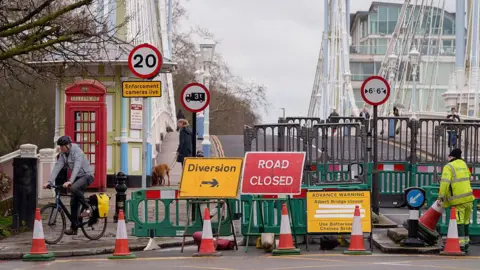
Kensington and Chelsea Council (RBKC), which manages the 150‑year‑old west London bridge, closed it in February after engineers discovered cracks in a cast‑iron component.
The authority will decide whether to add the project to its 2026-27 capital programme at a leadership team meeting later.
It has also written to Transport for London and the Department for Transport asking for contributions "but the timeframe for securing such funding is at odds with the council's commitment to reopen the bridge as soon as possible", a report to the leadership team says.
Repairs are currently expected to take up to a year to complete due to the bridge's "uniquely complex design".
The report reads: "Bearing in mind that it opened 13 years before the motor car was invented, it's a testament to the skill and ingenuity of successive generations of civil engineers that the beautiful Grade II* listed building that is Albert Bridge not only still spans the River Thames, but is capable of carrying motor vehicles."
Eight bridges carry road traffic across the Thames in central London, with many of the capital's population using them - but the responsibility is spread across only six of the capital's 32 boroughs.
RBKC is in discussions with the London Assembly about whether that distribution is unfair, including in relation to the council's sole responsibility for Albert Bridge.
The council says it must maintain certain mitigations until repairs are completed, at a cost of £56,000 per month.
The initial emergency works that are still in the process of being installed are forecast to cost the council about £550,000.
The planned works include repairing the rocker bearing plate - a heavy‑duty steel component that supports structural loads - and unseizing the axle within the rocker that caused the damage.
About 15,000 cars and light vans are having to find alternative river crossings each day while the bridge remains shut to traffic, though it is still open to pedestrians and cyclists.
'Systemic failure'
BBC London's transport and environment correspondent Tom Edwards said: "London's bridges have been called the nation's embarrassment, and the beautiful Albert Bridge is just one of many that is struggling to deal with higher levels of heavier motor traffic.
"All of the options open to the council show that repairing the Trembling Lady is going to take time and cost a lot of money."
He clarified that while officials "don't think this is another Hammersmith Bridge" with a seven year closure, it shows how after the end of the Greater London Council in 1986, "councils were transferred national bits of infrastructures and have since struggled to afford to maintain and repair them".
"Observers say it is a systemic failure."
The Department for Transport said: "We're committed to tackling roads that are in poor condition, and last year announced a £1bn investment in local highways enhancement projects and a new structures fund to help councils renew bridges, flyovers and tunnels."
However, DfT is still finalising the structures fund. Once complete, local highway authorities including Kensington and Chelsea will be able to submit schemes for consideration.
A TfL spokesperson said: "We will be working with the borough to understand any proposals for reopening the bridge to traffic."
The London Assembly has been approached for comment.
Listen to the best of BBC Radio London on Sounds and follow BBC London on Facebook, X and Instagram. Send your story ideas to hello.bbclondon@bbc.co.uk
