Meningitis: All you need to know after recent outbreak

 PA Media
A Lancashire GP has offered advice and reassurance about meningitis following the recent outbreak that resulted in the deaths of two students.
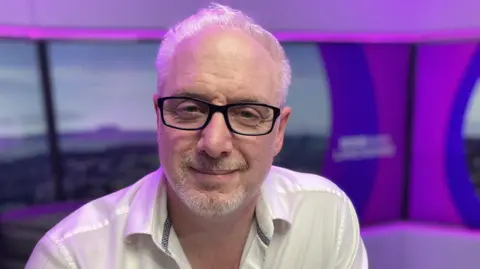
Dr Chris Scales, lead GP at Eaves Lane surgey in Chorley, said the events in Kent were "rare" given how the B strain of the disease more commonly affected young children rather than university-age adults.
Despite the disease showing "general" symptoms, it can spread quickly and make the affected person's health worsen quickly, the doctor said.
A further 20 confirmed cases have since been confirmed at two universities in Kent.
Dr Scales said there were two forms of meningitis, a disease which can have serious, sometimes deadly, consequences for young people.
He said: "There is the viral meningitis which is actually more common and tends to be milder and then you've got the bacterial meningitis which is rarer but more serious and can be life-threatening".
He added that the Meningitis B strain which has been seen in Kent, was the "most common" strain we see in the UK and was usually vaccinated against as a baby.
Meningitis B, or MenB, accounts for over 80% of invasive infections - since vaccination made other forms much rarer.
Since it was introduced in 2015, MenB infections have been reduced by about 75% in those immunised.
However, anyone over the age of 11 has not been protected unless their parents paid for the vaccine privately.
The risk from MenB is highest in very young children and older teenagers and young adults - often linked to going to university.
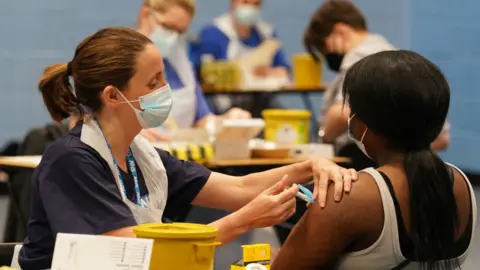
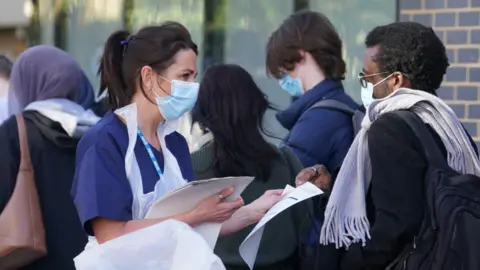
Since the outbreak, centered mainly on the campus of the University of Kent, a targeted vaccination roll-out will look to immunise 5,000 students.
Dr Scales said MenB jabs could protect babies for "three to five years", while jabs for strains A, W, Y and C were available to those aged 14 with "top-up" jabs available up to the age of 25.
 PA Media
Dr Scales said the disease was contagious, but spread differently to a flu or Covid, instead passing through close contact - such as kissing, sneezing and coughing.
Certain people can hold the meningitis bacteria in their nose or throat without getting ill, but can still pass it to others.
The GP said symptoms could appear almost as cold-like symptoms.
"The initial symptoms could be a fever, headaches, neck stiffness whilst some become more drowsy," he said.
"Late signs are things like a rash that doesn't disappear, so you don't want to wait until someone's got all the symptoms to get seen.
"They can be fairly general symptoms but it's the speed at which they come on and the degree to which somebody is ill."
Dr Scales said if someone was getting ill and it worsened fast, they should "use their instincts" and get seen by a medical professional.
He said the 111 service could "advise over the phone" and people should go to A&E for an "urgent" matter.
Listen to the best of BBC Radio Lancashire on Sounds and follow BBC Lancashire on Facebook, X and Instagram. You can also send story ideas via Whatsapp to 0808 100 2230.
