The lab giving the 'gift of sight' for 40 years

 BBC
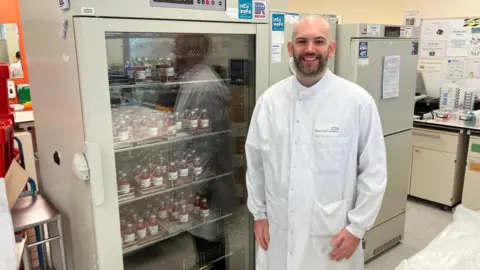
BBC"We're a little lab, but we make a big difference," says Bristol Eye Bank Manager David Usherwood.
He is proud of his Filton-based team, which, together with its NHS sister site in Liverpool, processes around 5,000 eyes a year and uses the harvested corneas to improve the sight of at least 10 patients per day.
Celebrating its 40th anniversary this year, the service run by NHS Blood and Transplant is responsible for collecting eyes from deceased donors and processing the corneas, ready for transplant.
"The patients waiting to receive these eyes often have very poor vision - their corneas have gone cloudy and they can't really see - so receiving these corneas can change their lives," he said.
"The main part of the eye we're interested in transplanting is the front part, that window, and it's actually those cells on the inside of the eye those surgeons are going to be transplanting, and that's what gives patients back their sight," he added.
The journey of a transplanted cornea begins with the lab's retrieval team.
They travel across the south-west of England and bring donated eyes back to the lab in a carefully temperature-controlled cool box.
"It's a 24 hour window period for eye donation from cardiac arrest, so in that time we have to contact the next of kin [of the deceased] to obtain the consent," said Syed Mushtaq, the lab's Retrieval Team Supervisor.
"We also need to arrange access with mortuaries and at times our teams will go to funeral directors - time is of the essence."
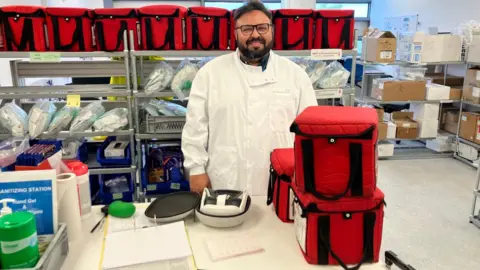
The retrieval team takes the eyes back to the lab, where they're taken to a specialist clean room.
"We'll assess them under a microscope to make sure their morphology and cell count is suitable for a transplant and matches our criteria," said Usherwood.
"We'll take the whole globe of the eye, and clean it, before removing the cornea with a trephine, and we'll suture it and place it in a warm culture media [a liquid containing essential nutrients and minerals to support the growth of microorganisms]."
'Significant waiting list'
There is a significant waiting list for the lab's services - an estimated 4,000 patients according to the NHS, which means some people wait up to a year to receive a cornea.
This is down, Usherwood said, to the number of corneas the lab receives.
Usherwood insists the waiting list would be a lot shorter if more were donated.
"We're a small team," he added.
"But that gift of sight is really important to people to live a normal life," he added.
Follow BBC Bristol on Facebook, X and Instagram. Send your story ideas to us on email or via WhatsApp on 0800 313 4630.
