Colombia's budding tech scene needs a cash boost

 Bloomberg via Getty Images
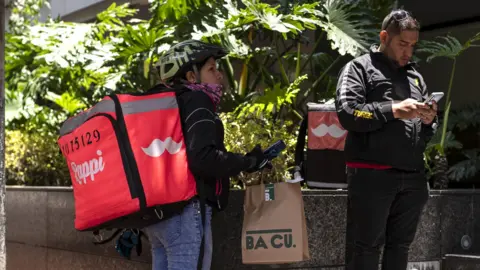
Visit Bogota and it's hard to miss the Rappi bikes with bright orange bags featuring a moustache motif whizzing around the city dropping deliveries off.
The on-demand Colombian delivery platform is lauded as the country's most successful tech start-up, with the unicorn (a company valued at over $1bn [£750m]) said to be worth more than $5bn, and attracting over 35 million active monthly users.
Rappi's success signals a bigger change happening in Colombia – the country has shaken off its dangerous reputation, especially since the 2016 Peace Accord. It has become a magnate not only for tourists, but also immigrants moving to destinations such as Medellín and Bogotá from the likes of the US, Canada and the UK.
The country has become a key business hub with an emerging start-up scene. In a report published by KPMG last year, the accountancy multinational counted 2,100 start-ups in Colombia, up 24% from the year before.
"The country is in second position among the best start-up ecosystems in Latin America after Brazil," says Maria Peñaranda, manager of emerging giants and innovation at KMPG Colombia.
Almost 80% of the country's start-ups are early stage, she says, demonstrating a dynamism in the creation of new companies.
"Long-term cases like Rappi continue to influence the ecosystem as catalysts for talent recycling and investor confidence," says Peñaranda.
She mentions other success stories: global payments firm Yuno and renewable energy company Erco Energy who have both transitioned into established companies with revenues of more than $10m and expanded across regions.
 Foodology
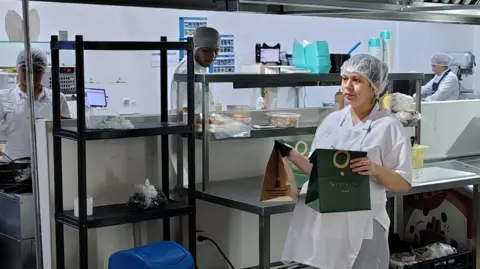
Another start-up doing well is Foodology, which creates virtual restaurants, where the food is cooked in so-called dark kitchens.
Founded in Bogota in 2019, the company has raised over $60m, employs more than 800 people, and claims to be fully profitable.
Most of the restaurant brands it runs in Colombia are its own. "I wanted to find a way that Colombia could get amazing food, but faster and in an a more innovative way," says Foodology co-founder and chief executive Daniela Izquierdo.
"We have thousands of digital storefronts. You're taking in orders for one single kitchen from around 400 different places. We built a big piece of software that is managing inventory and making sure they're showing the same menu and the same product availability."
She says they are now licensing out the software.
In Colombia many start-ups look to quickly expand to other markets. "Colombia is not a huge market on its own, so founders usually start a company there and expand to say Mexico or Brazil," says Izquierdo.
Foodology is an example of that - it has since expanded to Mexico and Peru.
 Foodology
While it's been boomtime for Foodology, it's a different proposition for many other start-ups, which are struggling for investment.
In 2019 SoftBank launched an innovation fund specifically targeting start-ups in Latin America.
"That changed the dynamic and created a positive news cycle, and Latin America attracted a lot of attention," says Colombian-based Daniel Vásquez, managing partner of US-based venture capitalists Actions Capital.
"But the majority of those investments haven't been successful for different reasons." He says this has led other investors to retreat.
"The Latin America market had a big boom in 2021 to 2022, but in recent years the market hasn't been great for Latin America," says Izquierdo.
"The [US] stock market plummeted and VC funding generally across the world slowed down. And while VCs will say they want to invest some in emerging markets, when the market is going down, I feel that's like the first thing that goes. So, there's been like very little venture capital investment."
With so few investors in the country, Colombian companies need to look elsewhere for financial injection.
"If you want to be a venture-backed company, you have to look outside of Colombia as there are very few VCs there," says Vásquez.
"I've seen good companies fail… because they're burning money and they just can't find that next round to continue the trajectory that will eventually make them a profitable businesses. It's very difficult for start-ups to fundraise."
Vásquez says for the future of start-ups to be brighter, there needs to be more success stories and for the market to mature.
"We need the local institutions, businesses and families, to invest more in technology. I think we, Latin America, invest very little in R&D and when VCs come and they see that locals are under-investing in technology they see that as a sign of little opportunity. That message needs to change."
 AFP via Getty Images
Brynne McNulty Rojas says she benefited from a more fortunate and different investment backdrop when she and her co-founder were raising money for their Bogotá-based property tech company Habi.
It specialises in the purchase and sale of used homes, and offers other services such as financing, listings and mortgage brokerage, and has helped digitise the buying and selling of property.
"When we set out to raise money in 2019, there was a newer interest and excitement about the region than there had been, say, five to 10 years prior. There was more accessibility of capital," she says.
Set up alongside Colombian Sebastián Noguera, Habi has emerged as a leader in the Latin American tech sector, with unicorn status after a $200m round of funding.
Still, McNulty Rojas says she "would love to get more local investors".
"It's great to have local individuals or institutions because it helps get things done on the ground."
Despite the financial challenges, she would recommend Colombia to other entrepreneurs.
"It's a great place to build because the talent is there, and then I think the market is there. We've been really lucky, and I've loved working in Colombia."
