Know when to fold them: the tech inspired by origami

 Getty Images
Screams filled the laboratory – screams, thankfully, of joy. Akib Zaman, a PhD candidate at Massachusetts Institute of Technology (MIT) had just made a mini chair appear, seemingly out of nowhere.
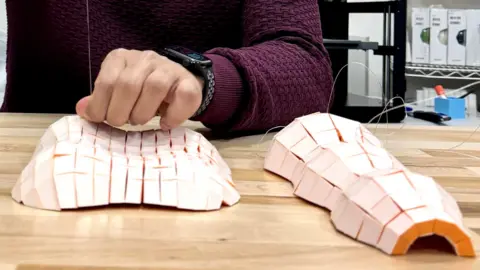
He had pulled a thread attached to a flat, rectangular piece of waffle-like material segregated into dozens of wonky-looking square tiles. With that careful pull, the slab compressed together, suddenly stood up, and took on the shape of a tiny, curvy, modernist-style chair.
After months of work, it was the first time he and one of his fellow researchers had seen their idea come to life. "That was a great moment," recalls Zaman. "We were both excited – we screamed."
Zaman was inspired by the Japanese art form kirigami, like origami but instead of merely folding paper to achieve a 3D shape, kirigami also involves cutting.
It's often used to make paper pop-ups. Both origami and kirigami have influenced engineers for many years. These techniques can enable materials to behave in surprising ways – but finding useful applications for them has long been a challenge.
 Algorithmic Design Group, MIT-CSAIL
In Zaman's case, he and his colleagues found a way of 3D-printing material divided into chunky, square-shaped tiles. The angles of the sides of those tiles, and the precise nature of the cuts that separate them mean that, when squeezed together, they pop up into a desired 3D shape. It could be a chair, a tent-like structure, or a curved container of some kind, for instance.
The team made a computer program that converts a 3D model into the flat, grid-like version, to which a pull-cord is attached. The work was described in a paper published in December.
"You could make a larger structure like a building," says Zaman.
At the other end of the scale, the technology could also be used to make tiny structures that, when activated, open up and deliver drugs to specific sites in the body. Zaman says he and his colleagues are now collaborating on research in this area.
But one of the key hurdles when bringing origami or kirigami to engineering is that these techniques often make things rather complicated. The famous Miura fold, developed by Japanese astrophysicist Kōryō Miura, folds a sheet of material into parallelograms, allowing it to fold down very compactly.
The intention was to create storage solutions for solar arrays on satellites and spacecraft.
In 1995, a real Japanese satellite deployed a solar panel that had been Miura-folded. However, Mark Schenk, an expert in origami-inspired engineering at the University of Britsol, says, "There are easier ways to solve the problem."
He notes that it can be difficult to scale up origami-based designs and also to use them with materials that aren't paper – which is extremely forgiving even after being folded and re-folded many times.
"Origami still isn't commonly used yet in real engineering applications," says Schenk. But that could be changing.
Researchers' mathematical understanding of origami-like structures has come on leaps and bounds in recent decades, he notes, and there are now multiple start-up companies and university spin-outs seeking to develop origami- and kirigami-inspired products.
 Stillfold
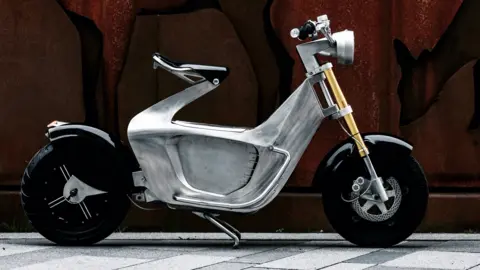
Stilfold, in Sweden, is one such start-up. "We're industrializing an easier way of forming sheet metal based on origami," says chief executive and co-founder, Jonas Nyvang. Stilfold uses a blunt wheel to make creases in sheet metal. That creates a curve or bend in the material, which also stiffens it. "Like when you hold [a slice of] pizza," explains Nyvang.
Origami models sometimes rely on folding or curving of paper for additional stiffness.
And a Finnish project called Fold2 has explored using intricately folded cardboard to make packaging inserts designed to protect products during shipping.
For Stilfold, the advantage of doing this with metal is to strengthen that material without requiring lots of brackets, screws or supports – reducing the overall volume of material required, and therefore also the cost and embodied carbon emissions of any product made with the technique. "We can achieve about 20-30% material reduction just by adding stiffness," says Nyvang.
Stilfold has developed a robot that can crease sheet metal and the company has, to date, used the method to manufacture chassis for 200 shiny metal electric motorcycles, which are now being shipped to customers.
Nyvang says Stilfold is working with Swedish automotive firms Volvo and Scania, to see if they can come up with new, lightweight parts for cars and trucks.
But encouraging more widespread adoption of the technology might be tricky. Nyvang says it is sometimes difficult to convince engineers to switch to a completely different way of doing things.
 Raman Vaidya/Moneesh Upmanyu
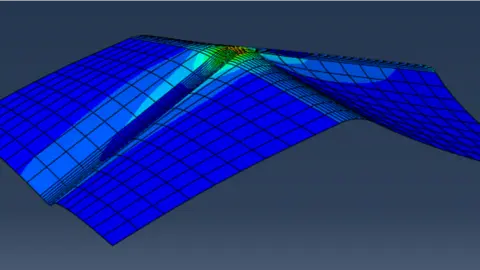
And yet the prospect of using origami to improve existing technologies is, for some, tantalizing. Moneesh Upmanyu at Northeastern University in the US, and one of his PhD students, were awarded a patent last year for a design that uses origami to make strong but foldable wing structures.
It's like a wing with a flexible, corrugated structure within it – something like an accordion – that allows said wing to fold down quickly, or flex with ease.
Such a wing could, for example, bend merely its edges, just like birds do with their feathers, in order to stabilize themselves in flight.
"Birds can actually morph their wings," says Upmanyu. "They have perfected this highly efficient way to fly." Aircraft and wind turbines might one day do something similar. Upmanyu suggests that the wing could automatically and dynamically respond to air pressure, using a valve-based system to adjust its shape.
It will take a lot of research and investment to develop these ideas into real products. In the meantime, traditional, paper-folding origami remains a pursuit adored by many. However, not everyone enjoys it.
"For me, it's an academic interest, it's my job," admits Mark Schenk, who says he has little interest in making paper origami models. "My mother, funnily enough, is very good at it."
