London's e‑bike hire: Parking problems amid surging popularity

 Contributor
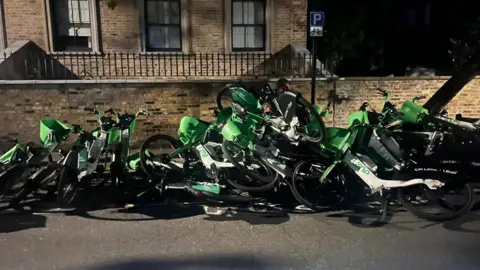
As e‑bikes pile up on pavements across London, pressure is mounting for tougher regulation. But as hire firms defend their efforts and argue for better infrastructure, can the city find a balance?
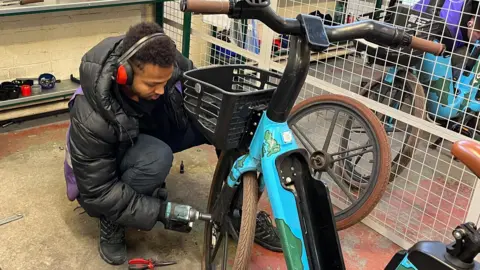
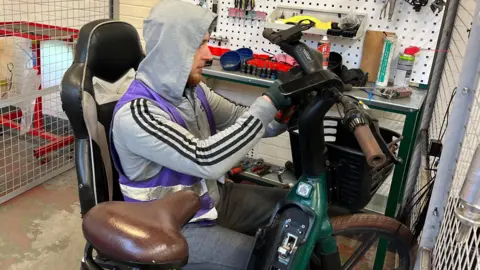
In a warehouse in Southwark, everywhere you look are racks of e-bikes. Loud electric tools whirr away as bikes are repaired and then loaded onto vans for redistribution. Some 400 bikes a day can be repaired here during the summer peak.
We are inside a warehouse of one of the main e-bike hire operators in the capital - Forest - who sell themselves as being London's homegrown e-bike operators with 20,000 e-bikes and ambitions to grow more.
Although a relatively new transport mode in London, events like the Tube strike have helped bring about a rise in popularity - Forest says its usage numbers for one week in the summer surged 80% compared with the previous year.
Forest is not the only operator - Californian company Lime has about 50,000 e-bikes in London although it will not reveal the exact number. Other operators are Bolt and Voi.
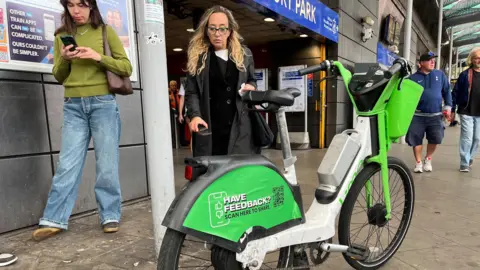
Although they are widely seen as a green choice - zero‑emission when used, even if their production is not - e‑bikes come with their own issues, from questionable rider behaviour to the far bigger frustration of bikes abandoned on pavements.
Residents have also raised concerns about parking bays outside their homes encouraging late night drop offs and anti-social behaviour.
Will Jansen, chief operating officer at Forest, agreed inconsiderate parking was a challenge but believed things were improving.
"We use an AI-enabled tool in our app that confirms the end ride photo whether someone's parked on the road or the grass, something that we deem is non-acceptable, or whether it's causing something like an obstruction or a pavement," he said, adding that Forest also gave free minutes for good behaviour to its users.
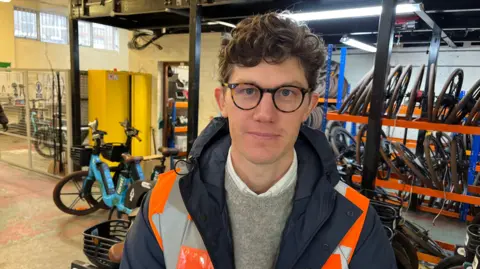
Despite these schemes, he accepted it was still a challenge and that the company was working with councils.
"But the actual data does support when you look at the last five years, the improvement has been tremendous and compliance with people parking the bikes more neatly," he said.
"As the schemes have actually grown, the operators getting good usage out of the bikes can actually reinvest a lot of that money into more resources, to be able to tidy them on the streets.
"So we've now got close to a 100-person team that goes out every day doing concurrent maintenance, moving obstructions, tidying bays - all this kind of thing contributes to a much more neat and tidy scheme."
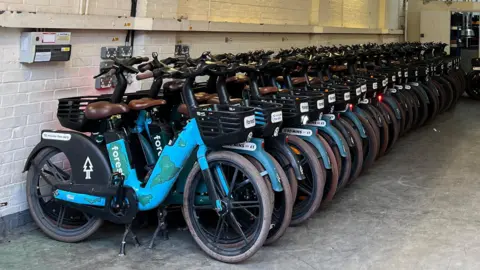
Head of fleet at Forest, Jake Jeffcoate, reiterated parking was a priority and that it had a team known as the Guardians to clear up the bikes.
"They're out on bikes, or in our electric fleet vans. They are collecting bikes, or they are repositioning bikes, which are causing issues," he said.
"We have a team of supervisors who are constantly monitoring some chats between local authorities, who can prioritise certain problematic bikes."
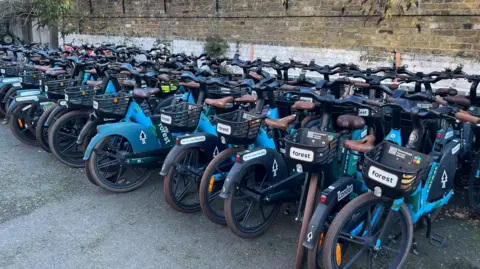
But some councils are getting tough on discarded e-bikes and are now confiscating those left blocking pavements.
Kensington and Chelsea Borough Council charges operators a retrieval fee of £84.45 per unit to get their e-bikes back - it has brought in about £100,000 so far.
The street teams have to use highway laws to seize the e-bikes, meaning they can only take them if they are considered to be obstructing a highway or causing a danger.
It is complicated and sometimes while an e-bike may look like it is blocking a pavement or a road, it is allowed to be there.
'Like the wild west'
Operators pay councils tens of thousands of pounds, some even hundreds of thousands, to put their e-bikes in a borough.
Some allow all operators, while others restrict it to just one.
London Mayor Sir Sadiq Khan said it was like "the Wild West" and he wanted Transport for London (TfL) to take over regulation.
"I'm pro-cycling but we have one council with a certain set of rules, another council doesn't allow the bikes, another council has a different set of rules," he said.
"You've got visually impaired people who can't get around, people with buggies who can't get past bikes that are discarded."
He added they were lobbying the government to bring in regulation so London had one system of regulation.

The English Devolution Bill, which is currently going through parliament, will give TfL the powers to regulate and license dockless e-bikes.
TfL could also get the powers to remove all e-bikes if they are not parked in a designated parking bay, and fine the operators.
Currently, operators can only be fined if the e-bikes block pavements.
Supporters say a similar trial with e-scooters had a 90% compliance rate, but operators think part of the attraction of e-bikes is you can leave them everywhere so they want a mix of parking models.
Jansen also thinks local authorities should be investing in safe cycling infrastructure and protected cycle lanes.
"London is a great city to cycle in, but I know a lot of people personally find it unsafe because they are on congested roads in amongst the traffic and there are large amounts of London that still haven't invested in Highway infrastructure.
"I think that's the next step. We need to see more of that investment from local government.
"Not just parking but infrastructure to cycle these bikes safely. "
Listen to the best of BBC Radio London on Sounds and follow BBC London on Facebook, X and Instagram. Send your story ideas to hello.bbclondon@bbc.co.uk
