'It's common to wrestle a smartphone from a toddler'

 Getty Images
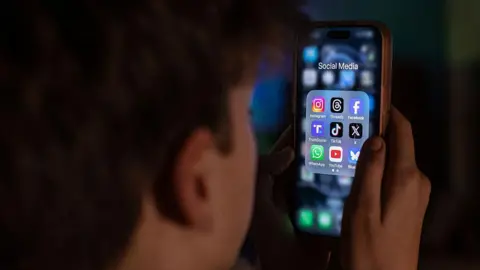
The use of social media "sets children up to fail", a doctor has said, as peers backed a ban for under-16s.
The House of Lords approved an amendment to the government's schools bill on Wednesday that would ban children in the UK from social platforms.
However, the government has said it will try to overturn the amendment in the House of Commons, while it holds a consultation on the potential ban.
Experts in Yorkshire have mixed views - with some praising the likely benefit to children's mental health, while others warn it is unrealistic to "pop that genie back in the bottle".
Whitby GP Rebecca Foljambe says she is frustrated by the potential delay that would be caused by further consultations.
"We all know how much the mental health of our children has deteriorated in recent years and the rates of mental illness remain stubbornly high," she says.
"We observe regularly that social media platforms are keeping these children in their mental illness state."
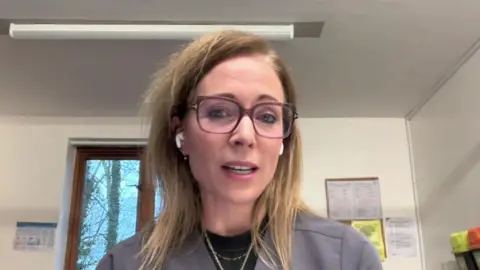
"Raising the age of social media to 16 is immediately necessary and one of a set of actions that could really help reduce the risk of harm to our children on these platforms.
"We've seen an insidious creep of these devices, not just smartphones but all screens, into all children's lives, right from birth.
"It's commonplace to be wrestling a smartphone or an iPad out of a toddler's hand before examining them."
She says the ban is not about trying to restrict children.
"Just because a child might feel safe on these platforms it doesn't necessarily mean that they are safe.
"It's not giving them liberties and social freedoms to connect, especially when they're vulnerable, it's just making them more likely to be pursued by predators, and maybe share images or content they will regret."
'I'm proud to cut back my screen time'
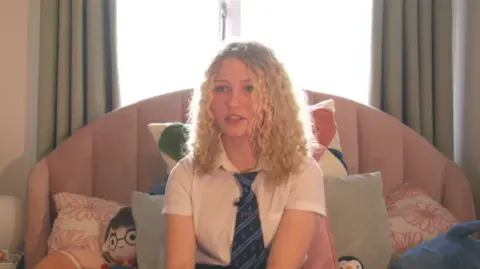
Teenager Violet took part in a scheme last year to reduce the amount of time children at Kettlethorpe High School in Wakefield spent on their smartphones.
The 15-year-old used to spend between eight and 10 hours a day on her phone, but has now found hobbies away from screens.
"I don't spend ages and ages watching people do random stuff on TikTok or YouTube," she says.
"I'm actually doing something with myself, which makes me feel more proud because I've done this instead of sitting on my phone for hours.
"I get a bit insecure and when you're looking at people with clear skin and tonnes of filters you think 'why don't I look like that?'."
Her father James says, since cutting down her screen time, Violet has become a happier child.
"We started to see her far more engaged in family activities, taking up new hobbies and interests. It really improved our relationships," he says.
'Pupils less able to learn'
David Scales is principal of Astrea Academy Woodfields, a secondary school in Doncaster. He backs the move.
The school banned phones in September. He says people are increasingly "waking up" to the problems of social media.
"We've been worried by the rise in this technology, which is leading to children having more problems with mental health because they're less safe, more distracted and less able to learn," he says.
"Attitudes have changed towards phones.
"If you go into a restaurant, if you go into a pub, you will see people glued to the screens and not socialising and I think people are waking up to the fact this is not healthy and is causing problems with particularly under-16s."
'Lazy cop-out'
Shannon Alexandra is an influencer from Sheffield who started a social media business aged 14.
She thinks a ban risks prolonging the problems of social media.
"Really the issue isn't young people having access to the platforms, it's the criminals, the people who maintain the abusive behaviour, and the complete lack of meaningful safety measures that allow trolls and predators to operate within the space in the first place," she says.
"I built a viable business from social media and we need to look at it as a useful tool and emerging technology that young people can use moving forward in their life.
"Putting a ban on things is a lazy cop-out from the government, we need to do more to address the root problem on things that happen on the internet."
'Quick fixes aren't all they seem'
Megan Hinton is participation and engagement manager at the Marie Collins Foundation in Northallerton.
The charity works with young people who have experience of technology-assisted child sexual abuse.
She says a ban would not eliminate the risk of social media and would instead push children into "less visible and less regulated spaces".
"We completely understand the intention behind it and the instinct because it seems so simplistic, but often quick fixes aren't all they seem," she says.
Hinton says the ban would also cut vulnerable children off from online spaces where they can find support and community.
"A lot of LGBTQ+ children or those in minority ethnic communities rely on these spaces for identity peer support," she says.
"They might need access to trusted helplines, which are advertised on these platforms.
"If we ban social media for under-16s, on their 16th birthday we're effectively pushing children into a cliff-edge.
"They're going to be expected to go into these unregulated social platforms where they're more likely to come across harm if they haven't been able to navigate it."
'Not realistic for the modern world'
 Fumble
Emilie Cousins and Lucy Whitehouse set up charity Fumble to educate young people about sex and relationships in the digital age.
Whitehouse describes a social media ban as a "blunt instrument".
"The online world is a space to connect, to create, to learn, to grow, and that's the reality we're living in now.
"If we just try and pop that genie back in the bottle, that's not realistic, and if we're worried about certain elements of young people's digital lives, we should try to address those," she says.
"If we just ban everything outright, we're going to drive young people underground to spaces that are less visible, that we have less control over, and we have less ability to talk to them and communicate with them about."
Cousins says it is important the government reflects the views of young people when making decisions that will affect them.
"Young people tell us they want us as adults to acknowledge the complexities of using social media and to have honest and open conversations about the reality of online life without panic and these attempts at quick fixes," she says.
"Young people are hyper aware of the harms of social media and they want education so they can successfully look after themselves online."
Whitehouse adds that a ban would be a reflection of adults' fears about their own social media use.
"There's a lot of projection going on from the adult policy maker generation onto young people that we are struggling with, working out what are our healthy boundaries around our digital lives.
"And we are struggling because there is a predatory tech model that means the algorithms are manipulating our attention.
"Rather than properly addressing all of that for ourselves and for society as a whole, we just shove this projection onto young people and shut it all down, then that gives us a sense of emotional relief from that anxiety, but it's not realistic, and it's not the world we live in today."
Listen to highlights from South Yorkshire on BBC Sounds, catch up with the latest episode of Look North