Autonomous helicopter completes first flight

 Simon Pryor
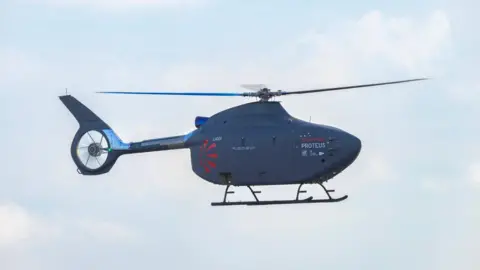
The UK's first autonomous full-size helicopter Proteus has completed its maiden flight.
The Royal Navy said the helicopter was designed and built by Leonardo in Yeovil under a £60m programme for the Royal Navy and would "unlock the potential of uncrewed aerial systems".
The aircraft was designed and manufactured in Yeovil and operates from Predannack Airfield in Cornwall, where its maiden flight took place.
Luke Pollard, Minister for Defence Readiness and Industry, said: "This maiden flight is a proud moment for British innovation."
He said: "Autonomous systems like this will be vital in protecting our seas without putting personnel in harm's way".
"Ground running" trials had taken place at Leonardo's Yeovil site and the helicopter's systems, sensors and engines were tested before it was lifted off the ground.
The Royal Navy said during the first flight, the aircraft was tasked with a short test routine which saw it operate its own flying controls independently of any human operator.
'Lead technological innovation'
It said Proteus was designed to conduct a range of missions including anti-submarine warfare and, patrolling the seas.
Commodore Steve Bolton said: "This milestone signals our intent to lead technological innovation, to enhance the fighting effectiveness of the Royal Navy in an increasingly complex operating environment, and to maintain operational advantage against evolving maritime threats."
Leonardo's managing director Nigel Colman said: "As the UK's only end-to-end rotary wing manufacturer, it has been a pleasure working with the Royal Navy and seeing Proteus take off for the first time."
Follow BBC Cornwall on X, Facebook and Instagram. Send your story ideas to spotlight@bbc.co.uk.
