UK preparing support ship to deploy to eastern Mediterranean

 Getty Images
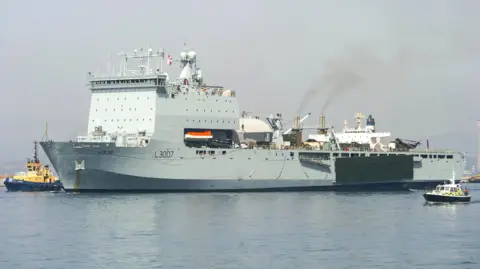
The UK is placing a naval support ship on "heightened readiness" to be sent to the eastern Mediterranean to support British nationals in the Middle East if needed, the Ministry of Defence has confirmed.
RFA Lyme Bay is equipped with an aviation platform and has medical facilities, meaning she can play a role in evacuations and medical treatment.
The vessel is currently in Gibraltar and has not been tasked yet. The MoD stressed the change in status was precautionary.
The UK is already sending the warship HMS Dragon to the Mediterranean, with Defence Secretary John Healey saying on Monday that it would leave Portsmouth in the next couple of days.
During the war, which began on 28 February, a number of Gulf nations housing US facilities have been targeted with Iranian missiles and drones, prompting the government to arrange evacuation flights for UK citizens in the region.
An MoD spokesperson said: "As part of prudent planning, we have taken the decision to bring RFA Lyme Bay to heightened readiness as a precaution, should she be needed to assist in maritime tasks in the Eastern Mediterranean."
The MoD would not be drawn on what the primary purpose of the vessel would be were it to be deployed, but its facilities as a support ship make it well-suited for humanitarian and disaster relief missions.
RFA Lyme Bay is a Bay Class landing ship - not a warship - and its primary function is to deliver troops, vehicles, stores and ammunition in the case of amphibious assaults.
The Sun reported that the RAF is due to deliver military medics and a mobile field hospital that can operate aboard the ship.
Recently, the support vessel has participated in joint exercises with the Indian Navy and Nato in Norway.
The UK government has not joined the US and Israel in offensive operations against Iran, but has offered the US use of UK airbases to conduct what it calls defensive strikes against Iranian missiles and launchpads.
It has faced accusations of not responding quickly enough to the crisis. The Royal Navy currently has no major warship in the Mediterranean region.
Conservative leader Kemi Badenoch said: "We have put bases in other people's countries, and those countries are saying we're not doing enough to help them. I think that's absolutely shocking."
She told broadcasters on Tuesday that the UK government's actions were "projecting weakness", adding: "If all you're doing is trying to catch arrows, then surely you'll get hit."
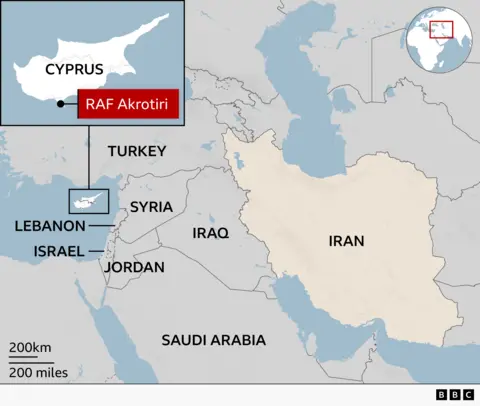
HMS Dragon's primary role will be protecting Cyprus and the British airbase there, after RAF Akrotiri was hit with Iranian-made drones.
HMS Prince of Wales - one of the UK's two aircraft carriers - has also been placed on heightened readiness, with defence sources telling the BBC on Saturday that its crew had been told to be ready to set sail in five days.
However, this was not explicitly for a potential deployment to the eastern Mediterranean and an MoD spokesperson said on Tuesday that the ship's scheduled deployment to the north Atlantic had not changed.
The government has stressed that it has been positioning military assets in the region since January and has sent more since the conflict began.
The MoD said three Wildcat helicopters with anti-drone capabilities had arrived in Cyprus this week, alongside a Merlin helicopter.
Healey told the House of Commons in a speech on Monday that RAF Typhoon fighter jets had taken out two Iranian drones, one over Jordan and a second heading towards Bahrain.
F-35s were also destroying drones over Jordan, the defence secretary said.
Counter-drone units were defending against attacks on coalition bases in Iraq, he added, while UK jets were conducting defensive sorties over the United Arab Emirates.
Bahrain and the UAE are among a number of Gulf nations that have been subject to strikes by Iranian drones and missiles, including some that have hit civilian targets such as hotels and airports.
With airspace restrictions still in place across the region, commercial flights in and out of the region are slowly resuming after many airlines cancelled services.
The first flight chartered by the UK government to bring British nationals home from Oman landed at Stansted on Friday.
Healey said more than 170,000 people had registered their presence in the region, and that 37,000 UK citizens had been evacuated so far.
