Moving our live coveragepublished at 04:32 GMT 8 March
We are moving our live coverage of the conflict in the Middle East here, external.
This page has been closed. You can follow our ongoing live coverage of the war in the Middle East here.
US President Trump has accused UK Prime Minister Starmer of seeking to "join wars after we've already won" and says that "we don't need" UK aircraft carriers
The comments, posted on Trump's Truth Social platform, come after the BBC learned that UK aircraft carrier HMS Prince of Wales has been placed on advanced readiness
B-1 bomber jets were earlier seen landing at RAF Fairford after the UK allowed the US to use its military bases for defensive strikes on Iranian missile strikes. Starmer decided not to join the initial US-Israel strikes on Iran
Meanwhile, a Dubai resident has been killed by falling shrapnel from an "aerial interception", officials in the United Arab Emirates say
Qatar and the UAE both reported being attacked by missiles and drones on Saturday, while Saudi Arabia says a missile was launched towards a military base
Iran's president earlier in the day offered an apology to neighbouring states and said Tehran would not strike them "unless attacked first"
Israel has warned residents in the southern suburbs of Beirut to evacuate as it targets the Iran-backed Hezbollah group
We are moving our live coverage of the conflict in the Middle East here, external.
The Kuwait army has reported fuel tanks belonging to Kuwait International Airport were targeted in a drone attack.
"Fuel tanks belonging to Kuwait International Airport came under attack by drones, in a direct targeting of vital infrastructure," an official defence ministry spokesman said, according to a post by the Kuwaiti military on X.
The spokesperson said the country's armed forces had been dealing "with a wave of hostile drones that breached the country's airspace".
In a post on Telegram, the IDF said they carried out a "precise strike" which targeted "key commanders in the IRGC's Quds Force's Lebanon Corps who operated in Beirut".
The Quds Force is the overseas operations arm of the IRGC or Islamic Revolutionary Guard Corps. The IDF said earlier this week that they had killed the temporary commander of the Lebanon Corps, Daoud Alizadeh.
In the statement about tonight's strike the IDF accused the Quds Force of having "operated to advance terror attacks against the state of Israel and its civilians" and said they will "continue to precisely eliminate the commanders of the Iranian terror regime wherever they operate."
The statement did not specify the exact location of the strike. Iranian officials do not appear to have commented on the strike so far.
Several hours earlier, the IDF had said they had begun "an additional wave of strikes in Beirut" on "Hezbollah infrastructure in the Dahiyeh area".
"We're not looking to the Kurds going in," US President Donald Trump told reporters on Saturday evening aboard Air Force One.
"We don't want to make the war any more complex than it already is," he added. "I don't want to see the Kurds get hurt and killed. And we've had a good relationship. They're willing to go in. But we really, I've told them I don't want them to go in."
This comes after Reuters news agency said the president told them on Thursday that he would be "all for" an offensive by Iranian Kurdish fighters.
The White House had previously denied a report that Trump was considering arming the Kurds - many of whom were trained by US forces in the past to fight against the Islamic State (IS) group in Iraq.
The BBC spoke to Iranian Kurdish opposition groups in exile in northern Iraq about their plans to cross the border - they denied claims that their fighters have already done so.
Hana Yazdanpana, of the Kurdistan Freedom Party (PAK), which claims to have the biggest armed force, said she had repeatedly asked the US to impose a no-fly zone to protect Kurdish fighters.
The hotel where four people died in an airstrike was housing people displaced by the fighting in Southern Lebanon and Beirut's southern suburbs, according to Reuters news agency.
Some had been seen leaving the building for fear of further strikes.
An Israeli strike on a hotel in central Beirut has killed four people, the Lebanese Health Ministry has said.
Another 10 people were injured in the strike, it added.
We'll bring you more updates as we get them.
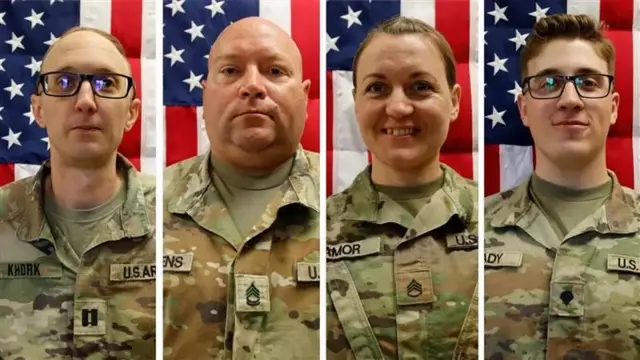 Image source, US ARMY RESERVE COMMAND
From left to right: Capt Cody Khork, Sgt 1st Class Noah Tietjens, Sgt 1st Class Nicole Amor and Sgt Declan Coady
Donald Trump joined the grieving families of six US soldiers killed in the war with Iran at the Dover Air Force Base on Saturday.
Here's what we know about the soldiers.
Those killed were:
The six were members of the Army Reserve, and were killed when an "unmanned aircraft system" evaded air defences to hit a command centre in Port Shuaiba, Kuwait, last Sunday.
We've more on their identities in our news story.
Israel's opposition urged the government on Saturday night to "destroy all of Iran's oil fields" in order to cripple the nation's economy.
Yair Lapid said this, as well as striking Iran's energy industry, would "topple the regime".
"This war must end when the regime in Iran has fallen," he wrote on X.
He adds that Iran's nuclear facilities and ballistic missile industry, as well as Hezbollah, must also be "destroyed".
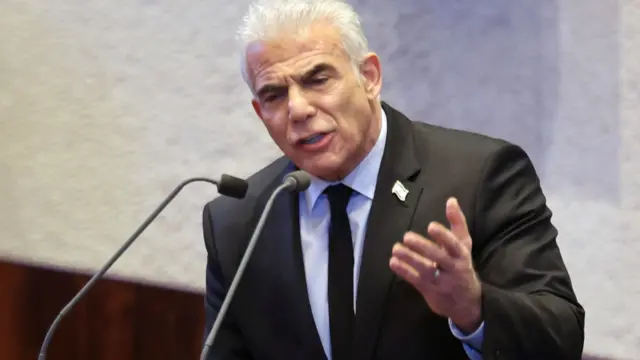 Image source, EPA
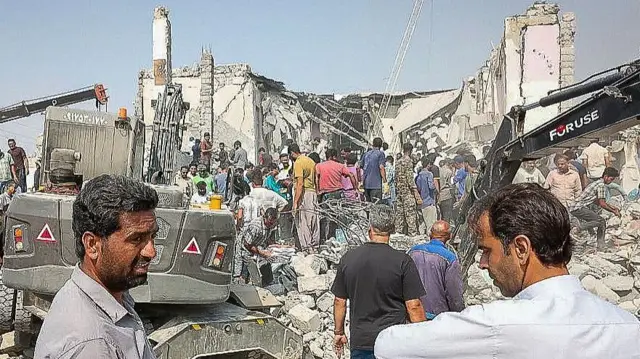 Image source, Getty Images
More from Donald Trump, who was asked by reporters aboard Air Force One about a strike on a girls' school in southern Iran last Saturday.
Iranian officials said more than 160 people were killed. BBC News has not been able to independently verify this death toll.
Aboard Air Force One on Saturday night, Trump was asked whether the US is responsible for the strike near an Islamic Revolutionary Guards Corps (IRGC) base.
"No, in my opinion, based on what I've seen, that was done by Iran," replied the president.
A reporter then asked Secretary of Defense Pete Hesgeth if this is true. He replied: "We are investigating, but the only side that targets civilians is Iran".
Trump reiterated: "We think it was done by Iran...They are very inaccurate, as you know, with their munitions. They have no accuracy whatsoever. It was done by Iran."
Last week, Secretary of State Marco Rubio emphasised: "The US would not deliberately target a school", saying US forces had "no incentive to target civilian infrastructure".
The school was hit in the city of Minab as the US and Israel launched widespread strikes targeting Iran's military sites and leadership.
Iranian officials have blamed the US and Israel for the attack. Israel has said it was "not aware" of any IDF operations in the area but told the BBC it is looking into the incident.
Satellite imagery analysis by BBC Verify revealed multiple strikes and burn marks, suggesting the school was hit more than once.
But without more footage of the remnants of munitions, it's not possible to clearly identify who is responsible.
You can read more about BBC Verify's analylsis of the strike here.
Here's more on what President Trump said about UK Prime Minister Starmer.
The US president took to his social media platform Truth Social, while aboard Air Force One en route to Florida, to say the US did not need the UK's two aircraft carriers in the Middle East.
"The United Kingdom, our once Great Ally, maybe the Greatest of them all, is finally giving serious thought to sending two aircraft carriers to the Middle East. That’s OK, Prime Minister Starmer, we don’t need them any longer — But we will remember. We don’t need people that join Wars after we’ve already won!"
This comes after Starmer refused to let Trump use UK bases to strike Iran. Trump later said he was "unhelpful".
“He has not been helpful," Trump said in an interview with the Sun newspaper. “I never thought I’d see that. I never thought I’d see that from the UK."
 Ghoncheh Habibiazad
Senior reporter, BBC Persian
“There’s a lot of smoke in the city. I can smell something burning,” says a woman in her twenties who lives in Tehran.
A number of oil depots in Tehran and Alborz provinces were struck tonight, according to a statement by the National Iranian Oil Company. The statement says that fuel supply to both provinces is being carried out “sustainably from other sources”.
“My mum was very stressed. First, there was a red light and everywhere was alight. Then a red cloud formed. We went upstairs to the rooftop and found out that an oil depot had been hit,” says a man in Karaj, a city in Alborz province near Tehran.
“It was as if the night had turned into day,” says another man in his twenties from Karaj.
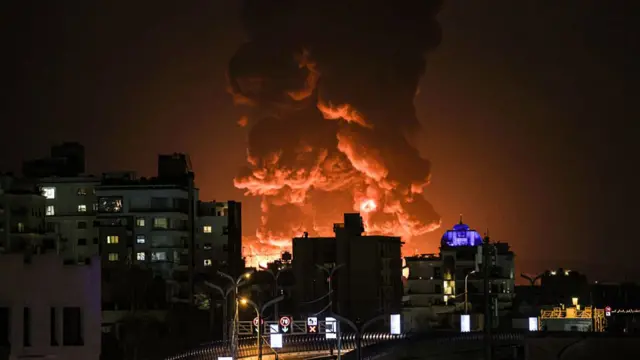 Image source, Getty Images
The Israel Defense Forces (IDF) has confirmed it struck "several fuel storage complexes" in Tehran, after footage we reported earlier showed huge flames above the city.
The IDF says it was a "significant strike" against fuel tanks that it claims the Iranian regime makes "direct and frequent use of to operate military infrastructure".
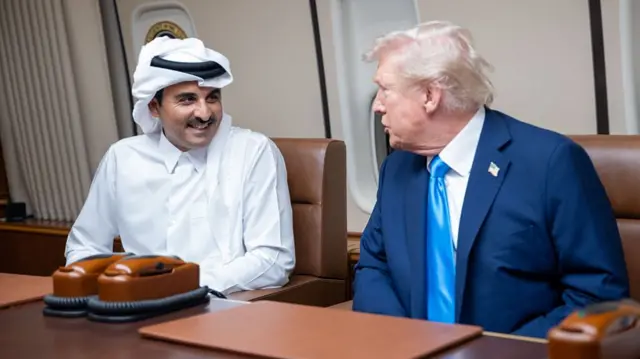 Image source, Getty Images
The Qatari emir and President Trump, pictured here last year, have spoken about the Iran conflict in a phone conversation
The emir of Qatar has told President Trump that Qatar "will not hesitate to defend" itself following continued attacks from Iran.
In a phone conversation, reported by Qatar's state-run news agency, Tamim bin Hamad bin Khalifa Al Thani told the president that the current escalation of military action in the region will have "dangerous repercussions".
Qatar's Ministry of Defence earlier today said it intercepted a "missile attack" targeting it.
 Adam Goldsmith
Live reporter
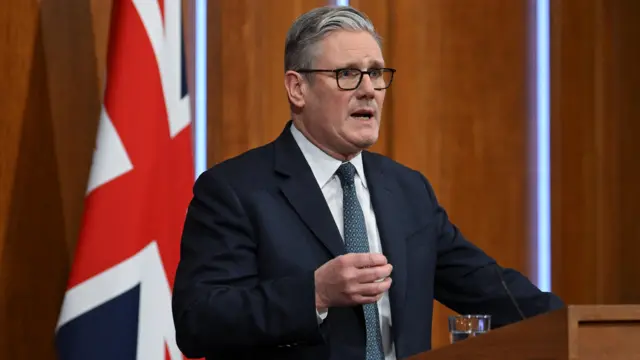 Image source, Reuters
Earlier today, the BBC learned that one of Britain's two aircraft carriers, the HMS Prince of Wales, has been placed on advanced readiness in Portsmouth.
As we've reported, though, Donald Trump a short while ago accused this manoeuvre of being too little, too late. Here's a reminder of how US-UK relations on Iran arrived at this point:
President Trump has been speaking to reporters on Air Force One and here's a quick summary of his latest comments:
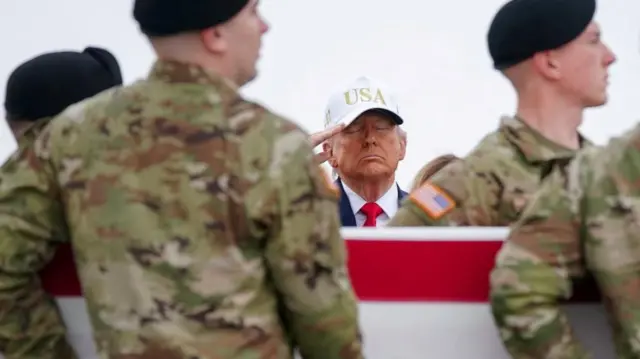 Image source, Reuters
As we've been reporting, President Trump has been in Delaware witnessing the return of US soldiers' bodies killed in the US-Israeli war against Iran.
We've just seen some images of Trump saluting coffins draped in the US flag as they are lifted by soldiers from a plane at Dover Air Force Base.
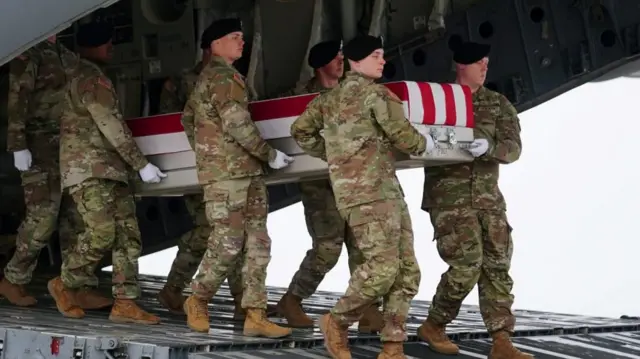 Image source, Reuters
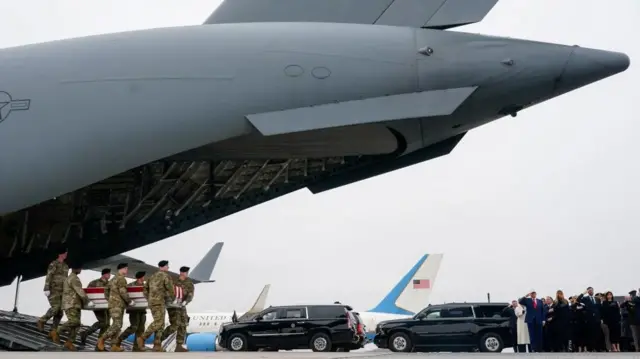 Image source, Reuters
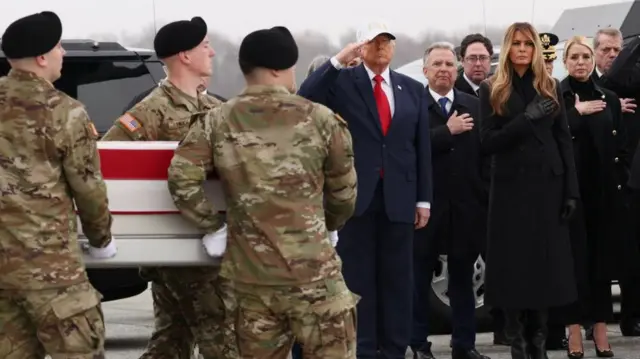 Image source, Reuters
Donald Trump has just posted on his Truth Social messaging platform.
He says "the United Kingdom, our once Great Ally, maybe the Greatest of them all, is finally giving serious thought to sending two aircraft carriers to the Middle East".
"That’s OK, Prime Minister Starmer, we don’t need them any longer - But we will remember," Trump says.
"We don’t need people that join Wars after we’ve already won!" he adds.
For context: The UK government has not joined offensive operations or given any commitment to do so. Earlier, the BBC reported one aircraft carrier had been put on an advanced state of readiness in case it needed to be deployed to the region. The UK has allowed the US to use its bases for defensive operations.
As we reported a short while ago, an oil depot in southern Tehran has been been struck, according to the Fars News Agency.
We've now seen video footage from Tehran that has been shared online showing huge flames above the city. The video has been authenticated by BBC Verify.
It is unclear whether there are any casualties.
Video shows huge flames in Tehran
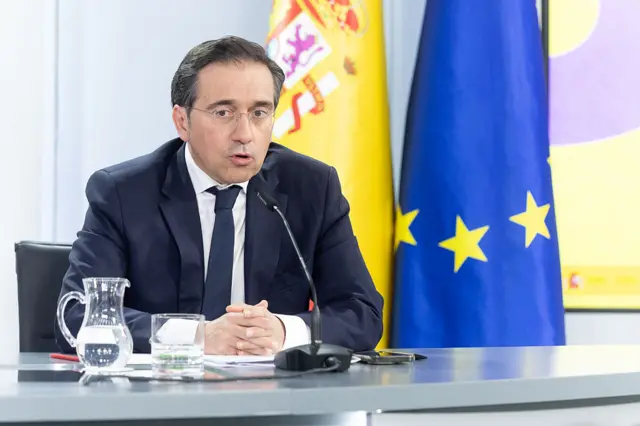 Image source, Europa Press via Getty Images
Spanish Foreign Minister José Manuel Albares
As Tehran continues to face US and Israeli air strikes, Spain has evacuated the last of its staff from its embassy in the Iranian capital.
Writing on Saturday night on social media, Spanish Foreign Minister José Manuel Albares confirms: "We have just successfully evacuated the Spanish Embassy in Iran".
He says this is after the ambassador and other essential personnel who had remained in Tehran have now crossed the border into Azerbaijan.
"The rest of our embassies in the region and the crisis room remain fully operational 24 hours a day through the emergency phone lines," he adds.
Spain's Prime Minister Pedro Sánchez has spoken out against Donald Trump's attacks on Iran, who says his government's position is "no to war".
Faren Taghizadeh
Senior Journalist, BBC Persian
Despite Iran’s internet blackout, I regularly receive text and voice messages from within the country - people talking about life under attack. One was from a forty-something man, who sounded really low.
"I’m freaking out," he says. He describes seeing "a lot of fighter jets" and hearing "five or six explosions".
Although the war itself is in the headlines, "the people inside Iran have been forgotten", he says.
In his view, all the media talks about is what Trump has said and how Iran responded. "Even Iranians abroad are mostly either dancing and congratulating Israel, the US, and Trump, or tearing each other apart," he says.
Meanwhile, inside Iran, he is seeing people "nearly break from fear" at the sound of a door slamming. "When I call someone and they don’t answer, I almost have a heart attack," he says.
BBC Persian is the Persian language service of BBC News, used by 24 million people around the world - the majority in Iran - despite being blocked and routinely jammed by Iranian authorities.
