Chris Mason: What Starmer's China reset tells us about his foreign policy

 PA Media
At the heart of the strategy behind the prime minister's visit to China this week is what some describe as China's "looking up economy".
What they mean by this is this is a tightly controlled state where the Chinese Communist Party is ever present. So, to deliver significant change the message from the top has to be abundantly clear, and when it is big shifts in outlook might then follow.
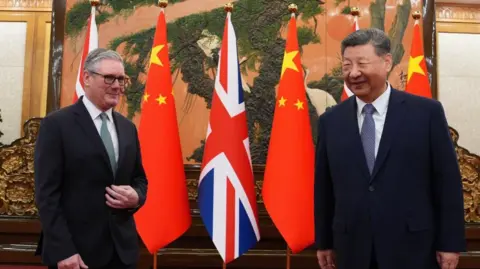
Downing Street hopes Sir Keir Starmer's three-day visit, including meeting President Xi and Premier Li in Beijing and a subsequent trip to Shanghai, will be noticed.
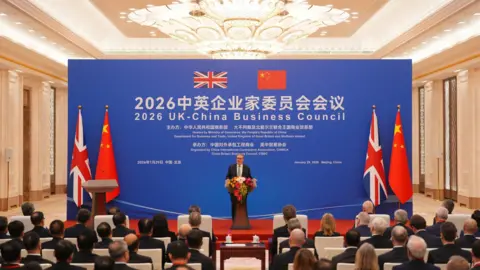
There has been no shortage of political and corporate glad-handing.
The early indications, from Sir Keir's point of view, appear positive.
As our China correspondent Laura Bicker has reported, Chinese state media, the mouthpiece of the Communist party, spent 18 minutes of its flagship 30-minute evening bulletin discussing the prime minister's visit on the day he met the president.
And of the sporting and cultural organisations I have spoken to that have accompanied the prime minister on this trip, as well as the businesses, there is a hope this could be an important moment - that opens up new opportunities for them.
"As long as this isn't a one-off," one put it to me. This was not a "one and done" visit, the prime Minister's official spokesman told us.
 PA Media
China, meanwhile, can revel in the reality that it matters, as a parade of Western leaders pass through.
French President Emmanuel Macron and Canadian Prime Minister Mark Carney have both visited recently.
Carney was to find out shortly afterwards how such a visit can go down in the White House if President Donald Trump reckons a country is considering getting too close to Beijing. The short answer: not very well.
Sir Keir had his own, more minor taste of that, when President Trump said it was "very dangerous" for the UK to do business with China.
On the rhetorical Richter scale of presidential admonishments, this was seen by the prime minister's team as pretty minor, not least because later in the same exchanges Trump described Xi as a "friend".
Sir Keir added, in an interview with me, that "it would be foolhardy to simply say we would ignore" China.
Over the last few days of long flights and long days, I have seen a conviction in the prime minister's case on China. He clearly finds it absurd that there was an eight-year gap between this visit and the last one by one of his predecessors, Theresa May, in 2018.
He sees these as wasted years and wants to make up for lost time. And he sees a dividing line with the Conservatives he appears happy to point out. Tory leader Kemi Badenoch told the BBC the other day that were she prime minister now, she would not have come on this trip.
So what can we take from what Sir Keir has managed to achieve?
There has been no shortage of schmoozing and warm words. That is because both are fuel in this "looking up economy" I mentioned.
Then there are the concrete agreements: the halving of tariffs, or import taxes, on whisky sold by the UK to China and the removal of sanctions imposed on some parliamentarians back in 2021.
And then there was an idea announced, but not yet delivered. The prime minister said the requirement for British visitors to need a visa to visit China for under 30 days would be scrapped. But the Chinese government said it was something they were merely "actively considering."
Sir Keir insisted to me it will happen, but acknowledged there was no start date agreed. "We are making progress," he said.
Ministers and the officials working on the minutiae of the negotiations are hopeful there can be a step-by-step ratcheting up of dividends associated with a closer, warmer relationship.
But perhaps little wonder some are queasy about this warmth. Critics say China is simply a state that cannot be trusted.
They point to human rights abuses, such as the plight of the Uyghurs and also to the jailing in Hong Kong of Jimmy Lai, the pro-democracy media tycoon.
Others talk about Chinese cyber attacks or MI5 issuing an alert to parliament before Christmas over Chinese spying in Westminster.
Security minister Dan Jarvis described that as a "covert and calculated attempt by China to interfere with our sovereign affairs."
And to illustrate that lack of trust, everyone I have encountered on this trip, from government officials to the corporate and cultural delegation to journalists, have taken more electronic security precautions than on any other trip I have been on. Most are on temporary phone numbers and many have left their usual digital devices at home.
Quite the backdrop, then, for a relationship being warmed up.
 PA Media
But having followed the prime minister, at home and abroad, for the nearly 19 months of his time in office, he has now set out his vision for foreign policy - and begun to match it with actions and visits.
"We have to engage with this volatile world" is how he summarised his approach when I spoke to him. "I don't think I have known a time when what is happening internationally is impacting what is going on back home so directly."
He is stung and irritated by the label lobbed at him by critics who describe him as "never here Keir" because of the number of foreign trips he does.
He has notably tried to push back on this trip, repeatedly talking about how events overseas have a bearing on the cost of living at home. He even made a reference to prices in the supermarkets when he was talking to President Xi in the Great Hall of the People.
Sir Keir has sought a close relationship with President Trump and secured it. For now at least. This is grounded in being judicious in his public remarks and only criticising the president when he thinks it is absolutely essential, such as recently over Greenland and the British troops killed and injured in Afghanistan.
He describes the UK as having "reset" its relationship with the European Union post-Brexit and has done a trade deal with India. And now, here he is in China.
Inevitably, if he leans too far in one direction, it limits his options in another. Rejoin the EU's customs union, and those trade deals with others would be gone, as he points out to his Labour colleagues who have called for just that.
Be seen to get too close to China, and prepare for the verbal hairdryer from the White House.
The trade-offs are legion.
"I'm a pragmatist, a British pragmatist, applying common sense," the prime minister told us on the plane, saying his desire was to "make Britain face outwards again."
Outwards and in multiple directions is his approach, moving incrementally.

Sign up for our Politics Essential newsletter to keep up with the inner workings of Westminster and beyond.
