Who is Jimmy Lai, Hong Kong's pro-democracy tycoon?
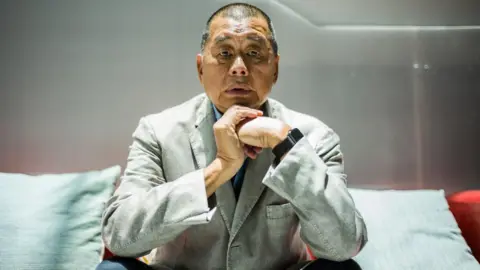
Hong Kong's pro-democracy media tycoon Jimmy Lai has been sentenced to 20 years in prison for colluding with foreign forces under the city's controversial national security law.
The 78-year-old, who was convicted in December, is the most prominent person to be charged under the contentious law. It was introduced by China in 2020, in response to massive pro-democracy protests which erupted in Hong Kong the year before.
The law criminalises anything Beijing deems to be subversive or secessionist, from chanting slogans to participating in pro-democracy protests. Beijing says it is necessary to maintain stability in Hong Kong but critics say it has effectively outlawed dissent.
Hailed a hero by the pro-democracy movement, Lai has long been viewed as a traitor by Hong Kong authorities and Beijing. He emerged as a key critic of China and his Apple Daily newspaper became a platform for Hongkongers who wanted more freedom.
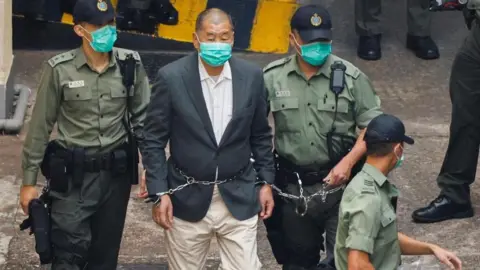
When the sentence was read out in court on Monday, Lai, who has been detained since December 2020, smiled calmly and nodded. He has always denied the charges against him, saying he had fought for the freedoms that he believed were Hong Kong's values.
Hong Kong says Lai has been given a fair trial under the rule of law, but critics say his case shows how the city's legal system has been used to silence political opposition.
His family has voiced concerns about his deteriorating health in detention. This August, his son Sebastien told the BBC that even if his father - a British citizen - got just five years in prison, it was "practically the same as a death penalty."
Rights groups on Monday also criticised the sentence, saying it was "effectively a death sentence" given Lai's age.
Sebastien also criticised UK Prime Minister Sir Keir Starmer for not securing Lai's release when he visited China in January. The "values [that the UK stands for] are being locked up along with my father," he said.
Lai became one of the fiercest critics of the Chinese state and a leading figure advocating democracy in the former British territory.
"I'm a born rebel," he told the BBC in an interview in 2020, hours before he was charged. "I have a very rebellious character."
 Getty Images
Rags to riches
Lai was born in Guangzhou, a city in southern China, to a wealthy family that lost everything when the communists took power in 1949.
He was 12 years old when he fled his village in mainland China, arriving in Hong Kong as a stowaway on a fishing boat.
While working odd jobs and knitting in a small clothing shop he taught himself English. He went from a menial role to eventually founding a multi-million dollar empire including the international clothing brand Giordano.
The chain was a huge success. But when China sent in tanks to crush pro-democracy protests in Beijing's Tiananmen Square in 1989, Lai began a new journey as a vocal democracy activist as well as an entrepreneur.
He started writing columns criticising the massacre that followed the demonstrations in Beijing and established a publishing house that went on to become one of Hong Kong's most influential.
 Reuters
As China responded by threatening to shut his stores on the mainland, leading him to sell the company, Lai launched a string of popular pro-democracy titles that included Next, a digital magazine, and the widely read Apple Daily newspaper.
In a local media landscape increasingly fearful of Beijing, Lai had been a persistent critic of Chinese authorities both through his publications and writing.
This has seen him become a hero for many in Hong Kong, who view him as a man of courage who took great risks to defend the freedoms of the city.
But on the mainland he is viewed as a "traitor" who threatens Chinese national security.
In recent years, masked attackers firebombed Lai's house and company headquarters. He was also the target of an assassination plot.
But none of the threats stopped him from airing his views robustly. He was a prominent part of the city's pro-democracy demonstrations and was arrested twice in 2021 on illegal assembly charges.
 Getty Images
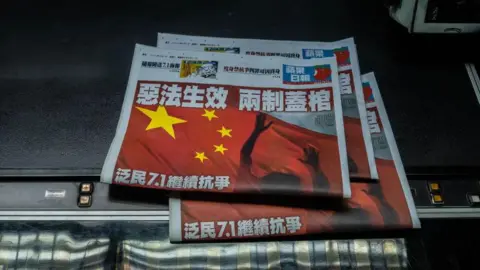
When China passed Hong Kong's new national security law in June 2020, Lai told the BBC it sounded the "death knell" for the territory.
The media mogul is known for his frankness and acts of flamboyance.
In 2021, he urged Donald Trump to help the territory, saying he was "the only one who can save us" from China. His newspaper, Apple Daily, published a front-page letter that finished: "Mr President, please help us."
For Lai, such acts were necessary to defend the city which had taken him in and fuelled his success.
He once told news agency AFP: "I came here with nothing, the freedom of this place has given me everything... Maybe it's time I paid back for that freedom by fighting for it."
Lai has been charged with various offences - including unauthorised assembly and fraud - since 2020.
The prosecution of Lai has captured international attention, with rights groups and foreign governments urging his release.
Over the years, Sebastien Lai has travelled the world to denounce his father's arrest and condemn Hong Kong for punishing "characteristics that should be celebrated".
"My father is in jail for the truth on his lips, courage in his heart, and freedom in his soul," he had said.
