Six months of searching for a missing capybara

 Marwell Zoo
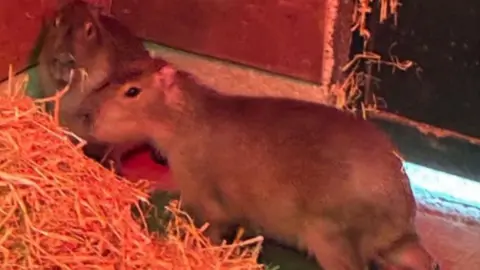
Six months after escaping from a zoo, a missing capybara that sparked interest around the world - and a trend for AI memes - remains at large in the Hampshire countryside.
Marwell Zoo, near Winchester in Hampshire, is still searching for one-year-old Samba, who attracted global interest after she went on the run earlier this year.
The saga began on 17 March when Samba and her sister Tango broke out through a small gap in a temporary enclosure.
Tango was quickly recaptured, but Samba proved more adventurous and gave keepers the slip when she made her bid for freedom.
Despite extensive efforts using thermal-imaging drones and a specialist sniffer dog, Samba has so far avoided being caught.
Originally from South America, capybaras are the world's largest rodents, with stocky bodies, short legs and partially webbed feet.
There have been sightings, most recently in mid-August when a member of the public managed to take a picture of an animal, which the zoo later confirmed was a photograph of Samba.
She was reported at several locations previously, including near the The Ship Inn in Owslebury, which was holding a quiz night on the evening she escaped.
Quizzer Nicky Scott said: "There was a bang on the window and one of my team pointed at a capybara sitting in the road.
"I ran out and followed it down the lane until it disappeared into a hedgerow."
Capybaras spend much of their time in and around rivers, lakes and marshes, feeding on plants and using water as a refuge from danger.
So perhaps its not surprising that Samba feels at home among the reeds and undergrowth alongside the River Itchen.
She was caught on video sunning herself on a riverbank by a dog walker on 22 March before disappearing into the water with a splash.
The species can reach running speeds of about 20mph (32kmh). When alarmed, they can slip beneath the surface and hold their breath for up to five minutes - an extra challenge for the search teams.

As searchers combed the riverbanks, thermal drones, humane traps and even a specialist sniffer dog were all deployed to trace the escapee.
Experts from the University of Southampton were brought to use drones to help with the search.
The team later used a thermal imaging drone in the Brambridge area after a fisherman reported a credible sighting on 6 July.
The search inspired the local community with people checking gardens, ponds, pools and outbuildings.
Pupils at nearby Twyford Primary School wrote poems, designed posters and made artwork as their contribution to the ongoing hunt.
 Handout
Samba's plight not only made local news, it sparked interest from stations across the world, which soon picked up on the story of the capybarra on the run.
Australia's Channel 7's Sunrise hosts discussed the search at length, while CBS News Chicago reported on the capybara "missing in the village of Hampshire".
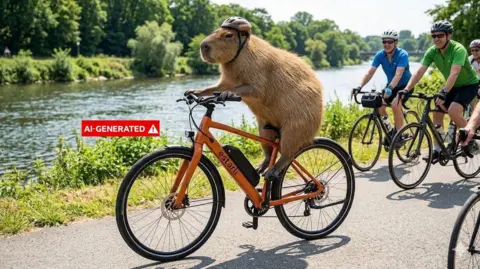
Social media also joined in with AI memes of Samba in all kinds of scenarios - from hairdressers to pubs, airports to ferries.
But despite all the publicity, suspected sightings and painstaking searching through the Hampshire countryside, Samba remains at large.
The zoo's website is still appealing for anyone who spots Samba to take a picture and share it, along with the exact location, to help with efforts to track her down.
