How a missing capybara has captured imaginations

 Marwell Zoo
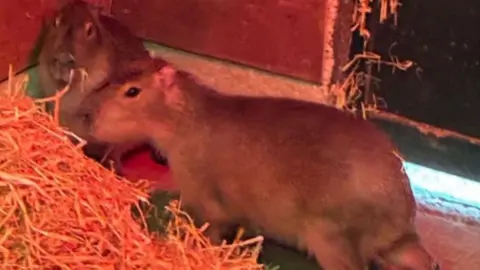
When a newly arrived capybara bolted from a Hampshire zoo, few could have predicted the impact it would have.
More than a week on, nine-month-old Samba has captured the imaginations - and hearts - of people around the world.
She arrived at Marwell Zoo, near Winchester, on 16 March after being transferred from Suffolk, but escaped the following day along with her sister Tango.
While Tango was quickly found nearby, Samba, described as the "more adventurous" of the pair, remains at large - despite a growing search effort involving thermal drones, humane traps and even a specialist sniffer dog.
 Sarah Devine
The first confirmed sighting of Samba was in the village of Owslebury - one day after her breakout from Marwell.
Nicky Scott spotted the animal while waiting for a quiz night at The Ship Inn.
"There was a bang on the window and one of my team pointed at a capybara sitting in the road," she said.
"I ran out and followed it down the lane until it disappeared into a hedgerow."
A team from the zoo rushed to the area and deployed a drone.
Samba, however, had once again managed to slip away - but not without leaving an impression.
"It's definitely the talk of the village," said Leo Todd, chairman of the pub's petanque club.
"Everybody is abuzz about it."
Search efforts expanded over the following days. A sniffer dog was even brought in to try and find Samba by following the scent of her straw bedding.
Soon, attention shifted towards the River Itchen near Twyford.
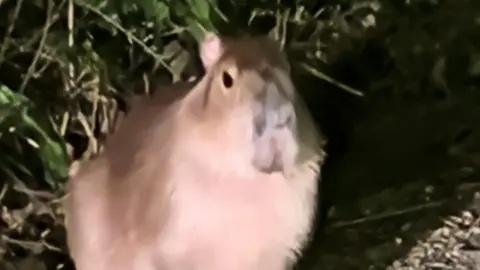
Dog walker Claudie Paddick spotted Samba "sunbathing" on a riverbank on 22 March.
She managed to capture some footage of the rodent before it dived into the water after being startled by her dog Growler.
"I thought it was a deer. You don't casually see a capybara on your walks," she said.
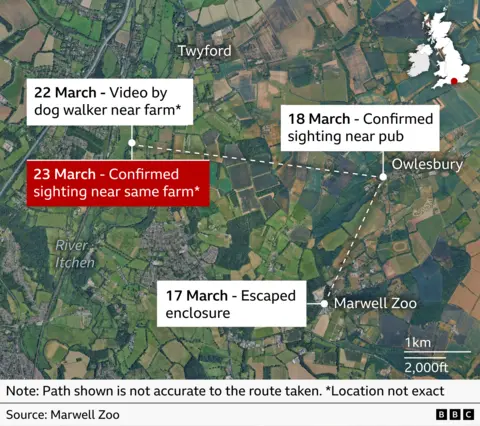
The sighting reinforced what zoo staff already suspected - that Samba would stay close to waterways.
With another confirmed sighting in the area, the search has since focused on the stretch between Twyford and Allbrook, where teams believe she may be sheltering along the Itchen Navigation.
Marwell's chief executive Laura Read said the area offers ideal conditions.
"It's calm, it's quiet, it's got the water, it's got plenty of food for her," she said.
Teams have been using thermal drones, reviewing camera trap footage and deploying humane traps baited with food such as melon in an effort to lure her out.
But Read warned that catching Samba would be no easy feat.
Capybaras, she said, are surprisingly speedy and could run about 20mph (32kmh), swim and stay underwater for several minutes.
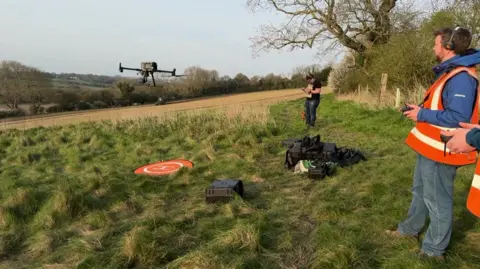
Sightings dropped off a little since that initial flurry, but Read said that could actually be reassuring.
"If she's somewhere not publicly accessible, that means she's safe and away from roads," she said.
Capybaras are the world's largest rodents.
They are herbivores and are not considered dangerous to people.
In the wild they have few natural predators in the UK, so it is thought the biggest risk to Samba is traffic.
 Twyford Primary School
For many following the story, the search has become about more than just locating the animal.
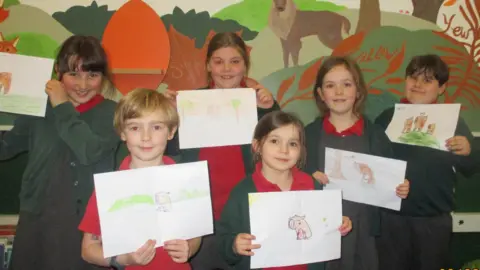
At Twyford Primary School, pupils have been writing poems, making missing posters and even incorporating Samba into their schoolwork.
Head teacher Neil Tunnicliffe said the story had "really captured their imagination" and that some had even headed to the Itchen with their families to take part in the search.
One pupil imagined the capybara "trying to play the guitar" in someone's kitchen, while another line declared she "was not a black mamba".
 Sammy Hooper
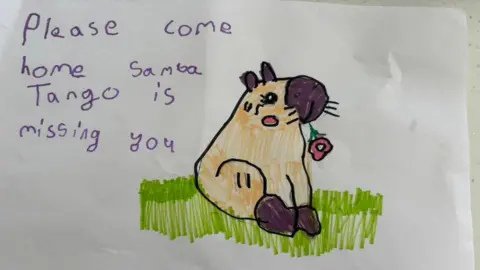
Seven-year-old Sienna, from Southampton, also drew a picture of Samba, writing: "Please come home Samba. Tango is missing you."
Her mother said: "Capybaras are her favourite animal – let's hope Samba is found soon."
The story has travelled far beyond Hampshire.
After making headlines across the UK, Samba's escape featured on CBS News Chicago, where presenters described "search crews in the village of Hampshire" trying to track down the animal - at one point referring to her as "Simba".
It has also been picked up internationally, including by People Magazine in the US and The Times of India.
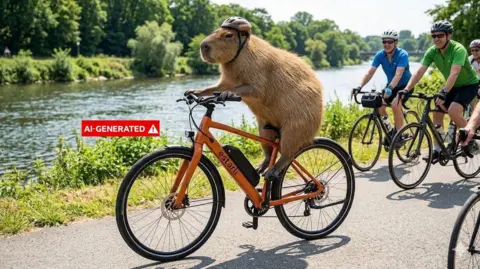
The story continues to have a life of its own on home soil, with people sharing AI-generated images of Samba appearing in a range of unlikely locations.
 Handout
For staff at Marwell, though, the focus remains firmly on bringing her home.
For now, the message is simple: keep your distance, report sightings - and keep an eye on the riverbanks.
Somewhere along the Itchen, Samba is still out there.
You can follow BBC Hampshire & Isle of Wight on Facebook, X (Twitter), or Instagram.
