Call for law change to help prosecute fly-tippers

 Martin Heath/BBC
A local politician is calling for a change in the law to make it easier to prosecute fly-tippers.
Philip Spicer, the Conservative councillor for Eaton Bray in Bedfordshire, believes it is currently too difficult to prove the offence, and wants councils to be allowed to use cameras on no-exit rural roads to identify offenders who enter with a load and leave without it.
New figures show more than 3,000 incidents of fly-tipping in the Central Bedfordshire area during the 2024/25 year.
The government said it has issued new guidance to help councils deal robustly with fly-tipping.
'A constant battle'
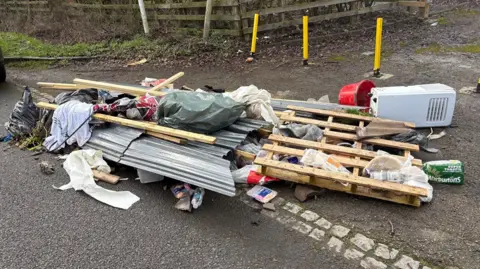
You would expect to see a pack of prawns, loaf of bread and bag of potatoes in a shopping basket - not dumped in the middle of a road.
But these items, along with lengths of wood, a bag of sand and an air-conditioning unit, were among the rubbish left scattered across one lane Spicer surveyed.
"It's a constant battle for the council to keep this road clear," he said.
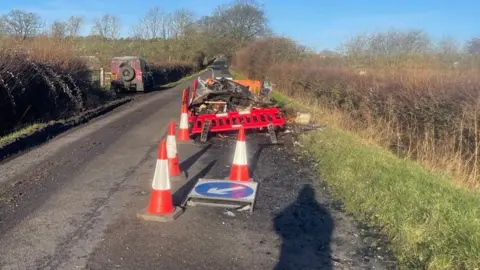
"It used to get dumped in the verge or into the ditch, and now, with the larger dumps, they just drop the tail lift and drive."
"Some offenders have a man in the back of the van driving down the road throwing it out as he goes along," he added.
"You have certain roads where you will see a stretch of fly-tipping all the way down for at least half a mile."
 Martin Heath/BBC
Government statistics released on Wednesday showed there were 1.26 million fly-tipping incidents across England last year.
Central Bedfordshire's figure of 3,031 equates to 9.6 incidents for every 1,000 people.
Neighbouring Luton recorded 11,599 incidents - 48.5 cases per 1,000 people.
 Philip Spicer
Spicer said: "It's so difficult to catch people fly-tipping because you actually have to witness it or have a video evidence of it actually happening.
"It just would be nice if we could change some of the rules where we could actually improve the way we can actually deal with this.
"Government possibly could look at it as shedding of loads."
He explained that, under his proposal, cameras placed at either end of certain rural roads with no intermediate exits could provide sufficient evidence. If a vehicle was seen entering with a load and leaving without it, that would be enough to prosecute.
The Department for Environment, Food and Rural Affairs said it had issued new guidance to councils allowing offenders' vehicles to be seized and destroyed, and criminals to be named and shamed on social media.
It added: "Convicted fly-tippers can receive a significant fine, a community sentence or even a prison sentence."
Follow Beds, Herts and Bucks news on BBC Sounds, Facebook, Instagram and X.
