'Digging a cave is fun - but we have a long way to go'

 BBC
BBCCavers have spent the past year digging mud and rock from a cavern as part of a project to open a new stretch of the underground site to the public.
The cave, near Pateley Bridge in the Yorkshire Dales, was discovered in the Victorian age but the new area has previously only been accessible to potholers.
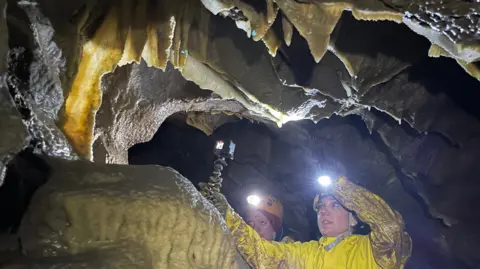
It is filled with tonnes of mud and rubble, but also contains spectacular formations of stalagmites, stalactites and calcite curtains.
Tom Thompson, from the Angels of the North Cave Diggers, estimated that the team of volunteers had removed 75 tonnes so far, with another 300 to go.
“It’s a great challenge and it's fun working with your pals, thinking of ways of solving the problems and thinking of ways of getting the mud out,” he said.
These included building a makeshift conveyor belt and wooden track with a wagon, to move the debris above ground.
The new cave will eventually be an extension of tourist attraction Stump Cross Caverns.
The vast cave system was discovered by miners looking for lead in the area in 1860.
It was opened to the public in the early 1900s and has been a privately-owned and popular visitor attraction ever since.
Oliver Bowerman, director of Stump Cross Caverns, said his family were hugely grateful to the cavers for their work.
“You can’t just go to your local builders’ merchant and ask for a quote for digging out a cave," he said.
“You need people with immense skill and speciality.
“Extending a cave is certainly a unique thing to do and a once in a generation thing.”
Many of the volunteers, who are also part of the Craven Pothole Club, have rigged up their own engineering underground.
To access the cave, they descend down a 50 feet (15.4m) deep former miners’ shaft.
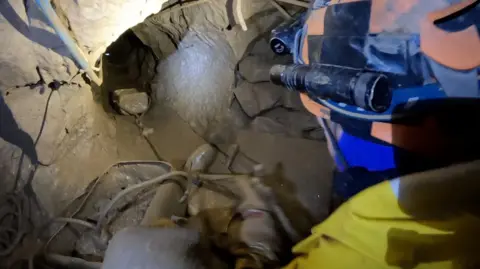
At the bottom they have built a conveyor belt and a wooden train track with wagons that can be loaded with the debris.
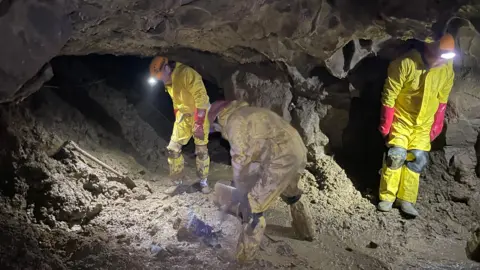
The volunteers use pickaxes to release rocks and rubble from the mud that has filled the cave.
Plastic cartons are then filled with the rubble, before they are pulled along the train tracks and the conveyor belt inside the narrow tunnels.
The rubble is then loaded into a hand-built lifting device called a shadoof.
Once on the surface the containers of mud and rocks are spread on the ground near the shaft where they are collected and analysed to see if they have any historic value.
Mr Thompson, who designed the shadoof, said: “There is so much to do and sometimes I think, ‘how on earth are we going to move all this mud?'
“But one of the things we are really good at here is that we are problem solvers.
“There is engineering involved, electrics involved, cave surveying.”
Volunteers from across Yorkshire and Lancashire gather once a week to work together in the cave on the project, which they expect will take a few years to complete.
Rowan Worsman, one of the volunteer diggers, said: “It keeps you going, it keeps you active, it is a good social thing.
“It‘s lovely to be downstairs (underground) and it is nice to be in the darkness and the quiet and just turn your light off and sit with nothing happening.
“That is what’s special to me.”
The owners of Stumps Cross Caverns said they hoped the new cave would open to the public in 2028.
“But we are being led by a volunteer group who do five hours a week and we encounter challenges as we go along," Mr Bowerman said.
“It will take as long as it takes, we are not in a rush to get this done.
“The most important thing is that it is done properly.”
The last extension at the site took place in 2000 when Reindeer Cave was opened.
During the digging out process of a previous part of the caves, the diggers found the glacial mud had concealed bones from a reindeer, wolverine, bison and Arctic fox.
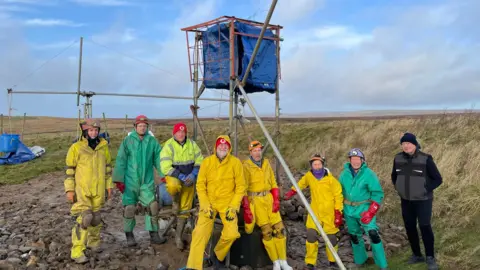
The digging started in early January 2025 and Stump Cross Caverns hosted a Christmas party for the volunteers to thank them for their hard work during the year.
Mr Thompson said that the cavers also benefitted from access to other caves on land owned by the caverns.
“Our club has had a really long history of association with Stump Cross Caverns and we have been digging here since the 1950s - although not me personally," he joked.
