'Life as a paramedic can be relentless - but it's a privilege'

 BBC
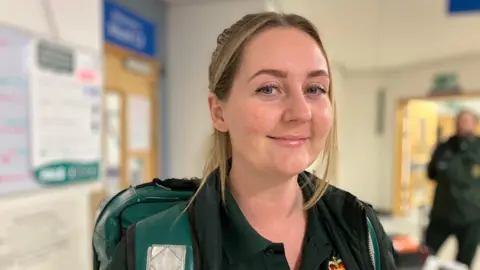
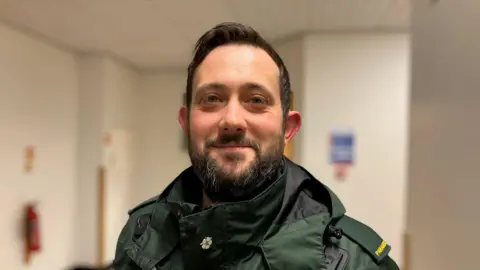
BBCWhen paramedics Shane Guinan and Rebecca Baldwin start their morning shift in Leeds, there is no easing into the day. The ambulance doors slam shut and, almost instantly, the first call comes in.
An alarm sounds. A robotic voice in the ambulance announces a "category two incident" - meaning one that is serious, but not immediately life-threatening. It involves a 95-year-old man who has fallen and may have a head injury.
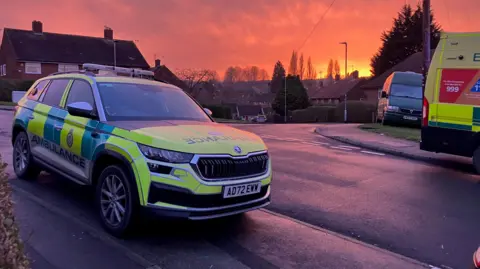
Within seconds, we are speeding through the streets of Leeds.
Shane drives, blue lights flashing, siren cutting through traffic.
It is my first time in an ambulance and Rebecca has given me the front passenger seat, where I can see the computer screen and the jobs coming in.
Less than seven minutes later, we pull up outside an independent living complex in Meanwood.
Rebecca is already out of the side door, a heavy kit bag slung across her back.
The patient, Horace Philips, is wedged awkwardly down the side of his bed, his thin legs stuck in the air. Frail and shaken, he has no idea how long he has been there.
"It was dark when I fell," he says quietly. "I was trying to get to the toilet."
While Rebecca gets to work checking his blood pressure and heart rate, Shane gently reassures him: "Don't worry at all, we'll get you sorted."
Working together, they carefully manoeuvre Horace into a safer position and begin a full assessment.
"He's been on the floor for a good few hours and he's got a lot of pain in his back and his neck," Rebecca says.
"He's living on his own here, so he needs some kind of social help as well as medical."
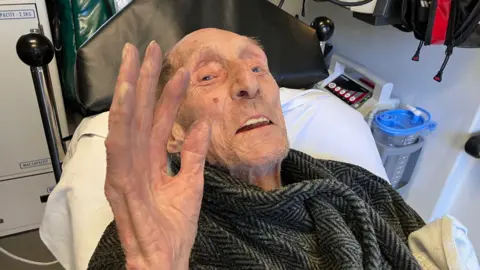
Once in the back of the ambulance, Horace looks brighter. He gives me a thumbs-up and thanks the crew repeatedly, apologising for "being a bother".
Horace is one of 3,500 people in Yorkshire who will need an emergency ambulance today.
"There are moments when you feel overwhelmed," Shane admits.
"The work is not always easy. You go to difficult jobs and then you're expected to carry on and go to the next job."
At St James's Hospital A&E, ambulances are lined up outside.
Inside, Horace is given a cup of tea and a sandwich while we wait on a corridor. We have joined a long queue of paramedics who each have a patient on a trolley.
"There's always a wait because there aren't enough hospital beds," Rebecca says.
"But Leeds is coping better than many places."
She is right. In Yorkshire, ambulance handover delays are shorter than the national average.
Between April and November 2025, the average handover time here was 19 minutes - down from 29 minutes the year before.
About 20 minutes later, Horace is handed over to hospital staff. We then head straight back to the ambulance - and almost before the doors are closed, the computer lights up again with the next job.
"Category two. Male, 67. Chest pain," the robotic voice says.
This patient, it turns out, is a "regular caller".
At his flat, Shane runs tests while Rebecca scrolls through his medical records.
Keith has called 999 many times with chest pain, often linked to anxiety rather than a heart condition.
"He doesn't have much support and he knows we look after him," Rebecca says.
They treat him with the same patience and professionalism as any other patient, explaining each step as they check his vital signs.
Keith insists on going to hospital, so we head back to St James's - but this time to a different department.
The Same Day Emergency Care unit is like a smaller version of A&E, where patients can be assessed and discharged in a matter of hours.
By now, Shane and Rebecca are late for their 45-minute meal break.
They "go offline" and, for the first time all day, the radio falls silent.
"It's always job to job to job," explains Shane.
"Some days we'll be two hours late for our meal break. It's busy all the time, so winter pressures just blend into summer pressures as well.
"There's always someone, somewhere needing an ambulance, and we will always be there to go to them."
A few miles away at the Emergency Dispatch Centre in Wakefield, the 999 calls never stop.
The specially trained staff here coordinate emergency responses across the whole of Yorkshire.
A giant screen on the wall flashes live data in bold, red text.
"Five calls queuing," it states.
"Fifteen agents not ready."
Dispatcher Cathy Scott scans her monitor.
She tells me at that moment there are 240 ambulances tied up with emergencies and "no available resources".
"I'm looking at Doncaster alone and I've got 18 active incidents and 10 patients waiting," she says.
"I've got a patient with lung cancer and a chest infection who's struggling to breathe, so that's quite a sad one.
"I'm trying to pull a crew from another area, but there's just nothing available."
Claire Lindsay, head of service, delivery, and quality at the Emergency Operations Centre, says call volumes are up by about 500 per day at this time of year.
"We have robust plans and extra staffing, and we're trying to answer calls as quickly as possible, but it can be quite difficult at times," she says.
"We are absolutely here for people in an emergency situation. If somebody's not breathing, had a stroke, or been involved in a road traffic accident, we're here.
"But if you're not seriously injured or ill, we just ask that you please seek alternatives. Dial 111 or go to your pharmacy or GP."
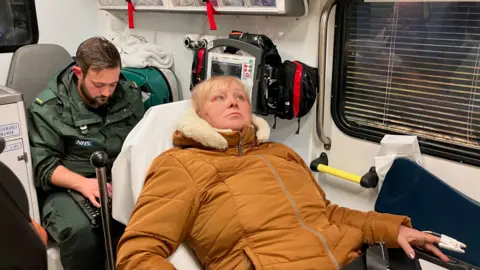
Over in Leeds, Rebecca and Shane are back on the road again.
Another "category two" call comes in - this time a 67-year-old woman with stomach and chest pain.
You can see the relief on Sarmite Sinkeviča's face when we arrive in her living room.
She clutches her side as she tells us: "The pain is 10 out of 10 - the worst I've experienced in my life."
After running some tests they decide to take her to Leeds General Infirmary so they can rule out a cardiac event.
This means another wait on another corridor, but Rebecca and Shane can only help one patient at a time.
"Some days it's relentless," says Shane.
"But I absolutely love the job. It's a privilege to be the person who turns up when people call for help."
Listen to highlights from West Yorkshire on BBC Sounds, catch up with the latest episode of Look North.
