Military veterans get preferential legacy treatment - O'Neill

 EPA/Shutterstock
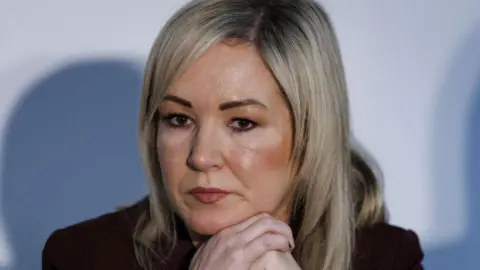
The UK government has been accused by First Minister Michelle O'Neill of giving military veterans "preferential treatment" when dealing with the legacy of the Troubles.
The government is in the process of repealing the previous Conservative government's legacy act and replacing it with new legislation.
Sinn Féin deputy leader O'Neill said there needed to be "fairness across the board" in legislation currently going through Westminster.
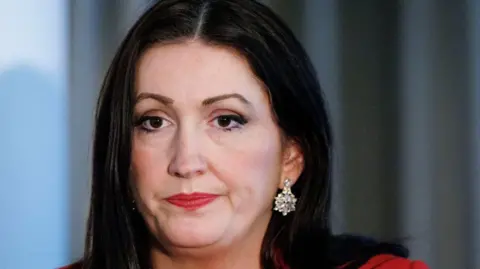
Deputy First Minister Emma Little-Pengelly of the Democratic Unionist Party (DUP) said her party was challenging the government to "stand up for and protect" veterans who served in Northern Ireland.
Both women were speaking to Sky News on Sunday.
O'Neill said all victims', survivors and their families wanted truth and justice.
"What we're seeing play out in Westminster is preferential treatment for British state forces, and avenues being closed down for families who want access to truth and justice or access to the courts," she said.
"So the British government saying to them, you're not good enough to get information at the same while elevating and trying to give preferential treatment for British veterans."
She said such an approach would not allow victims and survivors "to heal and actually to move forward".
Little-Pengelly said there had been an attempt "to rewrite history by having a lot of the focus in relation to the state, should that be police, or should that be the Army and others in Northern Ireland."
"We should always remember that 90% of the atrocities of the murders carried out were carried out by terrorist organisations," she said.
She said the current legislation "is not the correct way to go about this".
Northern Ireland Secretary Hillary Benn, who supports the new law, has said time is running out to deal with unresolved Troubles legacy issues.
 EPA/Shutterstock
The Northern Ireland Office said the Troubles Bill followed "extensive consultation with victims and delivers on one of the final aims of the Good Friday Agreement".
It added that the bill "will ensure the maximum possible disclosure of information for victims and families, puts in place protections for those who served, and will be capable of commanding confidence across communities".
What is in the new legacy legislation?
The new law which will replace the previous legacy act includes a new legacy commission, born out of the Independent Commission for Reconciliation and Information Recovery (ICRIR), which will have independent oversight.
The government said the deal involved a package of protections for veterans, including "a protection in old age".
The Legacy Commission, born out of the Independent Commission for Reconciliation and Information Recovery (ICRIR), will have independent oversight.
Inquests, which had commenced but had not ended before the current Legacy Act came into force in 2024, will be restored.
Others which had not begun will be reviewed to identify a way forward.
It also includes separate information recovery body, and a dedicated legacy unit within An Garda Síochána (Irish police).
Separately, MPs voted to remove a measure providing conditional immunity from prosecutions for Troubles-era crimes from the previous legacy act.
The controversial clause had already been found to be unlawful and was opposed by Northern Ireland parties and victims' groups.
It would have enabled anyone to avoid prosecution for offences related to the Troubles, if they had provided information about unresolved cases.
Before that vote, Benn told MPs the government did not agree with immunity "as a matter of principle" and that those who served in the armed forces had to abide by the rule of law.
Unity referendum disagreement
O'Neill also told Sky News she could foresee a referendum whether Northern Ireland will stay in the UK or unite with the Republic of Ireland during her time as first minister.
She said Sinn Féin wanted such a vote to be held by 2030 and that preparations should be taking place.
Little-Pengelly said nationalist parties had not increased their vote share since the first assembly election in 1998.
