How Aston Martin must adapt to meet changing needs

 Getty Images
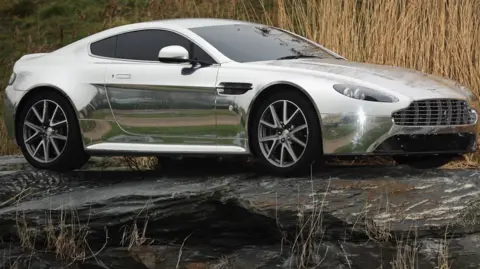
It is the firm famed for making the car James Bond drives, but its history has been almost as turbulent as some of the adventures of the Ian Fleming hero.
Aston Martin confirmed this week it would be cutting a fifth of its workforce, after the firm's net losses jumped by more than 50% last year.
Bosses at the luxury car firm blamed its woes on US president Donald Trump's tariffs in a statement made last month.
Experts believe Aston Martin, which is headquartered in Gaydon, Warwickshire, was particularly susceptible to those headwinds but believed there were opportunities for its fortunes to be revived once again.
 Getty Images
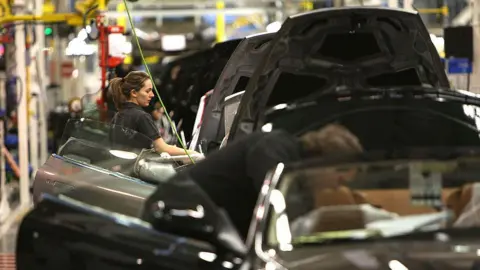
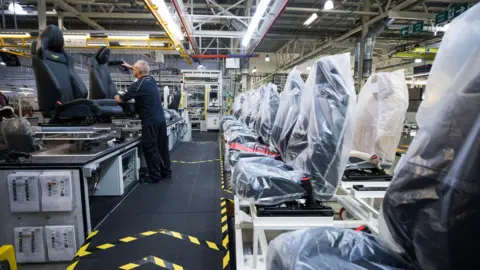
The firm is a significant part of the West Midlands' manufacturing prowess, and employs about 3,000 people. This means job losses could total about 600.
Its troubles come at a time when the car industry is facing one of the most difficult periods in its history, according to former Aston Martin CEO Andy Palmer.
He said car makers were having to adapt to manufacturing electric vehicles and plug-in hybrids, as well as changes in consumer behaviour.
He added that China was the largest automotive market in the world and that vehicles produced there were now competing within the luxury market traditionally occupied by the likes of McLaren and Aston Martin.
"There are competitors, there are emerging competitors, and they're hitting in places like China where historically most of those vehicle manufacturers have been taking their profits from.
"Whilst the Chinese manufacturers may not be a direct challenge in the luxury market, they're undoubtedly skewing expectations."
Palmer also agreed that volatility created by tariffs on imports to the USA was also having an impact on firms like Aston Martin.
 Getty Images
"Tariffs are ultimately paid for by the consumer, and both manufacturers and consumers are waiting."
He explained that firms could consider manufacturing their vehicles in the USA to avoid tariffs, but this was only likely to only be an option for larger manufacturers.
Despite that, the firm's brand recognition remains a large part of its appeal.
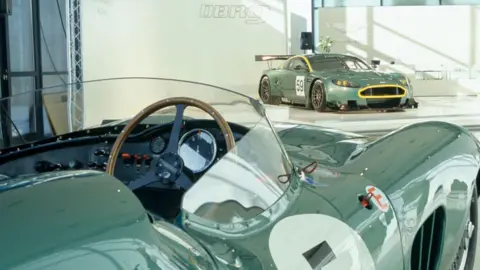
"The Aston Martin badge, the McLaren badge, the Bentley badge, the Rolls-Royce badge represent the part of car industry which the United Kingdom still lays claim to," Palmer said.
The UK and Italy were the only countries in the world making "truly luxury cars" he told BBC News, adding that "the United Kingdom is really, really good at the luxury car business."
 Getty Images
Professor David Bailey from Birmingham Business School said there was a "low volume crisis" in the UK car industry at the moment, with output at a 70-year low.
Reasons for this included a downturn in China, along with slow growth in the UK as well as tariffs when selling into America – which is one of Aston Martin's largest markets.
He said the brand was "one of the coolest car brands" and that it was "internationally known".
 Getty Images
Sales of Aston Martin vehicles helped make the West Midlands the UK's largest exporting region to America, he said.
The firm's success was also critical to supporting the wider supply chain in the region, with many local firms providing parts for the vehicles.
He believed Aston Martin would now need to collaborate more with larger companies like Mercedes, to access technology it would otherwise struggle to develop on its own, in order to return it to a more profitable position.
Tom Stacey, senior lecturer at Anglia Ruskin University, who works in supply chain and manufacturing research, said the company was operating within an "upper middle class squeeze".
He said there was an "ultra-luxury" market as well, which was continuing to do well and which Aston Martin could seek to tap into.
"One of the issues that they have is that their product hasn't significantly changed in 30 years," he said, adding that many Chinese brands were now able to offer similar capability.
 Getty Images
The firm had tried new products, he said – such as the DBX, which was well received initially, but Stacey added that projections had gone from about 5,000 sales per year down to about 1,000.
"It competes against a crowded marketplace.
"You've got Bentley there, you've got Porsche there, Lamborghini and Ferrari and the competition is really, really fierce," he said.
In 2017 Aston Martin announced the Rapide E which was designed to be a competitor to the Tesla Model S but was later cancelled.
"On every metric – and it looked very similar [to the Tesla] - it was worse," Stacey said.
The firm ought to diversify its core product, and go "full-in" on producing electric vehicles, Stacey said.
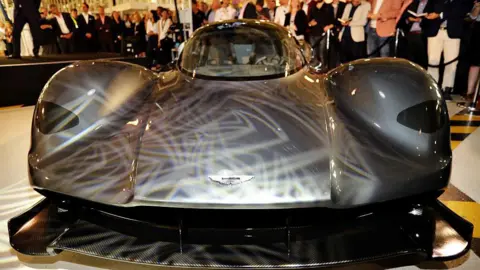
He said the new £850,000 Valhalla hybrid supercar was a potential bright spot for the brand.
If it attracted the attention of motoring magazines and YouTube channels it could act as a "halo" for other vehicles in Aston Martin's line-up, he said.
Follow BBC Coventry & Warwickshire on BBC Sounds, Facebook, X and Instagram.
