The abandoned house in a busy town centre with a 'grisly' history

 Google
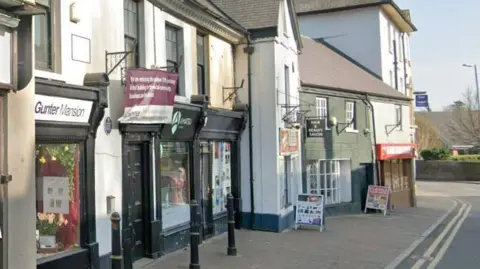
It is an unassuming building in the middle of a row of everyday shops - but it hides a grisly past.
In the 17th Century, "priest hunters" would comb the towns and villages of Wales and England looking for people worshipping the Catholic faith.
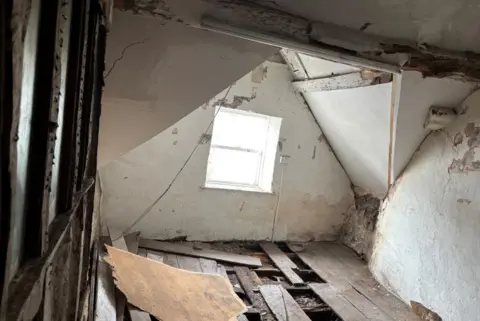
On Abergavenny's Cross Street, there is a secret chapel in the attic of the Plas Gunter mansion, where masses were held in the outlawed religion.
This is where Jesuit priest David Lewis was discovered - he was hung, drawn and quartered in Usk in 1679 and has been described as the last Catholic saint of Wales.
A small blue plaque on the outside wall of the building in the Monmouthshire town is the only clue to what happened inside.
The 400-year-old Grade II-listed building has been described as a "history capsule" by a group of volunteers who have secured £3m from the National Lottery Heritage Fund to restore it.
Its secret chapel in the tiny attic is considered one of the most important and best surviving recusant chapels of its kind in the whole of Britain, where Catholics worshipped at a time when it was dangerous to do so.
"We know for a fact that the story about mass being held in the attic in the 1670s was true because it was reported in the Houses of Parliament at the time," said Owen Davies, chairman of the Plas Gunter Mansion Trust.
"The masses were illegal at the time and they were discovered along with the secret chapel and ultimately the priests were arrested and tried.
"One of them, David Lewis, was hung, drawn and quartered in Usk, and these were the last Catholic saints of Wales."
Why was Catholicism outlawed?
The break from Catholicism began during the reign of Henry VIII.
For most of his life, the king had been a devout Catholic, but in the 1520s he wanted to divorce his first wife Catherine of Aragon - but the Catholic church did not allow this.
The Act of Supremacy was passed by Parliament in 1534, making Henry the supreme head of the church in Wales and England, which he hoped would enable him to divorce Catherine.
It led to the formation of the Church of England.
People began converting to Protestantism, and Catholics were fined for not attending services in the religion.
A suspicion of Catholic plots grew, partly fuelled by the fact some of the most powerful countries in the world - France and Spain - were Catholic.
Measures were brought in against Catholics, such as being found guilty of treason and put to death for trying to convert someone to the religion.
Laws and restrictions were put on the faith until the Catholic Emancipation Act was passed in 1829.
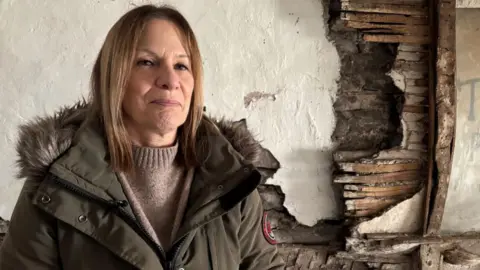
"During the 1600s, it was illegal to be Catholic, and the Gunter family who lived here [at Plas Gunter] were staunch Catholics who allowed itinerant Jesuit priests to come and celebrate mass here in their house," said project co-ordinator Deborah Holland.
"At that time anti-Catholic hysteria hits fever pitch and there were priest hunters out for Jesuit priests and eventually two priests who said mass here, David Lewis and Philip Evans, were captured and hung, drawn and quartered.
"They came to a grisly end."
After the Gunter family moved out, the attic and its secret chapel were boarded up and remained this way for about 300 years.
It was not until the 20th Century that they were discovered.
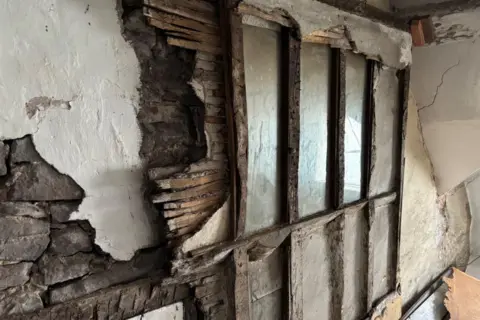
But it is not only the chapel that holds the secrets of the building.
There is also an elaborately-carved 17th Century plaster ceiling in what was once the parlour.
As the plaster and rendering on the walls in each room is carefully removed, the mansion begins to tell its story.
"Old buildings are fascinating and there are so many stories here about the family who lived in the old house, the Gunters," said volunteer co-ordinator Ann Payne.
"There are still a lot of Gunters living in this area and, of course, the Catholic priests and their martyred ends.
"This house is constantly evolving and we are patchworking all of this together."
Restoration teams have made significant discoveries around the mansion where the original garden once stood - these include the first remains of a Roman road in the town.
