Irish priest who founded Boys Town on path to sainthood

 Boys Town Archives
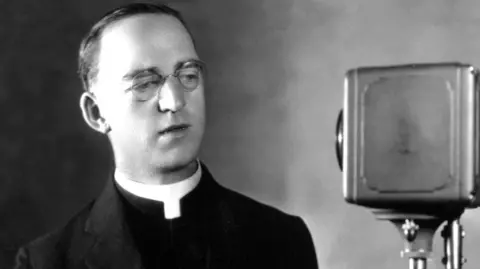
An Irish-born priest whose groundbreaking approach to child poverty inspired an Oscar-winning film, has now taken a significant step towards becoming a saint.
Fr Edward Flanagan set up a sanctuary in the United States to care for thousands of orphaned and impoverished boys during World War One.
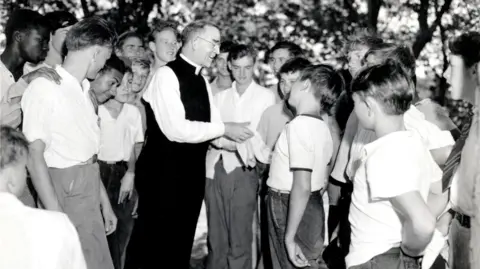
He bought a farm in Nebraska which he developed into an entire village dedicated to caring for abandoned and underprivileged youths, known as Boys Town.
Now, Pope Leo XIV has declared the late Irish-American priest to be "venerable" - a stage on the pathway to being recognised as a saint by the Catholic Church.
More than a century after Fr Flanagan set up his refuge for "wayward boys" the sprawling site still exists today, helping millions of young people and their families.
The organisation hailed its founder as a "true visionary" who believed that "every child deserves to be valued and loved, and a chance to live a healthy, positive life".
The Irishman's life story inspired the 1938 film Boys Town, starring Spencer Tracey and a young Mickey Rooney.
It won two Academy Awards, including the Best Actor Oscar for Tracy's portrayal of Fr Flanagan.
 Boys Town Archives
Who was Fr Flanagan?
Fr Flanagan was born into a large Catholic family in the village Ballymoe in the west of Ireland in 1886.
He received his early education at schools in counties Roscommon and Sligo, helping out with his family's farm as a young boy.
In his late teens he emigrated to the US with his sister, and soon began studying for the priesthood at a seminary in Maryland.
He was ordained in 1912 and started work as a parish priest in the Diocese of Omaha, Nebraska.
Witnessing high unemployment and hardship in Omaha, he opened a shelter for homeless men, where he listened to stories of how they ended up destitute.
He was struck by how many of the men had grown up in poverty and neglect, with chaotic childhood memories of parents who had either died or abandoned them.
Their experiences, and his own studies of the juvenile justice system, convinced him intervention was required at an early stage if a child was at risk of delinquency.
He once said: "I've always hated the cruel system that neglects boys until they're forced into breaking the law."
 Boys Town Archives
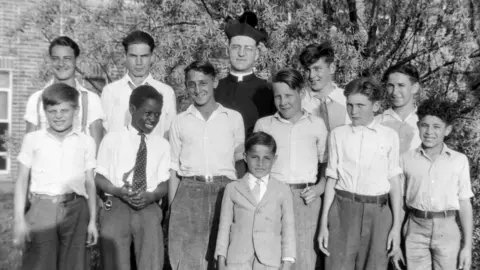
Fr Flanagan opened his first home for boys in Omaha in 1917, which housed and educated more than 150 youths within its first year of operation.
The programme quickly outgrew the available space in the Omaha premises and in 1921 he acquired Overlook Farm, which became known as Boys Town.
Despite some opposition to his project, the priest ensured the site welcomed all boys regardless of race, religion or nationality.
The village grew to have several schools, churches, a post office, a hospital and health clinics as well as its own police and fire departments.
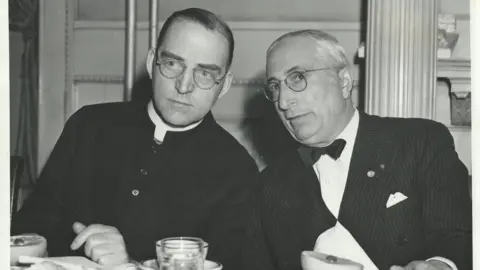
Fr Flanagan became known internationally for his pioneering work and progressive views on juvenile justice.
He famously wrote: "There are no bad boys. There is only bad environment, bad training, bad example, bad thinking."
On a visit to his native Ireland in 1946, Fr Flanagan criticised the Irish justice system which was still imprisoning children.
He died two years later during a mission to Germany to assess child welfare.
A 'model of Christian living'
Fr Flanagan was one of six individuals named by the Pope on Monday whose lives and "heroic virtues" have made them potential candidates for sainthood.
The announcement was also warmly welcomed by the Catholic Church in Ireland.
The Bishop of Achonry and of Elphin, Kevin Doran, who leads the diocese into which Fr Flanagan was born, described him as a "model of Christian living".
The bishop said Boys Town was founded in a "time of crisis, when many young people were living rough on the streets and getting in trouble with the law".
He added that Fr Flanagan created a place were "young people could feel at home, and have all the advantages of a solid education and formation for life".
"Father Flanagan's life and virtue have much to say to us today, in a wealthy country where so many children are forced to live with homelessness, and in a world in which we still find it so easy to define people as 'hostile aliens'," Bishop Doran said.
 Boys Town Archives
The village of Boys Town has been a US National Historic Landmark since 1985.
In 2024, the organisation provided services and resources to more than 3.5m families throughout the US, including healthcare and crisis intervention.
Welcoming Pope Leo's announcement, it said Fr Flanagan was "a true visionary whose belief in the potential of every child still shapes Boys Town today".
How does someone become a saint?
There are a few steps required on the path to sainthood in the Catholic Church.
1) Wait a while
The process to make someone a saint cannot normally start until at least five years after their death. But this waiting period can, in some circumstances, be waived by the Pope.
2) Become a Servant of God
An investigation can then be opened to see whether the person lived their life with sufficient holiness. Evidence is gathered, and if the case is accepted the individual is called a Servant of God.
3) Show proof of "heroic virtue"
The department that makes recommendations to the Pope on saints scrutinises the evidence.
If the case is approved, it is passed to the Pope who decides whether the person lived a life of "heroic virtue". If so, they can be called "venerable".
4) Verify a miracle
The next stage, beatification, requires a miracle to be attributed to prayers made to the individual after their death.
Incidents need to be "verified" by evidence before they are accepted. After beatification, the candidate is given the title "blessed".
5) Canonisation
This is the final step in declaring a deceased person a saint. To reach this stage, a second miracle normally needs to be attributed to prayers made to the candidate after they have been beatified.
