What is a poinsettia and how do you stop it dying?

 Arden Lea Nurseries
For many people across the UK, it's not a proper Christmas without a poinsettia to brighten up the house.
Originating in South America and parts of Africa, the plants are a fixture on supermarket shelves and garden centres across the country.
But for some, the distinctive red plants seem hard to keep healthy once they are taken home.
So what is the best way to look after the plants? Are they poisonous? And will they last until next year? BBC Radio Lancashire has asked the experts.
How do I look after my poinsettia?
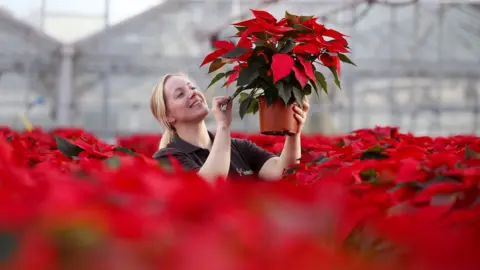
Duncan Taylor ran Arden Lea Nurseries in West Lancashire for decades before he handed over the business to his sons.
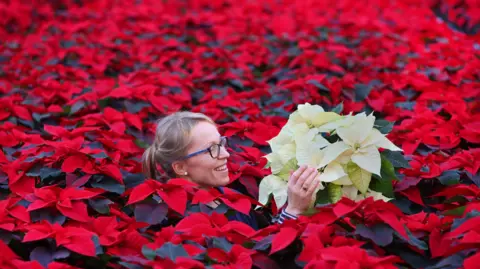
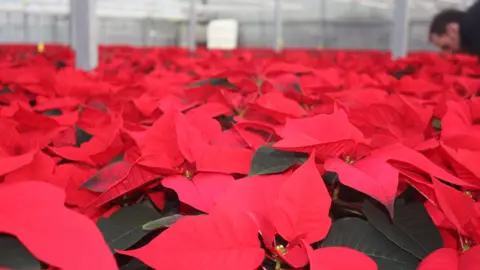
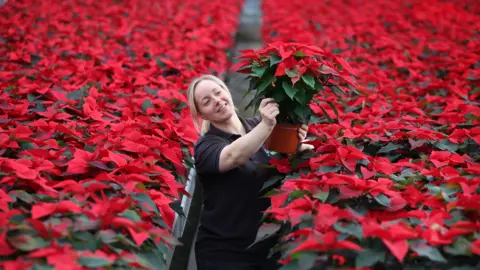
It takes the nurseries six months to grow about 25,000 poinsettias every year, to be sold at Christmas across the region.
"You've got to treat them like your wife, very gently and catering to their every need," Mr Taylor said.
The plants like slightly warmer temperatures of around 15°C (60°F), "which is no trouble in June, but it is a problem around September, October, November", Mr Taylor said.
"Don't put it over where the radiator is and don't put it in bright sunshine, but it likes light."
The RHS advises only watering the plant when the surface of the compost has begun to feel dry.
The BBC Gardeners World Magazine suggests increasing humidity by spraying gently with water every few days.
 Arden Lea Nurseries
Are poinsettias poisonous to humans?
Poinsettias produce a milky coloured sap that is an irritant to humans and pets.
The Royal Horticultural Society advises that it is best to avoid touching this, as it could cause skin and eye irritation.
The Poison Control Centre in the United States of America advises that if children or pets do eat it they can develop a mouth rash or an upset stomach.
Unlike popular myths, the sap is not deadly to pets or humans.
 Arden Lea Nurseries
Where do poinsettias come from?
Poinsettias come from South America and Africa, and are thought to have become popular Christmas houseplants thanks to a Mexican legend.
The story goes that a young girl wanted to leave a gift for the baby Jesus at a Christmas Eve service at church.
But she could not afford to buy a gift, so left a bundle of weeds instead.
The weeds flowered into the famous red leaves of a poinsettia plant, becoming synonymous with the colourful festive season.
 Arden Lea Nurseries
Can I keep my poinsettia for next year?
Once your plant seems content, Mr Taylor advises to keep it where it is, and it should last at least a few months.
You would have to get a little bit lucky for your poinsettia to last a full 12 months, he said, and even then, it might not look quite as vibrant the next year.
"I think the most I've ever kept one was to about May," he said.
"And it wasn't dead then, it was just very dusty and I got fed up with it.
"Keep it as long as you can, and when you are sick of it chuck it away and buy a new one."
BBC Gardeners World magazine advises its readers to feed poinsettias monthly after Christmas with a high potash liquid feed, such as a tomato feed.
Listen to the best of BBC Radio Lancashire on Sounds and follow BBC Lancashire on Facebook, X and Instagram. You can also send story ideas via Whatsapp to 0808 100 2230.
