I lost the ability to read, it turns out I'd had a stroke

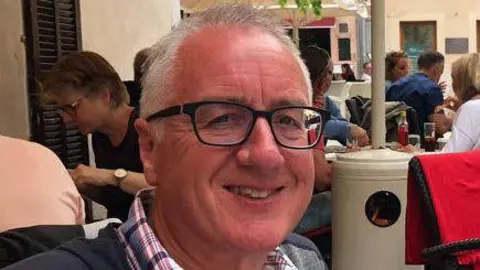 Family handout
A stroke survivor whose only symptom was suddenly being unable to read has urged people to look out for uncommon signs of the potentially deadly condition.
Gordon Robb, from Bonnyrigg in Midlothian, had a bleed on his brain but was reluctant to seek emergency care after not experiencing the usual symptoms of the condition.
Instead, the 63-year-old found that words - including emails, texts and the screen of a cashpoint - looked as though they were written in a foreign language.
He had decided to make GP appointment, but a cousin insisted on an A&E visit where it emerged he had had a haemorrhagic stroke.
Speaking on Radio Scotland Breakfast, Gordon said he had been having a normal day, spending time in his garden but when he decided to go inside and catch up with some texts and emails, he discovered he couldn't read what they said.
"When I was looking at the messages, I could see them very clearly, there was no visual impairment, I just could not read these messages," he said.
"At that point I just felt, I'm tired, I was up late the night before watching the Ryder Cup."
He went to bed thinking "a good night's sleep" would solve the issue and was able to run a 5k the next day.
But, it was when he went to an ATM and realised he still couldn't read he became concerned and decided to go to his GP.
His cousin, whose husband had died from a sudden stroke just three weeks earlier - drove straight to his house and insisted on taking him to A&E.
It was there he discovered he had had a haemorrhagic stroke.
"I am incredibly lucky, and quite honestly felt like a fraud in the stroke ward because I was no different to how I am normally, except that I suddenly could not read words," he said.
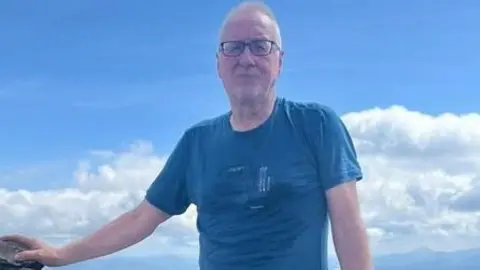 Family handout
Robb said he had thought about the possibility of a stroke but ruled it out due to having none of the classic symptoms.
Experts said that difficulty recognising written words, without any other symptoms, affected fewer than 1% of people at the time of their stroke.
"It just shows the importance of paying attention to unusual symptoms, even if they aren't ones you have heard of before," Robb said.
"If I hadn't gone to the hospital, and quickly received treatment, I could have been walking around with a ticking time-bomb in my head."
Robb's symptoms are improving, although it now takes longer to read in comparison with before his stroke, and he occasionally cannot find the right word during a conversation.
He is now taking part in a new British Heart Foundation-funded clinical trial led by academics at the University of Edinburgh looking at medications that can be used to prevent future haemorrhagic strokes.
Dr Sonya Babu-Narayan, the British Heart Foundation's clinical director, said: "Facial weakness, arm or leg weakness and speech problems are well-known signs you or your loved one may be having a stroke, but there are some lesser-known symptoms like being unable to recognise the written word.
"If you have a symptom that you feel is not right, however strange or unusual, it is really important to seek help. Every minute matters if you may be having a stroke or other medical emergency."
