Rosebank oil field 'could breach international law' over West Bank link

 Reuters
Campaigners against Rosebank, Britain's largest untapped oil field, have told the UK government that approving the project would risk breaching international law.
They say profits would flow in part to the Israeli oil and gas company Delek Group, which the UN human rights commissioner accuses of "supporting the maintenance and existence" of illegal settlements in the West Bank.
Legal advice commissioned by the environmental group Uplift, says the link with Delek means the UK government risks breaching the Geneva Conventions if it gives drilling at Rosebank the green light.
Delek did not respond to a request for comment.
The UK government said it could not comment on individual projects.
Uplift's legal advice refers to potential breaches of Article 49 and Article 53 of the Geneva Conventions, which relate to occupation, deportation and the destruction of property.
It also alleges that Delek's activities could be regarded as "ancillary" to war crimes and crimes against humanity under Section 51 of the International Criminal Court (ICC) Act 2001.
Alice Hardy, a human rights lawyer who co-wrote the advice, said "granting the Rosebank licence may amount to aiding or abetting a grave breach" of international law.
The Scottish Palestine Solidarity Campaign (SPSC) is writing to Prime Minister Sir Keir Starmer urging him to defer the decision on drilling at Rosebank while his government considers the new advice.
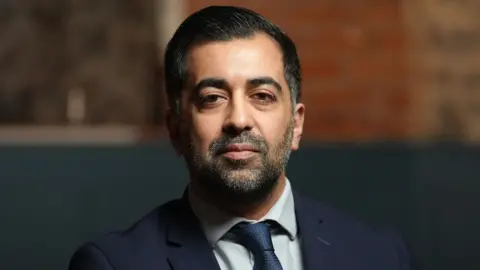
Scotland's former first minister, Humza Yousaf, is supporting the SPSC, arguing profits from the field off Shetland would flow to a company "blacklisted" by the United Nations for human rights violations.
"The UN wouldn't blacklist a company if it didn't think there were serious concerns," said the former SNP leader.
Delek is the majority shareholder in Ithaca Energy which owns 20% of Rosebank.
The UN Human Rights commissioner lists Delek on a database of "business enterprises" which have "directly and indirectly, enabled, facilitated and profited from the construction and growth of the settlements".
Ithaca said it was a "responsible employer" which adhered to the "highest standards of corporate governance."
Israel strongly rejects the characterisation of settlements as illegal and says it acts in accordance with international law.
Hardy, a partner in the public law and human rights team at Bindmans Solicitors, said Delek's presence on the database meant it had been found to have "a clear and direct link to activities in breach of Article 49 of the fourth Geneva Convention", contributing "to the maintenance of the illegal settlements."
Israel has built about 160 settlements housing 700,000 Jewish people since it occupied the West Bank and East Jerusalem following its victory in the 1967 Arab-Israeli war.
An estimated 3.3 million Palestinians live alongside them, aspiring to their own state comprised of the Gaza Strip and the West Bank with East Jerusalem as its capital.
In 2016, UN Security Council resolution 2334 condemned Israel's "construction and expansion of settlements" in the Palestinian territory occupied since 1967, describing them as having "no legal validity" and constituting "a flagrant violation under international law".
Earlier this month the UN human rights commissioner Volker Türk said Israeli laws, policies and practices were having an "asphyxiating impact" which "resembles the kind of apartheid system we have seen before".
Those accusations were dismissed by Israel as "absurd and distorted".
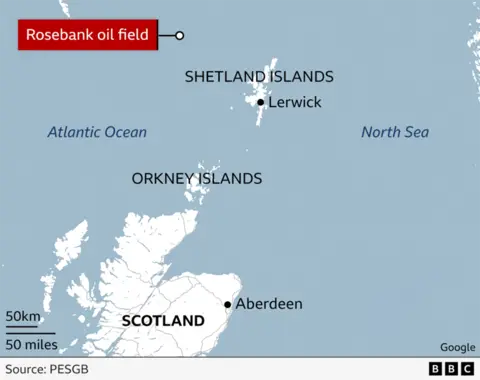
The UK government is currently reconsidering whether or not to give Rosebank the go-ahead after environmental campaigners successfully challenged its original approval in 2023.
The field, approximately 80 miles (130km) west of Shetland in the North Atlantic, is estimated to contain between 300 million and 500 million barrels of oil.
The Court of Session in Edinburgh ruled that the original decision to approve drilling was unlawful because, while it had assessed the emissions which would be generated by production at Rosebank, it had failed to take into account the climate impact of the eventual burning of the oil and gas extracted, known as "downstream emissions."
 PA Media
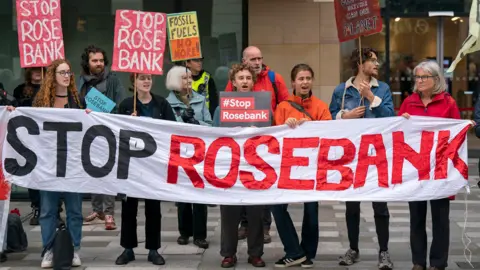
If the UK does approve the project, environmental campaigners have suggested they may be willing to go back to court to seek judicial review related to Delek.
"I think the UK government should make it clear it is not going to approve Rosebank. If it does, then it's very possible they'll have a court challenge on their hands," said Yousaf.
The former first minister added that he also opposed Rosebank on environmental grounds as it was "incompatible" with meeting Scotland's net zero targets.
Offshore Energies UK (OEUK), a trade body representing the energy sector, insists Rosebank would create thousands of jobs, generate billions for the UK economy, and improve energy security.
Tessa Khan, executive director at Uplift, argues that the vast majority of the UK's oil is exported and so Rosebank would not lower bills or increase energy security.
"The fact that a significant share of these profits flow to a company linked to human rights violations in Palestine significantly adds to these concerns," she added.
