New technology trialled on £2m lock upgrade

 Alex Pope/BBC
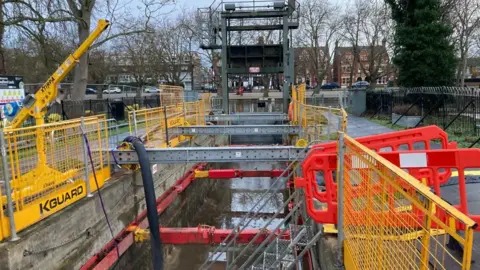
New technologies, including Artificial Intelligence (AI), were used for the £2m renovation of a lock on the River Great Ouse, its project manager said.
The Environment Agency started work on the Bedford Lock, by the town's Embankment, in October, and it was expected to be finished by March 2026.
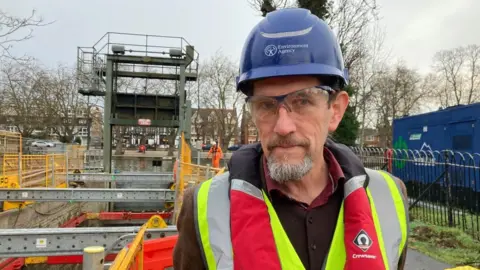
Project manager Steven Wilby said for the first time, a high-resolution camera was used to see the condition of the lock underwater, and after 3D models were made, next steps were taken with AI input.
He said these underwater "scans are proof that we could now reliably use this in the future for other work".
 Alex Pope/BBC
The lock, the first in the town, allowed the Great Ouse to be navigated, along its route through Cambridgeshire to the Wash at King's Lynn, in Norfolk.
It was built in 1868 and was last refurbished in the 1950s.
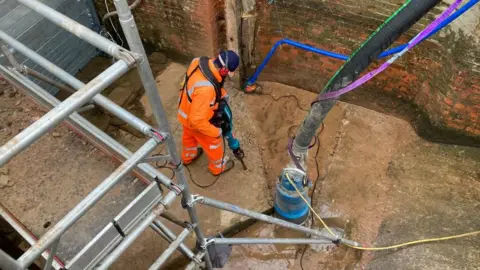
Mr Wilby said repair work was needed as walls were breaking due to damage caused by tree roots that were chopped down in 2009.
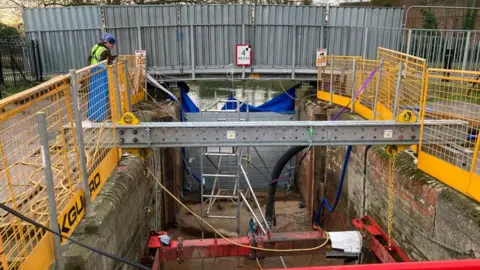
The water had been drained so that work could be carried out, which had been two years in the planning.
 Alex Pope/BBC
"The Environment Agency is always looking for innovation and safety," Mr Wilby said.
"We asked our contractors if there were any new technologies out there that were coming along, and they suggested that we use this underwater camera."
Images were integrated into a 3D model then decisions were made using AI about what might be below water.
What they predicted was "true", he said.
"It will also have new doors fitted at one end, and at the other, its guillotine gate will be renovated and painted," he explained.
 Alex Pope/BBC
Mr Wilby said: "You will not see the benefit today, but you will see the benefit in the future.
"When we come back to this lock, in the future, some of the innovations we've put into this lock will make it easier for the next project manager to come along and do it cheaper than we did it this time."
 Alex Pope/BBC
Follow Beds, Herts and Bucks news on BBC Sounds, Facebook, Instagram and X.
