Hidden homeless: 'I slept on buses and in front of security cameras'

 BBC
BBCMore than 200,000 families and individuals across Britain are experiencing hidden homelessness, a 30% rise since 2020, according to new research from the charity Crisis and Heriot-Watt University.
Crisis defines the hidden homeless as people dealing with their situation informally - and who aren't included in official statistics - for instance by living in cars or sheds, sheltering in industrial buildings or sleeping on friends' sofas.
Maria, now 53, arrived in the UK in 2001 from Spain, working as a hospital cleaner before getting a degree in London, and then being employed by the NHS as a healthcare assistant for the next two decades.
But in 2021, Maria was sitting in her living room when a drink-driver smashed into the house she rented. She was injured and the house was left uninhabitable.
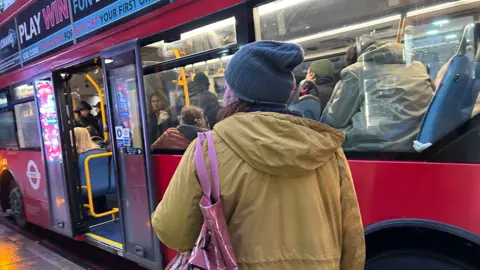
After suffering from PTSD and losing her job, she spent six months sleeping on buses, camping out in shopping centres and sofa-surfing.
'My friend died in front of me'
"My books, my lovely dresses, everything was gone," she told BBC London about the aftermath of the crash. "I got kicked out with just my coat and my handbag. This is where the troubles started.
"My landlord and the council didn't help me. The police said it wasn't their business.
"The building was uninhabitable. I was contacted by insurance but I was a tenant not a landlord. My mental state started to suffer. I lost my job because of stress and trauma.
"I didn't know how to apply for benefits because I've never been in the system... I didn't know where to go, who to talk to, who to tell.
"I had no support network. I came to the UK in 2001 to be with my brothers after going through a divorce in Spain. But by this point my older brother had passed away, my parents in Spain had died, and my other brother had moved back and I was ashamed to tell him.
"I sofa-surfed with a friend. But he later died in front of me from a heart attack. In that process I was an invisible tenant. His landlord said she didn't know me. I wasn't on the contract.
"I couldn't afford to rent anywhere else."
'You're an easy target'
"I ended up on the street," Maria explained. "I had fibroids. I had a lot of bleeding, became anaemic and needed a blood transfusion. I would return from hospital treatment to sleep on a bench.
"As a woman you feel unprotected, you lose the capacity to find solutions because you feel completely lost.
"In the night, you're facing the possibility of being attacked physically and sexually. You're an easy target.
"I slept in front of security cameras in case something happened. And once I was attacked with a knife by another woman.
"Physically it's much more challenging. If you want to wee and you're sleeping rough, you can't do it in the park like men do.
"At the beginning I was going with my suitcase up and down all the night to make up time until the next day... in the shopping centre, in worship centres, sleeping on buses. I would try to refresh myself how best I could or buy wipes.
"You're trying to pretend, to fool people, to not look like you're homeless, like you're travelling. Everyone ignores you."
'It can happen to anyone'
Maria told BBC London: "You discover another world. You discover the homeless world that you were not aware existed and you learn from homeless people. I trust them. There's an understanding, maybe. Homeless people don't steal from you and they protect you.
"You feel more unstable, you lose your confidence, you lose sense of reality
"It can happen to anyone because in my case, I was a normal working person in the NHS and it happened to me.
"A&E is a spot for homelessness. When I was working there I was aware of that, and helped people. Then I was in that very same situation."
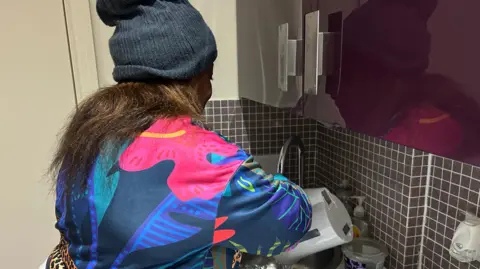
Crisis helped Maria to start looking for emergency accommodation. She now has her own home and is rebuilding her life.
Without official government statistics, Crisis considers its study to have provided the first comprehensive number - 208,600 households in Britain - of those who are facing hidden homelessness.
These figures are based on statistical modelling conducted as part of the Homelessness Monitor, a 14-year research programme tracking homelessness trends.
Chief executive of Crisis Matt Downie said: "We knew that hidden forms of homelessness were common, but this report reveals a more urgent problem than we thought.
"Quite often women are sleeping in places which are hidden so they don't get attacked. This is really serious, life-threatening stuff.
"When we talk to people who are hidden homeless they feel terrified, completely ostracised, disenfranchised and lonely from society."
"The situation for hidden homelessness in the capital is as bad, if not worse, than anywhere else in the country, because this is the least affordable place to live."
A government spokesperson said "These figures are truly shocking.
"Everyone deserves a safe place to call home and we will leave no stone unturned to end homelessness and tackle the blight of hidden homelessness.
"We are fixing the crisis we inherited by investing more than £1bn in homelessness services, launching a homelessness strategy and building 1.5 million new homes - including thousands of genuinely affordable homes for families and working people."
The government has announced its national plan to end homelessness by investing £3.5bn over the next three years.
It aims to halve the number of long-term rough sleepers, end the unlawful use of B&Bs for families and prevent more households from becoming homeless in the first place.
Listen to the best of BBC Radio London on Sounds and follow BBC London on Facebook, X and Instagram. Send your story ideas to [email protected]