Memories of the night Storm Desmond caused chaos

 BBC
BBCTen years ago, Storm Desmond caused the worst floods to hit Cumbria in living memory. What happened then and what has been the impact since?
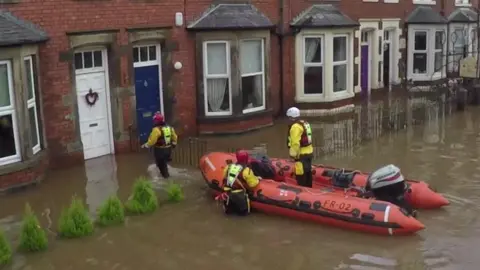
By the time firefighters got into the house, the water was up to the disabled resident's chest - and rising.
Sitting in a wheelchair in the dark, the person was totally at the mercy of the flood waters flowing through their Carlisle home that stormy night.
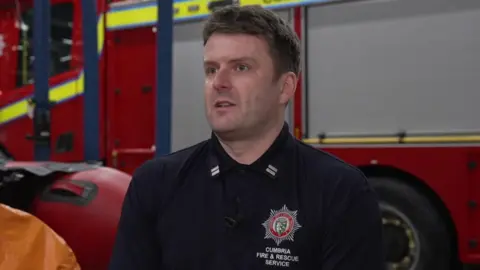
"That's probably the one where, if we hadn't have been there at that time, it definitely wouldn't have been a happy outcome," recalls Stuart Forrester, the manager at Carlisle East Fire Station, some 10 years later.
It was 5 December 2015 and Cumbria was under siege.
The rain had been relentless, inch after inch of falling water having nowhere to go on already saturated ground, swelling streams and rivers way beyond their bursting points.
It was to be a long shift for Stuart and his colleagues.
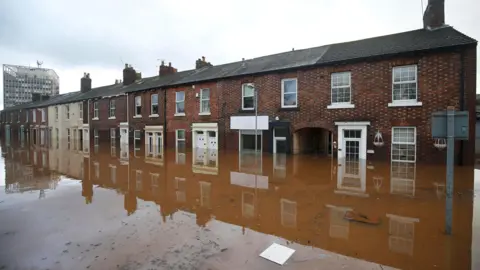
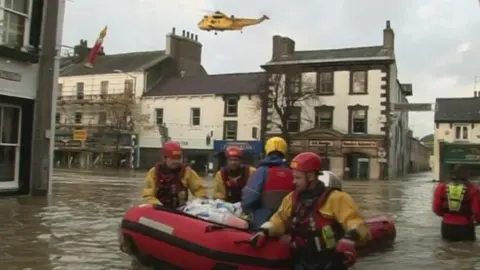
Where once cars had been parked between rows of terraced homes, now boats were needed to navigate the rising waters drowning the city's streets.
And there was the permanent threat it could become a whole lot worse.
"We were behind the flood defences where the water was well above our heads," Stuart says.
"If that flood defence had gone, it would have been worst case scenario."
 REUTERS/Andrew Yates
The crews worked quickly, going house to house to pull people to safety and get them to dry land.
"As daylight rose, it became apparent just how much of the city was under water," Stuart says.
In some areas the floods had reached the second floor of peoples' homes, ladders being used to help get people into the emergency boats.
With no food, power or drinking water, the evacuees were taken to casualty handling areas, away from the waters rushing through their homes.
As the scale of the disaster grew, so too did the emergency response, local firefighters being bolstered by colleagues from other brigades and their equipment.
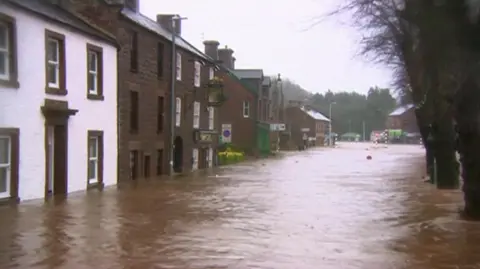
Across Cumbria, some 5,500 homes were flooded along with 1,000 businesses and 600 farms.
For many it was their third flood in a decade, with previous disasters striking in 2005 and 2009.
But for most, Desmond was the worst.
At St Lawrence's Church in Appleby, vicar Sarah Lunn points at a marker on the end of a pew, showing where flood waters reached in 2005.
She lifts her hand about a foot (30cm) higher to another small sign commemorating where Desmond got to.
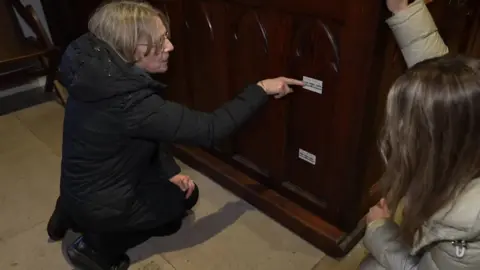
"It way over-topped everything," she says, adding: "It was just the ferocity of it.
"It's that sense of absolute helplessness, there wasn't anything anyone could do.
"You couldn't stop it."
But as well as the drama of it, Sarah's memories are also awash with the "resilience, love and community spirit" shown by her parishioners.
Almost 170 properties flooded in Appleby, many of which were businesses such as Bojangles Bistro.
Owner Jim Chalmers reckons his cafe was some 5ft (1.5m) under water, with wooden floor panels lifted and heavy furniture such as fridges and freezers floating around.

During Storm Desmond, the River Eden was the highest it had been in the town since records began in 1984, with water levels more than 5ft (1.5m) higher than those in the 2005 flood.
The town had flood defences but they simply could not cope.
Townsfolk and the Environment Agency hope they are now better prepared should a similar event occur.
Some £12m has been spent on improving the town's defences, with a new pumping station expected to be completed next summer.
Back at Bojangles, Jim, who is also the chairman of Appleby Emergency Response Group, details further measures residents and businesses have taken.
"We now have a written plan with trained volunteers who have all got their own roles in helping to prepare for a flood and become more resilient," he says.
In Cockermouth, lessons learned in the 2009 floods, including the creation of a new defence built the following year, helped minimise the destruction of Desmond.
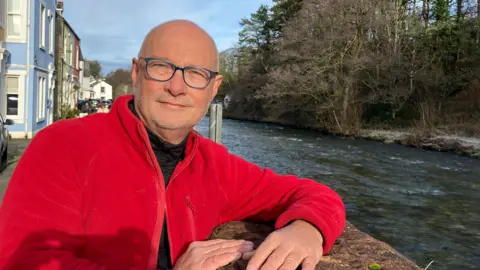
"Lots of residential properties flooded, it wasn't a good time, but it could have been a lot worse," says Jonty Chippendale, a former retailer in the town.
"It wasn't as bad as 2009 and some of the reasons for that were the work that was done after the 2009 flood to make Cockermouth more resilient
"The clear-up operation in 2015 was a well-oiled machine whereas in 2009 there were skips all over the place."
 BBC/Ed Hanson
Now, the Cockermouth Emergency Response Group, which has some 200 volunteers, keep a close eye on the town's two rivers, the Cocker and Derwent.
"Floods in Cockermouth don't happen out of the blue," Jonty says.
"You usually get a few days warning if there's a big weather event coming and people take it seriously now."
The group has also created action plans to help residents in the event of a flood.
"We've identified the most vulnerable ones in the community," says Brian Mitchelhill, the chairman of the group's trustees.
"In the event of a flood, we send our volunteers to the most vulnerable first, then we start knocking on everyone else's door to make sure they are OK," he adds.
 BBC/Ed Hanson
Ten years on from Desmond, Stuart, the Carlisle fire chief, also feels his team is better-prepared for another flood.
As well as improved equipment, they have also had extra training, for example how to use their boats in fast-flowing "high energy" water.
"So if those cars are getting swept into a river, or there are currents running through the city, we can use the boats to deploy and safely rescue people," he says.
He says Storm Desmond was the "largest and most prolonged" incident of his career.
"Basically we were being redirected from life risk to life risk to life risk," he recalls.
"You can go quite a long time in your career without having to deal with that, but it's why people join the emergency services at the end of the day.
"We want to help people, but hopefully it doesn't happen again any time soon."
Additional reporting by Duncan Leatherdale.
