One in 20 London spiking incidents leads to charge

 BBC/Gem O'Reilly
The number of people charged for spiking offences amounts to fewer than 5% of the overall reported incidents, figures from the Metropolitan Police show.
In the year to November 2025, the force said 126 spiking offences resulted in what it called "positive outcomes", including charges, out of some 2,700 allegations - although the overall number of offences is thought to be higher.
Scotland Yard said there had been a 9% rise in the reporting of alleged incidents. Nearly two-thirds of complainants are female.
Cdr Clair Kelland said it was "encouraging to see more people coming forward but we need even more victims to report incidents as early as possible".
She added: "It's the key to identifying offenders and stopping them from harming others.
"Even if you've taken illegal substances, there is no criminal offence of having these substances in your body so we're not interested in the fact you may have taken some drugs. What we're interested in is catching these perpetrators."
The Met Police told BBC London that a police forensic test of urine or blood is required for the results to be used as evidence in court.
"Early reporting is critical," Cdr Kelland said. "We know that most of these substances pass through your body within about 12 hours, so please contact the police and report - we are here to help you."
 BBC/Gem O'Reilly
Lucy Harris, 21, had her drink spiked at a nightclub while celebrating her 19th birthday with two friends.
They fell unwell and decided to go home before vomiting and drifting in and out of consciousness. She wants more organisations to be vigilant.
She said: "There was a real feeling that I might not have survived that night. For about a year afterwards, I'd say I was very careful. Still now, I am very careful.
"Women are very smart and if you are spiking someone with the intention of doing something, as soon as a girl starts to feel a little bit off, we have this women's intuition and... we immediately know that we need to do something."
Stephen Hart was on a night out in 2005 when his drink was spiked and he was raped. He contracted HIV from the incident.
"I didn't know about it happening to men. I didn't know who to call," he said. "Two policemen came to my flat with an ambulance crew."
Mr Hart said one of the officers questioned him when he said he thought he had been raped and told him "but you're a bloke".
"I felt somebody had questioned what I was saying. Because of that, I never called it rape for the next two years," he said, adding: "I felt like I wasn't being believed".
"It changed my life completely. What happened to me was wrong. Hopefully, if this can help one person, you know, it's making something good come from that."

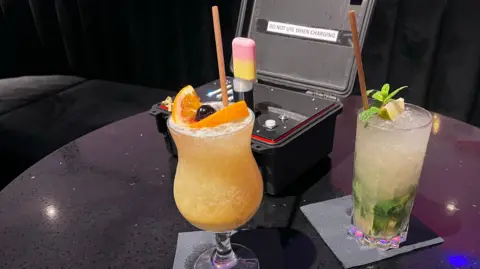
As well as drinks, spiking is also taking place through vapes. The Met Police said it was using new technology to detect if a vape had been spiked.
Deputy Assistant Commissioner Ben Russell said: "We will go out to bars, to pubs, to nightclubs and we'll say to people, would you like us to test your vape?
"We press a button and it will come up with a light. The different colour of the light will tell you if there's anything in there that shouldn't be," he said.
Mr Russell said the force was also concerned about children smoking vapes, which could be spiked with a "cannabis derivative product".
"That can actually be dangerous for young children," he said. "We have seen children as young as 14 buying vapes at school, and they've ended up in hospital because they don't know what they are smoking."
The force also uses infrared sensors to monitor powders or drugs that could be used in drinks.
The Crime and Policing Bill 2025, which was introduced in the Commons in February this year, brought in a specific criminal offence for spiking, aiming to make it a clearer law.
It is currently going through the House of Lords with an expected amendment.
Cdr Kelland welcomed the bill, adding: "It's really important that spiking is recognised as a standalone offence.
"We rely on other legislation at the moment, so we absolutely welcome that change."
The Met Police has launched an immersive virtual reality experience in central London, inviting office workers to step into real-life scenarios where spiking could occur, especially during the Christmas party season. It aims to teach people how to spot signs of spiking, safeguard victims and report incidents swiftly.
Listen to the best of BBC Radio London on Sounds and follow BBC London on Facebook, X and Instagram. Send your story ideas to hello.bbclondon@bbc.co.uk
