Oil price back above $100 despite deal to release record amount of reserves

 AFP via Getty Images
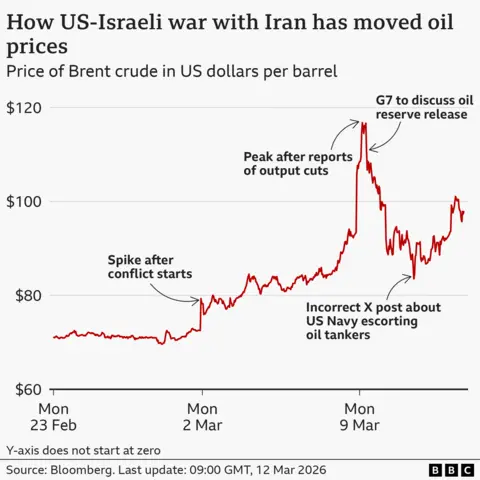
Oil prices climbed back above $100 a barrel on Thursday and stock markets fell after three more cargo vessels were hit in the Gulf and Iran's new supreme leader vowed to keep blocking the key Strait of Hormuz shipping route.
Brent crude rose around 9% in volatile trading, reaching $101.4 a barrel.
The jump came despite the International Energy Agency (IEA) saying on Wednesday that it will release a record 400 million barrels of oil in an attempt to curb the economic impact of the US-Israel war with Iran.
Investors are increasingly concerned that the global economy will take longer to recover if strikes to shipping and energy infrastructure in and around the Strait of Hormuz continue.
In his first public comment since being named as supreme leader, Mojtaba Khamenei said the "lever of blocking the Strait of Hormuz" should still be used by Iran.
The strait is a key waterway for energy shipments but is effectively closed over concerns that vessels could be attacked.
As well as transporting oil, liquefied natural gas is shipped through the passage and surrounding countries operate refineries which produce jet fuel and diesel.
An Islamic Revolutionary Guard Corps spokesperson said on Wednesday that any vessel linked to the US, Israel or their allies would be targeted.
"You will not be able to artificially lower the price of oil. Expect oil at $200 per barrel," they said.
"The price of oil depends on regional security, and you are the main source of insecurity in the region."
Stock market indexes in the US and Europe fell on Thursday. The US Dow Jones Industrial Average and the S&P 500 both fell 1.5% while the Nasdaq dropped by 1.7%.
London's FTSE 100 slid almost 0.5% while Germany's Dax, France's Cac and Spain Ibex all dropped. Earlier in Japan, the Nikkei share index closed down 1%.
On Thursday, the IEA said the war in the Middle East was "creating the largest supply disruption in the history of the global oil market".
It said that Iraq, Qatar, Kuwait, the United Arab Emirates and Saudi Arabia have cut total oil production by at least 10 million barrels per day.
It added that "production will take weeks and, in some cases, months to return to pre-crisis levels depending on the degree of field complexity and the timing for workers, equipment and resources to return to the region".
This week, the IEA announced that all 32 countries who are members of the agency had agreed to release a record of amount of oil to tackle supply shortages and higher prices.
However, while Brent crude prices ticked a little lower following the IEA's announcement it rose again, worsening after Iran attacked ships and Khamenei made his remarks.
Bill Farren-Price, senior research fellow at the Oxford Institute for Energy Studies, told the BBC's Today programme that markets had already expected the IEA oil reserves release so had "priced it in".
But he added that while the IEA's action helps: "It is a sticking plaster on a much bigger problem.
"The problem is we're losing about 20 million barrels a day of supply from the Gulf and 400 million is a lot but, in the context of a global market that consumes over 100 million barrels of oil per day, you can see the scale of the challenge."
Martin Ma from the Singapore Institute of Technology said that oil prices would stay high as long as there is a risk to supplies and the latest jump suggested that traders are still expecting a "prolonged" disruption.
 Reuters
Global oil markets have been extremely volatile since the US and Israel launched airstrikes against Iran on 28 February, with Brent crude reaching almost $120 a barrel earlier this week.
On the day before the conflict began, Brent was $73 a barrel.
There are concerns that higher energy prices - with gas also now more expensive than it was before the war - could cause inflation to rise and discourage central banks from lowering interest rates.
In the UK, the Bank of England had been forecast to cut interest rates this year. The rate is currently 3.75% and the bank will meet next week to decide its next move.
Maike Currie, head of personal finance for Pensionbee, said: "We were expecting two interest rate cuts this year. Now we're expecting none and there's even the possibility of rate rises."
Elsewhere in the world, the knock-on impact of the war and suspended oil supplies are being felt.
In the US, the White House said it was considering suspending the Jones Act - a law that requires goods moving between US ports to be transported on US-made ships - as it looks for ways to help contain energy prices.
Many countries in Asia, which are heavily reliant on energy from the Middle East, have been hit particularly hard.
Long queues were seen at petrol stations in the Philippines,Thailand and Vietnam this week as people raced to fill up with fuel.
Thai authorities have called for staff at most government agencies to work from home to conserve energy. Officials are also being discouraged from non-essential overseas travel.
The Philippines has also started a four-day work week for its government to help cut down on energy use.
