'As a blind passenger, train travel can be scary'

 Eleanor Mae Studio
From boarding a carriage to finding a seat and being able to tell if a toilet is engaged, travelling by train as a blind or partially sighted passenger is fraught with challenges.
The charity Royal National Institute of Blind People (RNIB) has drawn attention to the number of visually impaired travellers who have experienced problems with the pre-booked assistance they had arranged for their journeys.
An RNIB survey, published in January, said that fewer than half of passengers were being "reliably" met by the assistance they had requested.
The Rail Delivery Group, an overarching body representing train operators across the UK, runs the free Passenger Assist service, which is available at staffed stations.
Staff can provide help with reaching a platform, boarding a train, finding a seat and transporting luggage. The service can be booked up to two hours before a train departs, or if the passenger arrives without booking within 20 minutes of departure, staff will still attempt to help.
Harry Ward, a university student from Leeds, said he no longer used the service because he had been "consistently let down".
He has a visual impairment and autism, and said there were a lack of announcements at his local station, Horsforth.
"People assume that people with physical disabilities will either have our transport sorted for us in advance, or that we're just not going to travel. That's not the case," he said.
 Kelvin Jay-Wakefield
Ward added that often the staff assistance only extended to helping him board the train, before he was left to find a seat himself.
"I can't tell if there's a free seat. It becomes somewhat scary because I'm stood in the middle of a carriage, obviously very vulnerable."
The RNIB figures showed that 79% of blind and partially sighted people had difficulty finding a seat, while more than half (57%) struggled to find a toilet.
 Kit Taylor/BBC
Maqsood Sheikh, who is visually impaired, agreed that issues with accessibility and navigation often continued once a passenger was on a train, even if station staff had been helpful.
Sheikh, from Bradford, said he was used to searching for "tactile clues" as to his location within the train.
"You have to feel around and train carriages can be quite dirty.
"You don't know where the toilets are, and even when you do work them out, sometimes there's no tactile buttons and you can't tell if the door is locked."
He added that judging distances between the train and the platform edge was also difficult if assistance was not forthcoming.
"The gap in some stations can be huge, and in others it's not, so you don't know what to expect.
"When you don't know how big that step is going to be, it's quite scary."
The research showed that safety was a major issue for blind and partially sighted people, with four in five saying they worried about the gap.
Meanwhile, 68% said they would benefit from tactile wayfinding support to navigate to the train.
The Rail Delivery Group said that requests through Passenger Assist were increasing - more than 1.6m bookings were made between 2024 and 2025, an 18% rise on the previous year, according to Office of Rail and Road data.
The government figures stated that 94% of users who were met by staff at stations were satisfied with the assistance they received - though only 78% of passengers received all of the help they had booked.
'You take a gamble'
Other regular travellers have drawn attention to the need for station design to accommodate the needs of those with visual impairments.
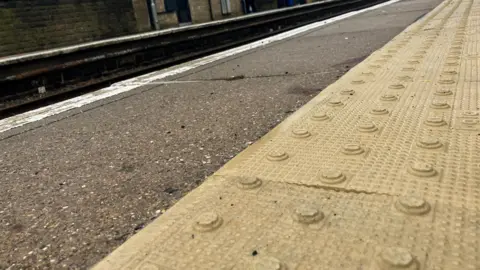
Chloe Tear, who has mild cerebral palsy, started losing her sight at the age of 18, and realised the importance of "tactile paving" on railway platforms.
The recognisable textured strips mean that a partially sighted person can use feel to work out where the platform edge is, both increasing safety while they wait and providing wayfinding guidance as to where a train will be.
Yet not every station has tactile paving, and it is only now being installed at Tear's local station, Menston on the Leeds and Bradford to Ilkley line.
"When I was using my long cane, tactile paving very much symbolised safety. It means I know where I can stand and still be safe, and it wasn't there.
"You very much take a gamble on every journey you take, and actually, that's scary.
"I completely understand that it's one of the smaller stations, but I think that's why it's even more important that they get it right."
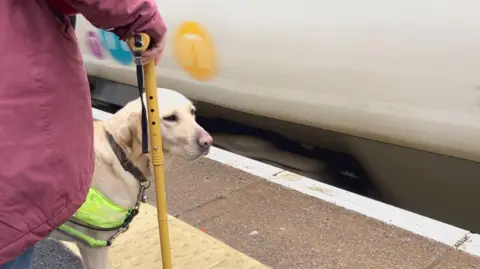
Tear is now 27 and has a guide dog, Dezzie, to support her with her journeys.
After years of her campaigning, the tactile paving is finally being added.
"It's really nice to see that it's going to become a much safer space, no matter what your disability is, but it's a shame that it's taken so long."
 Kit Taylor/BBC
Emma Vogelmann, co-CEO for disability charity Transport for All, said that the biggest issue for disabled passengers was consistency, adding that "disabled people don't know what to expect when they're travelling."
She said that smaller, unstaffed stations which have lost ticket offices had become less welcoming to those unable to use machines with "inaccessible" screens.
"We've heard from blind and partially sighted people who now have to buy their ticket on a machine.
"They've just had to give their payment card to a stranger and ask them to help, and hope that the person isn't going to run off".
The RNIB said that 42% of those surveyed preferred to buy tickets from a machine, compared to 21% through a smartphone app.
Transport for All has been asked to take part in the consultation process around the setting up of Great British Railways, a new body which will bring infrastructure and passenger services under one umbrella.
Vogelmann said: "The biggest issue that's been found is that quite often disabled people's rights on transport aren't enforceable.
"What we're advocating for is as much provision for accessibility to be built into legislation, so that we can hold enforcers to account."
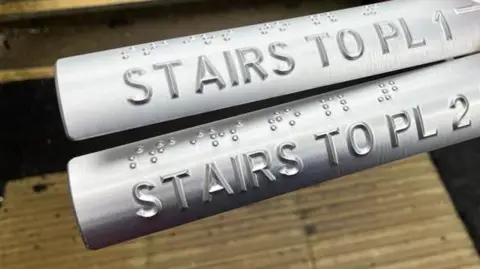
The government's Access for All scheme funds new accessibility features at smaller stations such as Menston, which will also benefit from two new lifts, a footbridge, and tactile wayfinding braille and raised text.
 Kit Taylor/BBC
Menston is managed by train operator Northern, whose accessibility and integrated travel manager Matthew Wilson said: "A large part of the UK rail network is still not step-free and has challenges with accessibility.
"The fantastic news is the government are still working on the Access for All scheme.
"We would love customers to tell us what the challenges are at their local stations and potentially make cases for future schemes."
In response to the RNIB research around passenger assistance and station accessibility, a Rail Delivery Group spokesperson said: "Improving accessibility across the rail network is essential to making sure passengers can travel independently, confidently and safely.
"We know sometimes we don't get it right, but the whole rail industry is working hard to improve how we support passengers with accessibility needs."
Listen to highlights from West Yorkshire on BBC Sounds, catch up with the latest episode of Look North.
