'People are suffering' - how do you solve a problem like Betsi?

 BBC
BBCPeople are "suffering" and "losing trust" in the NHS in north Wales due to serious and long standing concerns about the standard of services.
That's the warning from Prof Medwin Hughes, chairman of Llais - the body responsible for representing patient voices - who said the current model of healthcare in the region "doesn't work".
Ahead of the Senedd election, he insists the views of citizens and patients must be central to any plans for NHS reform whether in north Wales or more widely.
Betsi Cadwaladr health board said it knew "too many patients are still waiting longer than we'd like" but said it was "working hard to improve this across all of our services."
The health board is Wales' largest, but has been beset by serious problems since it was established in 2009, spending most of its existence in special measures - the highest level of Welsh government oversight.
There have been calls for the organisation to be split up, but opponents warn this could be expensive and time consuming.
BBC Politics Wales has been asking how the parties fighting for your vote in May aim to "solve a problem like Betsi?"
"There are clearly significant concerns that have been expressed by people of north Wales... over a very long time," said Prof Hughes.
"The question is how long will we wait before we consider what is appropriate and meaningful [in terms of] systemic change?"
He said people were "suffering" and "losing trust and confidence in a system that should be there to support them in a time of need".
Given the scale of the challenge, ahead of the Senedd election, Prof Hughes is calling on political parties to think seriously about solutions as "the current model doesn't work".
Established in 2009, Betsi serves a population of about 700,000 across six counties, has an annual budget of more that £2.3bn and employs more than 21,000 staff.
It has spent most of its existence - from 2015 to 2020 and again from 2023 onwards - in special measures, but remains the worst performing health board in Wales on many key performance measures.
- Of the 5,208 cases in Wales in January where somebody had waited two years or longer for planned treatments, more than 3,500 (68%) were based in north Wales
- The three major A&Es across the region are, by some margin, the worst performing in the country, with 3,473 patients spending longer than 12 hours in those departments in February
- It is the worst in Wales for cancer waiting times, with 50.8% of cases starting treatment within 62 days - well below the 75% target
These problems, along with others, meant the Welsh government concluded that the health board had some way to go before any easing of special measures could be considered.
'A monster - too big to control'
While on a 14-18 month waiting list for a heart procedure, Stuart Davies from Llangollen, Denbighshire, suddenly became unwell and was told by his doctor to go to A&E at Wrexham Maelor Hospital.
There, the 78-year-old said he waited for 12 hours.
"We're supposed to be one of the top countries in the world but it was horrible just being sat there waiting, and you're scared."
As a former councillor, Davies believes many of the failings relate to the size of the north Wales health board compared to six others in Wales and solving issues with Betsi will "never work".
"It's too big – it's a monster. I talk about a north-south divide and I'm convinced we get a second-class service."
 Stuart Davies
Linda Joyce-Jones, 62, of Bodedern on Anglesey, received a knee replacement in May 2025, after waiting for four years.
"The pain was pretty bad... and I did begin to wonder if I was ever going to get it done," she said.
She described the staff doing her operation as "absolutely exceptional".
"I feel sorry for staff who work at a health board that is totally belittled and totally criticised," she said.
Joyce-Jones said she became upset when listening to a recent Senedd debate about NHS performance in north Wales.
"I felt politicians of all parties were trying to score party political points and really didn't understand the challenges that the staff on the ground have," she said.
"And I think if that was their wife or their husband or their daughter or their son trying to so their very best for people they would perhaps have a different take on the situation."
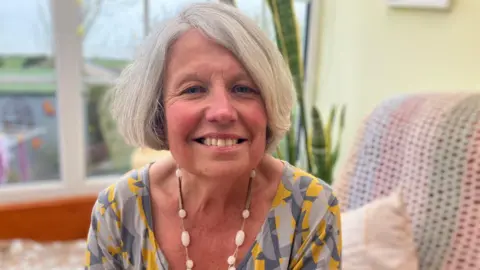
Husband and wife Jon and Bridget Osbourne farm sheep and cattle in the hills above Conwy, but both spent long careers in the NHS in north Wales.
They now run a campaign highlighting what they consider to be health board failures, while also calling for greater healthcare investment.
"We are now in a situation where 500 patients a year are dying unnecessarily in north Wales due to delays in their care.
"When you compare that with road traffic fatalities which amount to around 20 in north Wales you can see the scale of the problem," said Jon, who believes special measures have led to little improvement.
"It's patently failed... They failed to manage the situation because management is totally divorced from what's happening on the front line."
Bridget believes the problems can be traced back to the establishment of the health board, which merged six local health boards and three NHS trusts, which she said was not cohesive.
"There are three different areas – there's the rural west, there's the deprived middle, and [the east] towards Wrexham has more cross-border issues with England.
"That makes it very difficult to manage it from one spot."
Having management that is not hospital-based means "they don't see day-to-day what's happening".
Politicians, including successive first ministers, have long considered splitting up the health board and in 2023 a Senedd committee discussed a petition whereby more than 1,000 signatories called for it to be broken up.
But opponents argued restructuring could be costly, time consuming and might not lead to better outcomes.
Betsi Cadwaladr health board said it knew "too many patients are still waiting longer than we'd like", but said it was "working hard to improve this across all of our services".
It said it has introduced "key actions" which have seen two year-plus waits reduced half in a year, in part achieved by "insourcing and outsourcing" capacity from the private sector.
It has also established a new group to focus on improving patient flow to ease pressure on emergency departments.
What do the political parties propose?
Reform UK said the NHS in north Wales in particular "is dire and is in need of fundamental reform" including cutting waste, duplication and middle management "to unlock more funding for frontline services".
Plaid Cymru said problems were baked in at the start with "poor communication and poor alignment of information between each part - east, central and west" but wants to keep the health board as one "to see things improve".
The Welsh Conservatives said they would "cut waiting lists, end corridor care... [and] increase investment in primary care".
Welsh Labour said it was "determined to improve access to timely and quality care for people across north Wales" and would invest in new hospital buildings.
The Wales Green Party said "changing health board boundaries would divert attention from tackling the care crisis in north Wales".
This view was echoed by the Welsh Liberal Democrats who said "another restructure will not fix the crisis in our NHS".
