Moving picture: Tale of house rebuilt brick by brick set for the cinema

 Martin Giles/BBC
Moving house is said to be one of the most stressful things you can do.
But one woman took it to extraordinary lengths when she dismantled her home and began to rebuild it 100 miles (160km) away.
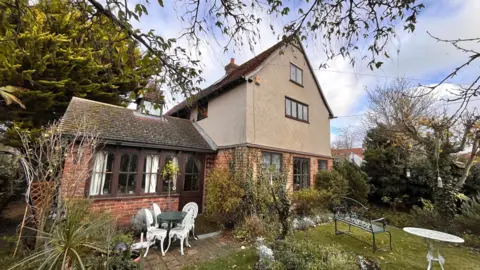
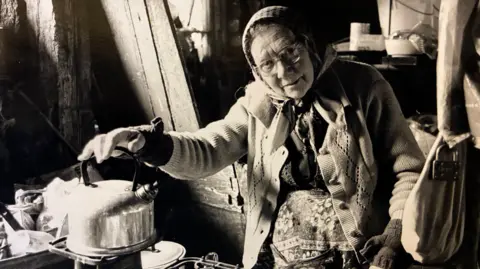
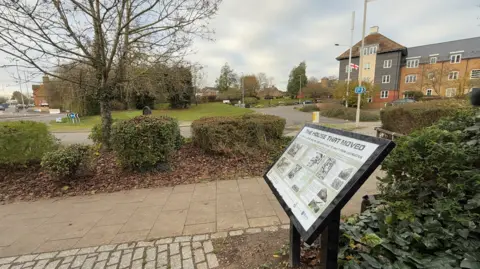
May Savidge was in her late 50s in 1969 when she moved her 15th-Century house brick-by-brick and beam-by-beam from Ware in Hertfordshire to Wells-next-the-Sea in Norfolk.
Her amazing story was told by the BBC's Nationwide programme in 1975, when she was 64.
Fifty years on, a film company has bought the rights to turn it into a movie.
This is the tale of an incredible woman who refused to surrender her beloved home to a planned roundabout, and her equally remarkable niece, who ensured the job was finished.
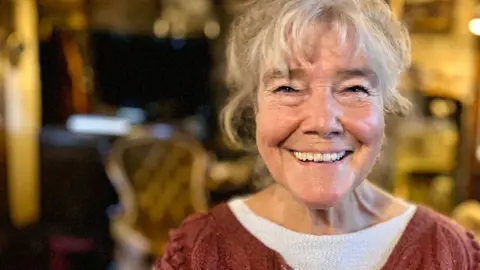
Sitting at a 14-seater former hospital boardroom table in the house, Christine Adams, 81, describes her aunt as "an amazing lady for those times".
Born in London, May had a tough childhood. A "pivotal moment" for her, says Christine, was losing both parents at a young age.
May went to night school and became an engineer, working on the de Havilland Mosquito aircraft introduced during World War Two.
During this time, she was living on a converted boat on the River Thames, perhaps an early sign of her love for homes that could move?
 Martin Giles/BBC
Christine describes May as "precise" and "closed" and says she never gave out hugs.
In the 1975 broadcast, May said she wanted to save the property because it was earmarked for demolition to make way for a new road.
Christine says her family thought she had "lost her marbles" but May just saw the house as "a kit of parts".
Her aunt's matter-of-fact worldview can be seen in letters she wrote to the RAF and the US Air Force, asking for their help.
"'I wondered if you had a helicopter that could lift the frame. I bought this little plot of land right by the village green'," Christine quotes.
"She describes the route: down the River Lee and into the Thames and up the East coast."
Both wrote back, politely declining, so instead May hired seven lorries.
 Submitted
May did live in the house, sleeping in a chair until she died in 1993, despite it being in a terrible state, according to her niece.
"It was completely unfinished: flapping polythene in the windows; no upstairs walls at all," Christine says.
"It's certainly more than a house to her. It was her baby. She never married; she never had a family."
May left the house to her niece's children, but Christine knew it was down to her to finish the work.
At the time, Christine was separating from her husband of 40 years and says she channelled her anger into the renovation.
"I plastered like the Dickens," she says.
She also tackled the garden that, in May's final years, had been neglected and had grown as high as the first floor of the house.
"My anger finished the house, really," says Christine, who loves living in the house now it is complete.
"I turned into Auntie May," she jokes.
 Steve Hubbard/BBC
Christine has written a book about the story, and a film company has now bought the rights to it.
She thinks May would have "loved" the idea of her story being shown in cinemas.
But she is not certain she would have loved how Christine finished the house.
"She would be saying, 'Is that leadwork actually leadwork, or have you stuck the lead on?'
"You can almost hear her tutting."
Follow East of England news on X, Instagram and Facebook: BBC Beds, Herts & Bucks, BBC Cambridgeshire, BBC Essex, BBC Norfolk, BBC Northamptonshire or BBC Suffolk.
