STV could face further strikes as unions to ballot over pay freeze

 SNS
SNSScottish broadcaster STV is facing the threat of widespread industrial action over a planned pay freeze.
Both the National Union of Journalists (NUJ) and broadcasting union Bectu are to ballot their members on whether to strike.
The row comes amid a separate dispute over changes to news programmes which led to a journalists' strike in January.
STV said it had to ensure the business remained sustainable but understood a pay freeze could be challenging for staff.
Chief executive Rufus Radcliffe said: "In the current market conditions, we have had to take a range of measures to reduce our cost base, including a temporary salary freeze.
"We know this is challenging for colleagues, but we must ensure the business is financially sustainable in the long term.
"We remain committed to open and transparent communication with our colleagues."
STV has been hit by falling advertising and a drop in the number of commissions to make programmes for others.
The company is proposing a pay freeze this year for all its staff but will offer them additional holidays instead.
The unions argue a pay freeze means a drop of around 3% in the value of wages.
The NUJ's Scottish organiser Nick McGowan-Lowe said: "It's regrettable that in the middle of a dispute over STV's planned cuts that the joint unions are now having to ballot over pay as well.
"STV claim that they cannot afford pay rises, but the truth is that they have chosen to spend that money instead on a new radio station, while staff at STV News are expected to do more with less staff while taking an effective pay cut."
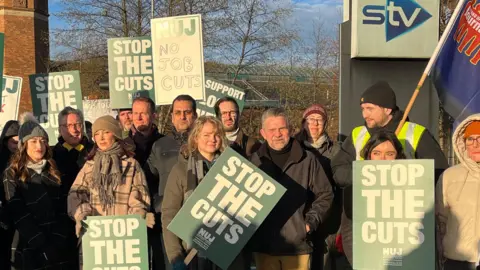
If members vote to strike, action could take place before the end of March.
An NUJ strike is likely to mean that Scottish news programmes will not be broadcast.
Bectu members work in a wide range of creative and technical jobs across the company.
If both unions secure mandates for strike action, they may discuss whether taking action together or on separate days would maximise the impact.
The NUJ already has a mandate to strike over compulsory redundancies at the company.
These are linked to planned changes to news programmes which include the end of an entirely separate service for the north of Scotland.
Some 30 jobs are affected but it is understood only a handful of staff are still facing the possibility of compulsory redundancy. Most of those affected have been redeployed or agreed to voluntary severance.
Regulator Ofcom is still to reach its final decision on whether to allow the on-air changes.
Change in strike rules
The ballot coincides with changes to the rules on strike ballots taking effect on Wednesday.
The rules - introduced by the UK government - reverse some of the changes to union law made by the Conservatives.
Unions will only need to give 10 days' notice of a strike rather than 14 days. Mandates will be valid for a year rather than six months.
From August, a 50% turnout will not be required in strike ballots.
But an additional threshold which unions need to cross before they can call a strike in many public services - such as education and the NHS - goes from Wednesday.
This meant at least 40% of all those merely eligible to vote had to back striking.
