What is happening with Flamingo Land at Loch Lomond?

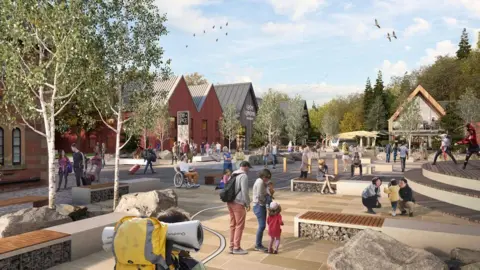 Lomond Bank
A proposed resort on the shores of Loch Lomond featuring a waterpark and monorail has been rejected by the Scottish government, following years of debate and protests.
The project was initially rejected in 2024 by Loch Lomond and the Trossachs National Park authority, who said it did not comply with environmental and nature conservation policies.
Theme park operator Flamingo Land successfully appealed the decision to the Scottish government's planning reporter, but minister for public finance Ivan McKee decided to recall the plans - meaning the final decision fell to the government.
It decided the £40m Lomond Banks resort could cause "flood risk, woodland loss and wider policy conflicts".
The proposal included a monorail, waterpark, hotel and restaurants.
What is Flamingo Land?
 Lomond Bank
Flamingo Land is a theme park and zoo in Yorkshire that has operated since the 1950s.
The name comes from a colony of the brightly coloured birds that were among the first animals on the site at Kirby Misperton.
In 2018 the company behind the park - Flamingo Land Limited - submitted proposals for a tourist development at Loch Lomond, including a hotel, craft brewery and leisure centre.
The plan was met with strong opposition, with an online petition against it gathering more than 55,000 signatures.
In September 2019 the company withdrew its original plans, but returned in 2020 with an updated £40m ($50m) proposal featuring a water park, monorail, swimming pool, hotel and restaurants.
Throughout the process Flamingo Land has insisted that the development would not be a theme park, and planning papers state that it would be a "a major step away" from their other resorts.
More than 174,000 people signed the petition against the new proposal.
Why do some people oppose Flamingo Land?

The original plans were dubbed "the most unpopular planning application in Scottish history" by Ross Greer, the Scottish Greens MSP, and the revised proposal proved just as controversial.
Concern focused on whether the development would distort public green space in one of Scotland's most scenic areas.
In April 2024, Lynne Somerville, the chairwoman of Balloch and Haldane Community Council, told BBC Radio's Good Morning Scotland programme that the plans would "dominate the whole west side of Balloch" and be a "living hell" for people living locally.
However, it is not just locals who are concerned, as evidenced by the number of letters sent to the council protesting against it.
Others have raised fears that the vista of Loch Lomond would be affected - damaging both a stunning view and a tourist hotspot.
Additional traffic in the area is another concern.
Flamingo Land estimated an additional 253 cars would be on the road during rush hour times, from 17:30 until 18:30.
What has changed from the original proposal?
The original proposals were unanimously objected to by West Dunbartonshire Council, but it did not oppose the proposal the second time around.
Tthe park authority is responsible for planning - not the council - but the local authority's change of heart was still greeted furiously by protesters.
Flamingo Land has also said the new proposal would feature visitor accommodation and walkways sympathetic to the local environment, and that public access would be maintained throughout the site.
The Scottish Environment Protection Agency requested that lodges were removed from part of the site designated as a flood plain and questioned whether proposals to mitigate the risk of floods were "technically feasible."
Flamingo Land stated in its plans that part of the site was exempt from the flood plain concern due to it having been in previous use as a railway line until the 1980s.
What benefits could Flamingo Land bring?
 Getty Images
Flamingo Land and Lomond Banks believe there would be considerable benefits for the local community, starting with creating around 200 jobs.
They have stated that they would use local businesses throughout the construction of the development, estimated to raise £3m for the local economy.
The company has made their promises to the area legally binding in a unilateral voluntary undertaking called "the Lomond Promise."
Improvements to transport in the Loch Lomond area would also be planned, upgrading the congested Stoneymollan roundabout.
The planning papers lodged with the park authority state that the Ballochloan roundabout should be reprofiled as well, and that the overall development would become a "focal point" for Balloch.
The same papers praise the possible monorail in particular.
Who made the final decision?
The Loch Lomond and The Trossachs National Park Authority board decided to reject the proposals in September 2024.
It cited the concerns over flood risks and the impact on the surrounding environment.
The developers said they were disappointed by the decision, but remained committed to the project and would appeal it.
The Scottish government planning reporter has since signalled his intention to give planning permission for the development, overturning the decision of the national park authority.
He said the project did not conflict with the local development plan for the area, or the rules set out in the government's national planning framework.
The site could operate safely despite being within a flood risk area, he said, and there could be "locally significant" benefits in terms of jobs and a boost to the economy.
However the Scottish government then stalled the plans in 2025 after deciding "the development raises issues of national significance in view of its potential impact on Loch Lomond and the Trossachs National Park".
This meant ministers would have the final say.
What did the decision on Lomond Banks say?
The verdict was announced in February 2026.
A Scottish Government spokesperson said: "Scottish ministers have dismissed the appeal and refused planning permission in principle for the Lomond Banks development due to flood risk, woodland loss and wider policy conflicts."
This went against the recommendation of the government's own adviser, who said it should be approved.
However ministers said that although they accepted his findings, they had reached a different conclusion regarding the possible risks in the development, particularly regarding flooding and the loss of historic woodland in the area.
Greer called the decision called the decision "a huge victory for the local community" and said Flamingo Land should walk away.
Heather Reid, convener of Loch Lomond and The Trossachs National Park Authority, said the decision "vindicated" its board's move to reject the proposals.
The company behind the proposals said the rejection "flew in the face" of its plans for "regeneration and long-term economic benefits to one of Scotland's most disadvantaged communities".
Jim Paterson, the development director of Lomond Banks, said the team behind the plan would now "carefully review the decision in full" and consider future options.
