Plastic beach waste 'nightmare' as seal rescues soar

 CLAIR MURGATROYD/BDMLR
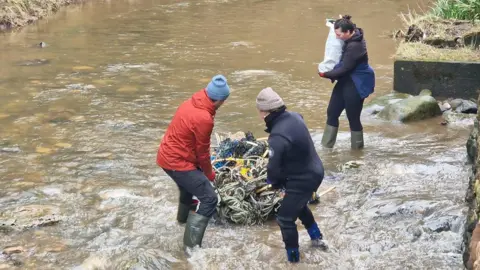
Diving volunteers rescued 41 marine mammals who had become trapped and injured by discarded plastic objects along Yorkshire's coast in 2025.
"Unfortunately, if they are entangled, there's a very high risk the animal will not survive," said Chris Cook, an area co-ordinator for British Divers Marine Life Rescue.
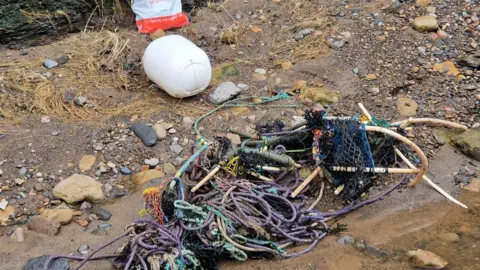
"There's everything from plastic, to rope, to flying rings, that holidaymakers bring to the coast. For our marine life they're an absolute nightmare."
"If you take it to the beach, make sure it goes home with you," he urged. "If you see something on the beach, pick it up and put it in the bin. It's just taking that bit of responsibility."
 CLAIR MURGATROYD/BDMLR
Cook said there had been "a huge increase" in call-outs, highlighting a quadrupling in the number of rescues over six years, from nine incidents in 2019 to the 41 in 2025.
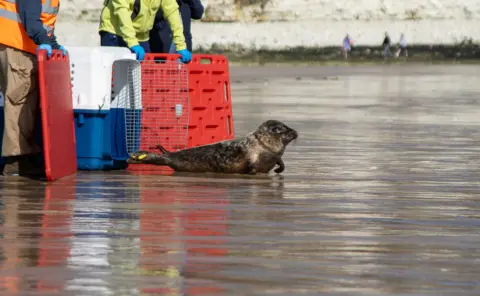
Last year, most calls to the volunteer-run organisation involved coming to the aid of trapped, and injured, seals.
"The reality is, if an animal is entangled it will severely affect its ability to move or feed," said Cook.
"The types of material we see - flying rings, for example - are hard plastic. Seals will have a look, get their head stuck - then, if they keep feeding, the object will dig into the animal itself.
"If you are taking a frisbee - take a solid ring, rather than the holed ring. The fact it's solid means it's much safer in that coastal environment than one of the open rings."
'Simple solutions'
Cook stressed the importance of "simple solutions", such as checking you have gathered all your belongings before leaving the beach - and putting any rubbish in the bin.
"The beach is there for us all to enjoy - so let's try to keep it clean and tidy.
"That makes it a nicer environment for us to visit, but a far safer environment for the animals too."
 BDMLR
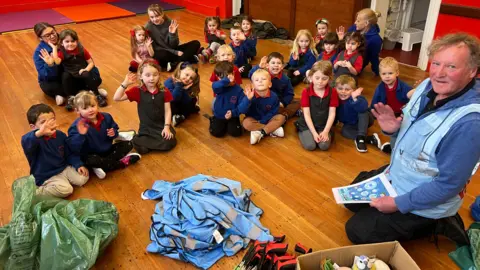
BDMLRThe British Divers Marine Life Rescue volunteers are being backed by the next generation - with Keep Scarborough Tidy founder Mick Couzens leading litter-picking sessions at schools along the coast.
"It's about starting early," said Couzens, who retired and moved to Scarborough in 2019.
"It's such a beautiful place, but it was so frustrating to see so much litter and fly-tipped rubbish," he said, when he founded Keep Scarborough Tidy two years later, in 2021.
Since then, Couzens has organised, and led, hundreds of community litter-picks.
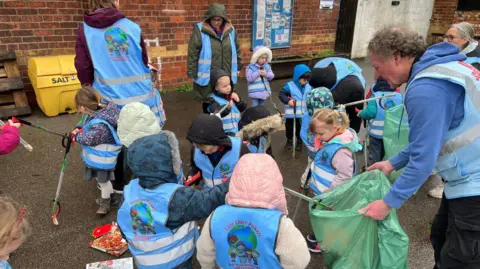
Those held in schools are some of the most important, he adds, citing a recent visit to Seamer Pre-School.
"The children at Seamer were so enthusiastic - they were an absolute joy. As a volunteer, it was one of the best days I have ever had."
 BBC/RICHARD EDWARDS
"It's so important to talk to people when they're young," said Couzens.
"At a session at a primary school, a four-year-old said to me: 'My daddy drops cigarette butts in the street - I'm going to go home and have a word with my daddy.'"
The session at Seamer saw Couzens use props - including soft toys which mimic the bird's call when squeezed.
He said using props, as well as stories about wildlife which illustrate how animals can be harmed by litter, "really help" engage younger children.
"Rubbish affects lifestyles and animals - it's very sad. It injures animals," he said. "The children really understand that and they want to help."
 BBC/RICHARD EDWARDS
"We only have one world," said Ginny Wilkinson, who manages the pre-school.
"The children need to understand from a very young age - and they do - that keeping the place tidy, looking after the animals and birds, and learning how to grow food are all life skills.
"They learn those skills, the skills become embedded, and the children grow up hopefully doing all the things we taught them when they were three or four.
"They'll teach their parents, if the parents have forgotten - and then eventually go on to teach their own children."
Listen to highlights from North Yorkshire on BBC Sounds, catch up with the latest episode of Look North.
