Remains found by island farmer are two people from Bronze Age

 PA Media
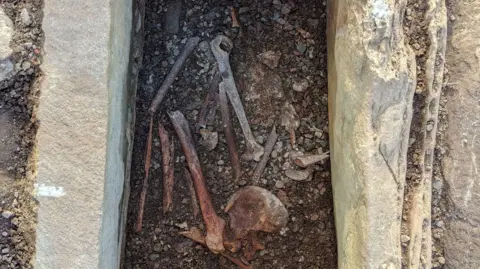
Remains discovered by a farmer in a long-forgotten burial chamber on the Isle of Bute have now been identified as two people from the Bronze Age.
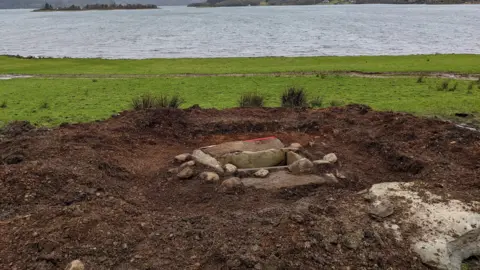
The chamber - or cist - was first discovered before 1863 when a human skull was removed and sent to the Society of Antiquaries of London, but the site was then abandoned.
It lay undisturbed until a farmer came across it three years ago, leading to an excavation by AOC Archaeology Group.
Analysis has now found that a man and a young female had been buried in the cist - which dates back around 4,000 years - although not at the same time.
Dr Jess Thompson, Scotland's first curator of osteoarchaeology with National Museums Scotland (NMS), found the person buried uppermost in the cist was an adult male aged between 35-50 when he died.
He was about 5ft 6ins tall and in good health.
The person buried at the lower level, whose skull is also missing, was female and either an adolescent or a very young adult.
The finds were declared through the Treasure Trove Unit and allocated to NMS in September this year.
They are now among thousands of items being cared for in a new facility which has been created at the National Museums Collection Centre in Granton, Edinburgh.
The facility, which became operational in autumn 2025, was created as part of the Scotland's Archaeological Human Remains Collections (SAHRC) project.
 PA Media
Dr Matthew Knight, senior curator of prehistory (Bronze Age Collections) at NMS and lead investigator on the SAHRC project, said: "The cist was found at a site called Rhubodach on the Isle of Bute, and it's a cist that had been forgotten about.
"It had actually previously been excavated in the 1800s when a skull was recovered and sent to London.
"At the time, other remains were noted still in the ground but they were left.
"The skull, unfortunately, has now been lost, but rediscovery and re-excavation of these remains is allowing us to reinterpret and retell the story of this individual.
"Analysis of the remains found that there wasn't just one individual in the grave, but actually two, and these two were buried with additional pottery and other grave goods."
In the 19th century it was common practice for only the skull to be recovered. It is not known where it is now.
It is not known whether the two people were related or how many years passed between the burials.
Human remains from around 2,500 individuals from about 600 archaeological sites from across Scotland are stored at the new Granton site, dating from the Mesolithic period through to the 18th or 19th century.
