Health, education, tax and more - Has the SNP delivered on its promises at Holyrood?

 Getty Images
Holyrood has broken up for May's election, and parties will spend the next six weeks debating their policies for the future of Scotland.
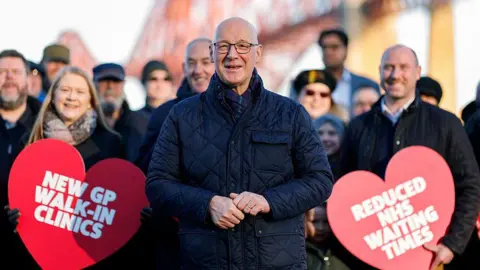
The SNP's record in government will be a major point of contention too, with John Swinney proud to defend it against the attacks of opposition leaders.
But how much has been achieved in the term of parliament which has just come to an end?
A useful yardstick of this is the SNP's own election manifesto from 2021.
Judging them on their own pledges, which have been delivered, which have been delayed, and which ones were dropped?
A lot has changed since Scotland went to the polls in 2021.
The SNP has been through three leaders, with John Swinney replacing Humza Yousaf who in turn replaced Nicola Sturgeon.
A pact with the Greens was established and then torn up, so there have inevitably been some changes in the government's agenda.
But some things persist regardless of leadership - like its commitment to the NHS.
In 2021, the party pledged to increase frontline health spending by 20%, or at least £2.5bn.
That target has been easily exceeded, with funding going up by 28%, an increase of just under £5bn.
A promise to increase NHS staff pay by an average of 4% has also been ticked off, with inflation driving public sector pay deals much higher than was anticipated in 2021.
However not everything has gone to plan in health and social care.
One of the biggest pledges of the SNP's campaign was the creation of a National Care Service, envisioned as a game-changing network of care boards across the country, a mirror for the NHS which would remove any "postcode lottery" from care.
Those plans suffered a slow-motion collapse through the parliamentary term, with a lack of detail and costings in the proposals alienating opposition MSPs and the groups which deliver care on the ground, from councils to unions.
The manifesto also pledged to freeze income tax rates and bands - but neither of those things happened.
The higher and top rates were both increased by a penny in 2023, and an additional "advanced rate" was inserted in between them in 2024 - along with another 1p increase in the top rate.
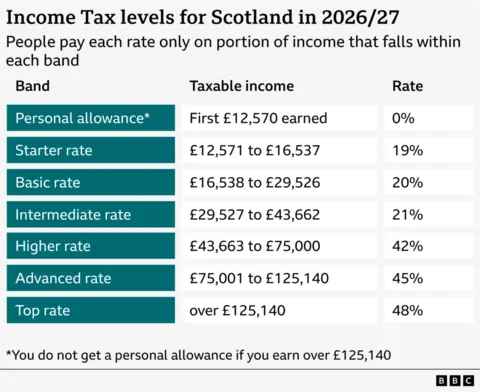
These changes came in the wake of the Russian invasion of Ukraine in 2022, and a cost of living crisis which left the government looking for extra funding to support services.
John Swinney has insisted that the pledge was not really broken, because of a caveat in the manifesto which noted that governments need "flexibility to respond to a change in circumstances".
That same crisis in energy prices was cited when another pledge was dropped - to decarbonise the heating of one million homes by 2030, which is "no longer considered achievable".
Another key devolved portfolio which attracts a lot of policy proposals is education.
In 2021, the SNP pledged to recruit 3,500 additional teachers and classroom assistants.
The trouble was that councils ultimately employ teachers, which left Education Secretary Jenny Gilruth having to threaten to cut their funding if they did not help to deliver on the pledge.
In the end, with headcount actually falling slightly, the government pivoted to set a new target of restoring teacher numbers to 2023 levels.
It's worth reflecting that the number of pupils in Scotland's schools is also projected to fall, and the country still has the smallest class sizes anywhere in the UK.
One thing which underlines the power of the manifesto pledge is that an extra line in this section promised to "allow teachers more time out of the classroom to prepare lessons and improve their skills".
The EIS teaching union was days away from strike action earlier this month over that commitment, with teachers viewing it as a promise which had not been kept.
A deal was struck to honour the pledge by cutting class contact time less than a week before industrial action was due to begin.
This will actually necessitate hiring more teachers, and the government put aside £40m for recruitment next year.
The SNP also promised to invest £1bn to close the "attainment gap" in schools - the difference in performance between pupils from more affluent and more deprived backgrounds.
Each year's budget paper has indeed pledged an extra £200m to the Attainment Scotland Fund, which is distributed to councils and individual schools based on their needs.
However the gap itself has stubbornly persisted.
Nicola Sturgeon famously made eradicating the attainment gap her "top priority" back in 2016.
But earlier this year figures showed it was still wider than it was before the Covid pandemic.
John Swinney's top priority meanwhile has been to eradicate child poverty, and he inherited a number of policies aimed at doing that.
Most notable among them is the Scottish Child Payment, a targeted benefit for families which has become one of the SNP's flagship policies.
The 2021 manifesto suggested doubling the child payment to £20 a week - and after a series of increases it's now set to hit £28.20.
However some other key policies have been scaled back or delayed.
A pledge to provide free school breakfasts and meals to every primary school pupil in Scotland is now limited to P1-P5 - with a targeted offering for older pupils based on need.
Some funding was pledged in this year's budget towards the promised year-round system of "wraparound childcare" before and after school - but the national offering of breakfast clubs is not due for delivery until August 2027.
 Getty Images
Some other pledges throw forward to the future, and are as such difficult to evaluate right now.
An example would be the promise to deliver 100,000 affordable homes by 2032.
Within months of winning the election, the SNP actually increased the target to 110,000.
The most recent figures - running up to September 2025 - showed 31,064 homes had been completed towards the target, including those for social rent, affordable rent and outright ownership.
Covid aside, completions have been higher in recent years, but they still need to accelerate somewhat if the target is to be met.
Given planning a housing development is generally a multi-year project, there was a positive reception from the housing industry for a four-year programme of funding totalling £4.9bn for affordable homes.
Meanwhile Scotrail has been brought into public ownership, as promised, and peak rail fares have been abolished.
However a related pledge to decarbonise rail services by 2035 has been pushed back by a decade, to 2045.
This is fairly typical of the manifesto as a whole. Some of its policies have been delivered, while others have been delayed - and a few have been ditched entirely.
How voters judge this record is going to be key in whether they give the SNP a fifth term in office.
And that may determine whether John Swinney can deliver another 2021 pledge which is sure to carry over into this year's manifesto - to hold a referendum on Scottish independence.
