Mental health charity says £205k grant is 'pivotal'

 Mousumi Bakshi/BBC
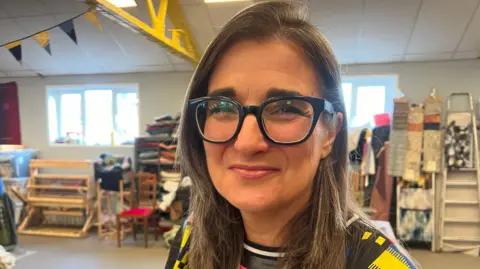
A charity which has been awarded £205,000 by the National Lottery says the funding represents a "really pivotal point" for them.
Sew Positive, a Cambridge-based charity, supports people experiencing social isolation, inequality and mental wellbeing through crafts.
It was given the three-year grant through the lottery body's Reaching Communities scheme.
It said it would use the grant to take on a permanent base at Gwydir Street, off Mill Road, the same venue where 90% of its services are delivered.
Founder Melissa Santiago-Val said: "As a small charity running for just five years this is a massive change and a really pivotal point for us."
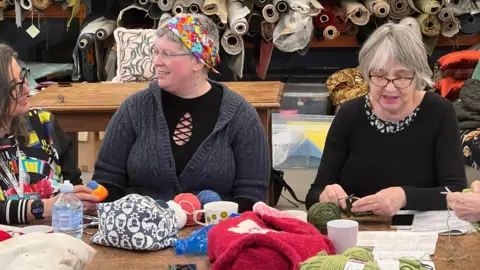
The charity said the funding would be divided between three of its programmes - Men's Hems, the Sewcialise Good Mood Cafe, and K2Tog Peer Support - and would allow them to continue their work in "creative, participant-led spaces".
 Mousumi Bakshi/BBC
Santiago-Val and a friend started the charity after they discovered the value of sewing and creativity to improve mental health and wellbeing.
She described Cambridge as "one of the most unequal cities in the UK".
"We get to see a lot of trauma, deprivation, and people who are really struggling, and often they have really complex issues," she said.
She said people who attended their services had been "finding it harder to access" other resources.
"Social isolation is such a difficult thing to overcome, and if you can get people to come to an activity regularly that can really change that," she said.
"Having that extra assistance from a charity, that can really help build confidence slowly and is really important."
 Mousumi Bakshi/BBC
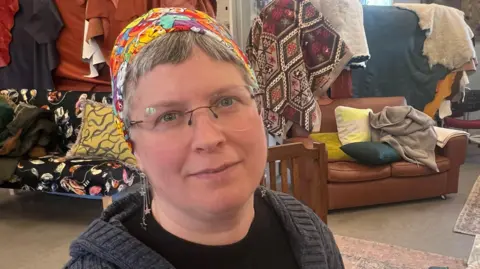
Julie Smith said she made the decision to stop working for personal reasons and started to knit to give herself a project to work on but started to feel lonely.
"When you are at home, self-esteem drops and you feel absolutely worthless," she said.
"I went online and looked for knitting groups combined with mental health and thought 'do these exist?' and they do."
She said the group made her feel "so welcomed and accepted".
"I found myself being able to be more creative than I would be knitting by myself," she said.
"I have found it so helpful and now it has become invaluable to me."
 Mousumi Bakshi/BBC
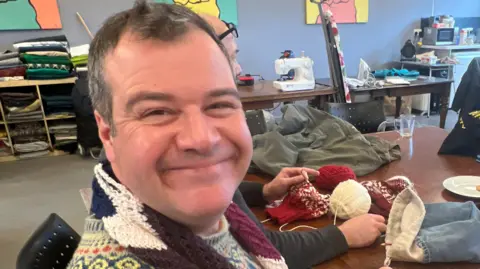
Adam Cleevely joined the charity's Men's Hems, and later created the knitting group.
He described himself as the "knitting teacher and influencer".
"I love being able to empower someone to create something with their hands and in an environment where they get to openly talk about what is on their mind," he said.
"The wonderful thing about craft is when you do it sitting side by side with someone else you tend to have discussions a different way than when you are face to face with someone.
"It is a much [more] gentle way and is easier to speak up about things you are going through."
'Significant increase'
Pam Green, director of Neighbourhood Health & Partnerships for Cambridgeshire and Peterborough, Central East Integrated Care Board, said: "What we see with these sorts of charities is people feel comfortable to make that first step to find that support that is not traditional and [which] can have as big an impact as very formal services."
She said if people felt able to go to a community offer it could be the best route for them.
"There is something about not having institutionalised care for everybody in our system and enabling that self care," she said.
"We know there is a lot of stigma still around mental health and if people feel they can navigate to a community offer and be looked after in a space like that before their presentation gets very severe.... it can be the right intervention for the individual at the time."
Follow Cambridgeshire news on BBC Sounds, Facebook, Instagram and X.
