Ministers pay out £400k after losing Supreme Court gender case

 Getty Images
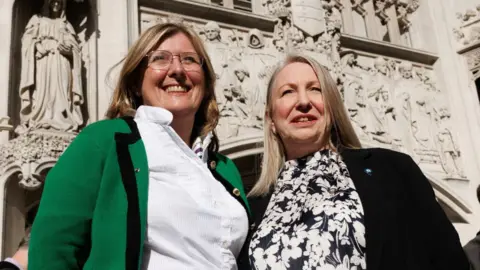
The Scottish government has paid almost £400,000 to a campaign group which defeated ministers in a Supreme Court legal case over the definition of a woman under equality law.
For Women Scotland (FWS) says it has been paid £242,500 to cover its legal expenses for the Supreme Court challenge, and £150,000 for an earlier Court of Session case.
Coupled with its own legal fees, the government has spent at least £766,498 on the court action.
It has been asked to comment.
In 2024, following years of legal wrangling, the Supreme Court ruled that a woman is defined by biological sex under equalities law.
The Scottish government had argued that transgender people with a gender recognition certificate are entitled to the same sex-based protections as biological women.
Ministers accepted the outcome of the ruling and updated guidance on single-sex spaces.
However, FWS is challenging the government's guidance for where transgender prisoners are housed, saying it is out of line with the Supreme Court ruling.
Ministers have argued that having a "blanket rule" for inmates could breach human rights law.
FWS has said funds received as a result of the "full and final settlement" will be used to cover the costs of the ongoing court case, as well as any future cases.
Conservative MSP Tess White MSP said: "SNP ministers have taken far too long to pay what is owed, but they should never have squandered taxpayers' cash in the first place on defending the indefensible."
What was the Supreme Court case about?
The legal dispute began in 2018, when the Scottish Parliament passed a bill designed to ensure gender balance on public sector boards.
FWS complained that ministers had included transgender people as part of the quotas in that law.
The issue was contested several times in the Scottish courts.
The Court of Session ruled in 2022 that the definition of sex was "not limited to biological or birth sex".
It was that ruling that FWS successfully challenged in the Supreme Court, with ministers paying the campaign group's legal fees.
The Scottish Parliament passed reforms that year that would have made it easier for someone to change their legally recognised sex.
The move was blocked by the UK government, and has since been shelved by Holyrood ministers.
