Yorkshire Water sewage spills down to 1,000 a week

 BBC
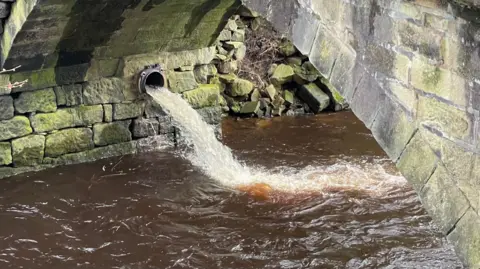
BBCYorkshire Water released untreated sewage into rivers and the sea for more than a quarter of a million hours in 2025, new figures reveal.
However, the 285,000 hours of discharge represented a fall of 33% on the previous year's total of 430,000.
Last year, which included the driest spring for 132 years leading to a hosepipe ban from July to December, saw the number of spills fall from from 88,164 to 51,404, according to the firm's records.
Yorkshire Water said the reduction was a result of big investments but clean river campaigners said the figures were still too high and partly a result of less rainfall.
Water companies are legally allowed to release untreated sewage into rivers and seas after heavy rain so that the pipe network doesn't become overwhelmed and back-up into people's homes.
Yorkshire Water said that by April 2030 it will have spent £1.5bn on improvements to 450 storm overflows.
Customers are paying more through higher bills to help fund the modernisation.
Water minister Emma Hardy said although it was good to see storm overflow spills were down, there was "still an unacceptable amount of sewage entering our waterways and a long way to go in cleaning up our rivers, lakes and seas".
The government had taken action, she said, which included banning "unfair" bonuses, ring-fencing investment and jail time for water company executives who obstruct investigations.
"We are ending the era of water company self-monitoring, introducing new MOT-style checks on water company assets and bringing in 'no notice' inspections to rebuild customer trust and protect the environment," she added.
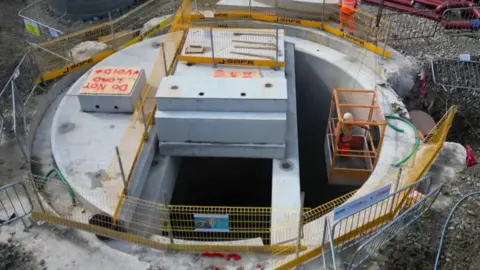
Hundreds of underground tanks are being built that can store up to 300,000 litres of waste water to prevent it entering water courses after heavy rainfall.
The government has set a target for each storm overflow, also known as a Combined Sewer Overflow (CSO), to operate on no more than 10 occasions annually.
Many in Yorkshire currently operate about 40 times a year.
Jon Stokes, from Yorkshire Water, said: "The tanks are sized so that we can make sure they don't spill more than 10 times a year, that will have a very minimal impact on water quality, there will be a mixture of run-off from roads and roofs, mixed with the foul sewage from people homes."
Yorkshire Water said that reducing the number of spills below 10 would involve billions of pounds additional funding and a complete re-plumbing of the sewer network.
Alan Lovell, chair of the Environment Agency, said publishing the data each year "ensures the public can see clearly what is happening across England's storm overflows".
"While these numbers are heavily influenced by rainfall levels in 2025, substantial reductions in spill duration and events are a clear win for people and the environment," he said.
"It is vital that improvements to the sewage system are sustained over the long term, and the Environment Agency will continue to hold water companies to account where performance falls short."
Despite the overall discharge fall, Environment Agency figures show that there was an increase in the number of hours of wastewater being discharged into the River Calder in 2025, compared with 2024. That goes against the national and regional average.
In 2025, 16,575 hours of dicharge was recorded - up 619 on the previous year.
Campaigners who want to see cleaner rivers said that they would like to see all waste water treated before it was released.
Adrian Sturdy, from the River Nidd Action Group in Knaresborough, said wet wipes were caught up in low-hanging trees above the river after a storm overflow pipe operated.
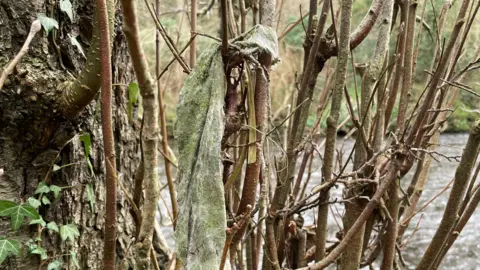
He said: "Baby wipes shouldn't be flushed down toilets, but they are evidence that there is sewage coming into our river and whenever there's a storm Yorkshire Water are releasing it into our rivers.
"It's terrible we come and clean up the wipes and then three months later we've got baby wipes six foot up a tree, the sewage shouldn't really go into the river at all."
Yorkshire Water said that, as part of the investment, all storm overflow sites would have screens installed to prevent wet wipes and other solids entering rivers.
Work carried out by Yorkshire Water in 2025 included the building of a £2.4m storage tank at Cudworth near Barnsley that has resulted in discharge from one the CSO falling from 41 incidents in 2021 to zero in 2025.
The firm also said that investment at Whitby Esplanade CSO resulted in a 75% reduction in discharges.
Listen to highlights from West Yorkshire on BBC Sounds, catch up with the latest episode of Look North.
