How Oxford Uni became one of first FA Cup winners
This weekend, 32 teams will be taking part in the FA Cup 4th round, all vying to make it one step closer to winning the world's oldest club competition at Wembley in June.
They will all be looking to emulate the iconic champions of old, whether that's Arsene Wenger's Arsenal, the Wimbledon Crazy Gang, Sir Stanley Matthews's Blackpool or maybe even the 1874 winners, Oxford University.
OK, not many people would say that last one but the University of Oxford was in fact one of the competition's first winners, and even helped write the rules of modern football.
Radio Oxford's Carla Buckingham has been exploring the university football team's 19th Century trailblazing, with her journey beginning with amateur historian Philip Martin.
The team had initially been called the Oxford Amalgamation Club because they were "amalgamating the rules from the different public schools" its members had attended, said Martin.
Football was still in its infancy in 1869, when the club joined the Football Association (FA), which had only been founded six years previously.
Alexander Jackson, from the National Football Museum in Manchester, said it had been around this time that football's original laws were drawn up by FA members.
"What they wanted to do, at this point, was create a universal game that could be understood by everyone, that everyone agreed about," he said.
Those laws established much of what we recognise as the game of football today - two halves lasting 90 minutes, the size of the pitch and 11 players on each side.
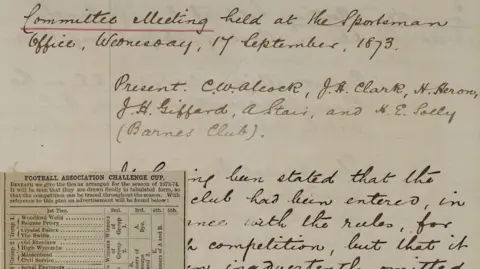
With the creation of the FA and its standardised rules came the creation of the FA Cup in 1871, a knockout competition for the early FA members.
By the 1873-74 season, 22 teams were taking part.

 National Football Museum
For the University of Oxford, their tournament began with a 4-0 win over Upton Park in October, before dispatching Barnes 2-0 in the second round.
The team then defeated Wanderers - the team they had lost to in the previous years final - in a replay, with a 1-0 win against Clapham Rovers sealing their place in the final.
That year's centrepiece was held in March 1874 at the Kennington Oval in front of two thousand people, where they faced the Royal Engineers.
"They [Royal Engineers] were the favourites because they were engineers, military men and they were a very strong team," Martin said.
The engineers only lost three matches between 1871 and 75, he said, and also spent two weeks training for the final "which was deemed really very unsportsmanlike".
"Oxford, of course, didn't bother training," Martin added.
 Public Domain
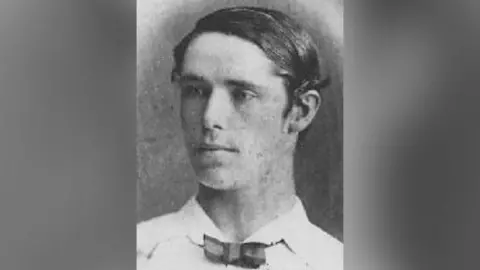
But Oxford had a not-so-secret weapon, their captain, 23-year-old Cuthbert Ottaway, who was the "first ever England international captain for the very first ever international in the world," Jackson said.
But it was another player, Charles Mackarness, who scored the first goal in the 1874 final for Oxford, before the team added another within the first 20 minutes of the match to seal a 2-0 win.
Although favourites, Jackson said the two early goals may have left the Engineers "shocked" so they "didn't recover" the deficit.
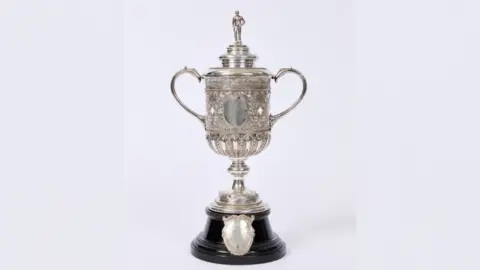
For the first and only time, Oxford University were winners of the FA Cup.
 Manchester City/National Football Museum
They would go on to appear in two more finals but after the last of those in 1880 the team abruptly left the competition, never to return.
Martin said that at a meeting of players in Oxford's King's Arms pub that year, it was decided the club would no longer play cup ties "basically because the students didn't want to pay the cost" of travelling.
"Over time it's got lost," Martin said of the team's triumph. "It's not been as well recognised knowledge as it should have been".
You can follow BBC Oxfordshire on Facebook, X (Twitter), or Instagram.
