AI helps discover rare woodpecker's call in Sussex

 Getty Images
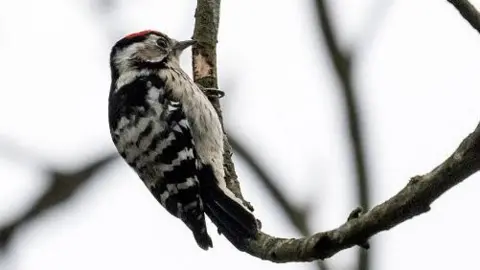
For the first time in more than three decades the lesser spotted woodpecker has been recorded in woodlands near East Grinstead.
The lesser spotted is the rarest of Britain's woodpeckers and it is thought only 600 breeding pairs remain in the UK.
Ecologists used artificial intelligence (AI) to help identify the woodpecker's call on more than 1,300 hours of field recordings taken last year on the William Robinson Gravetye Estate.
The birds have been in decline since the 1980s and are on the UK red list of birds of conservation concern.
 Fiona Irving / BBC
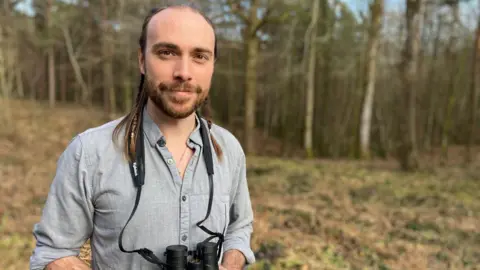
Dr James Whitehead and a team from the University of Sussex set up 37 acoustic monitoring stations across Sussex and took recordings every 10 minutes throughout the year.
The Gravetye Estate was the only site that captured a call of the lesser spotted woodpecker, a discovery Whitehead calls "very exciting".
Lesser spotted woodpeckers are about the same size as a sparrow, and tend to stay high in the tree canopy which can make them hard to spot.
Whitehead said artificial intelligence had "made it suddenly much more possible to monitor" the birds.
Using AI to process the thousands of hours of recordings from across Sussex, the lesser spotted woodpecker's call was found on the Gravetye Estate recordings four times.
However, it was down to what Whitehead described as the "woodpecker whizzes" at the Sussex Ornithological Society to ultimately confirm that the calls were that of the tiny woodpecker.
Two of the recordings were taken from the breeding season last year which Dr Whitehead said was "important" as it meant it was "highly likely" there was a breeding pair of woodpeckers on the estate.
 Fiona Irving / BBC
Unlike their greater spotted cousins, lesser spotted woodpeckers are not able to make their nests in living trees.
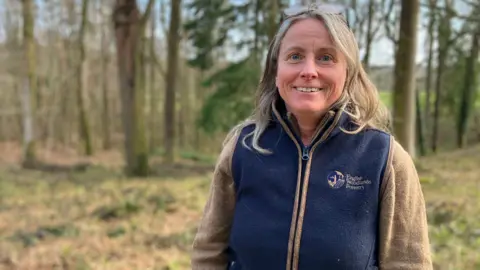
"They don't have the strength of beak to get through the bark of living material," said Laura Henderson, the director of English Woodlands Forestry, who look after the 167 hectares of woodland on the Gravetye Estate.
Henderson said now they knew the woodpecker was living in their woods, they could manage the woodland to help the bird.
She said they could leave what is called a "totem" when cutting down an "already damaged or diseased" tree so that "a big trunk of dead material" remained.
"It removes any risk that it's going to be a health and safety risk but it provides brilliant deadwood habitat," she added.
The audio recordings are continuing this year and the University of Sussex team hope to pick up more calls of lesser spotted woodpeckers.
Follow BBC Sussex on Facebook, on X, and on Instagram. Send your story ideas to southeasttoday@bbc.co.uk or WhatsApp us on 08081 002250.
