Gaza and asylum protests bring sharp rise in demand for policing

 PA Media
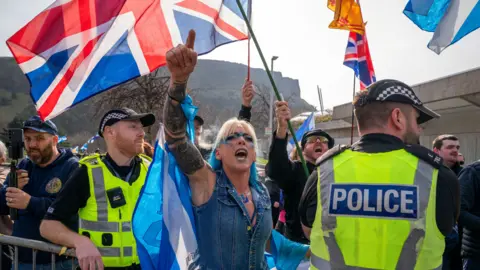
The conflict in Gaza and concerns over immigration have driven a sharp rise in protests that required a police presence on Scotland's streets.
Last year saw a 50% increase in the number of demonstrations, and so far this year Police Scotland has attended 530 protests.
A meeting of the Scottish Police Authority (SPA) board heard that of those protests, 40% were pro-Palestinian, 20% anti-immigration and 10% were linked to the war in Iran.
Assistant Chief Constable Alan Waddell said that international events had led to protests which have been "difficult and challenging" to police.
He said: "We've seen a considerable change in the protest landscape over the last 12 months.
"We see the direct impact of international events, but also domestic events and politics.
"We're acutely aware that our response can impact upon community cohesion."
 PA Media
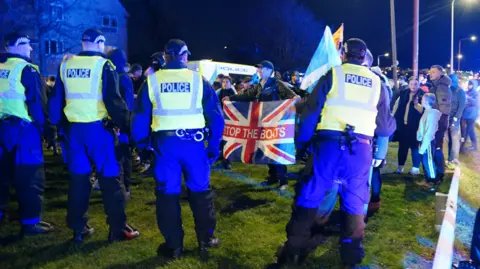
A national structure has been put in place to co-ordinate how the force deals with demonstrations outside hotels housing asylum seekers, to make sure there's "a consistent style and tone" in their response.
Waddell added: "Across Scotland our response is largely community based, so it's led by on almost every occasion local command teams with local officers, supported by national resource."
"Now there will be exceptions to that depending on the intelligence picture or the threat, risk and harm, but that's the start and default position for us."
Waddell said liaison officers were working with protest organisers and "good practice" had developed around the country to listen to community voices.
"We do review where we're at though, because these are difficult and at times challenging protests to do.
"When you look at the volume, it's difficult to get it right on every occasion."
Edinburgh attacks
Recent protests have included an anti-immigration rally which followed attacks in Wester Hailes in Edinburgh.
Mustafa Kokoneh appeared in court charged with attempting to murder a shop customer and a council worker, and assaulting two shop workers.
After the incident, dozens of officers had to step in when the demonstrators moved to confront a counter-protest which had gathered nearby.
Protests have also taken place outside hotels housing asylum seekers in Falkirk and Perth.
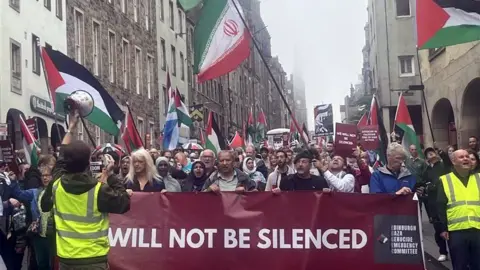
The war in Gaza and the UK government's decision to ban Palestine Action has also led to demonstrations.
Policing such events incurs extra costs for the force, which is hoping to reduce its over-time bill by 20% during the next financial year.
The SPA board passed what was described as a "challenging but manageable" budget for 2026/27, with £26m of savings allowing the force to maintain officer numbers at 16,500.
Unison branch secretary David Malcolm, who represents civilian staff on the force, said: "The budget is balanced because there's a vacancy assumption built in, but the work still has to be done.
"Members of staff can't do everything if there's not enough of us. They're raising concerns with us on a daily basis."
The Scottish government has said funding for policing is at record levels.
