Man's life support stopped too early, says coroner

 Family handout
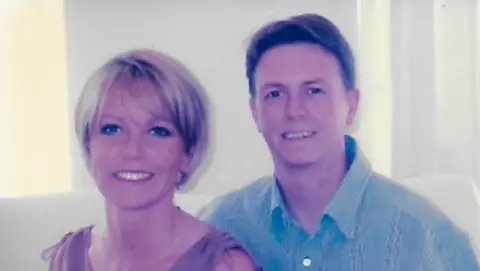
A 41-year-old man with leukaemia died after his life support was withdrawn prematurely, an inquest found.
Other doctors at Peterborough City Hospital were notconsulted about the decision before Simon Scott died in 2016, senior coroner David Heming said.
Mr Scott's inquest was heard alongside the inquests of John Hunt, 67, Ashley Gogerly, 57, and 55-year-old Robert Mackay, all of whom were cared for by Dr Andrew Gregg – who had earlier described his palliative care training as "apprentice-style".
Delivering his conclusion, Mr Heming said there had been a "failure of multi-disciplinary involvement" in two of the deaths.
Inquests into each man's death - between 2013 and 2016 - were joined and took place in autumn 2024.
The conclusions were delivered by Mr Heming on Friday.
 Family handout
Mr Scott, from Oakham, Rutland, was admitted to the hospital in December 2015 and diagnosed with leukaemia.
While undergoing chemotherapy, he suffered a known complication of sepsis and was transferred to the intensive care unit.
Mr Heming said life support was later withdrawn "prematurely" on 4 January 2016 "without seeking a second intensivist's opinion".
He also noted the dosage levels of two drugs used in Mr Scott's palliative care were "exceptionally high".
Mr Scott's sister, Suzanne White, had also remembered him having a strong pulse shortly before his death.
'Brilliant man'
She told the BBC her brother was a "smiley man" who loved karaoke, gaming and fancy dress parties.
"Everybody loved him. All of his colleagues loved him, all of his friends," she said.
"He was just a brilliant man and he did not deserve to die in the way that he died."
Peterborough City Hospital said it had changed its protocols since Mr Scott's deathso the withdrawal of life support from a patient must be signed off by two critical care physicians.
During the inquest, Dr Gregg's lawyer also said hospital staff had discussed the withdrawal in the days leading up to his death.
 The Queen Elizabeth Hospital King's Lynn NHS Foundation Trust
Mr Gogerly's death was found to be from alcohol-related liver disease, while Mr Mackay and Mr Hunt both died from multiple organ failure.
All three men had been taken off life support prior to their deaths.
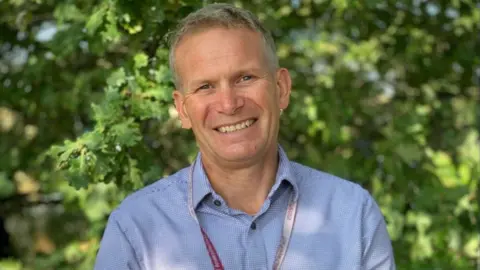
Dr Gregg left the North West Anglia NHS Foundation Trust in 2016, joining the Queen Elizabeth Hospital in King's Lynn, Norfolk, before retiring.
He told the inquest in 2024 that in 2016he had received no formal training in end-of-life care.
"My training has been based on watching other consultants," Dr Gregg said.
The BBC has approached him for comment following the inquest's conclusion.
Follow Peterborough news on BBC Sounds, Facebook, Instagram and X.
