Thousands of kites once filled the skies above India's cities. Today the tradition is dying out

 Vijay Pandey
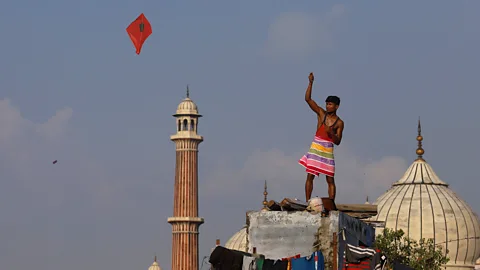
Kite flying was once a cherished tradition in many parts of India, with people crowding the rooftops during kite festivals. But recent heatwaves and a number of deaths due to illegal kite strings have seen many abandoning the once popular pastime.
The way his kites would catch the wind. It was legendary. Once, Syed Moinuddin – popularly known as Bhai Mian – flew 1,187 kites on a single string, stunning the crowd at a festival, about 30 years ago. For years, Bhai Mian, a so-called "godfather of kite-flying", perfected and promoted his sport across India. He flew kites of many different shapes. Soaring, darting, seemingly alive. Each one a small frame of intense colour, raging against an impassive sky. A tiger tamed by a thread.
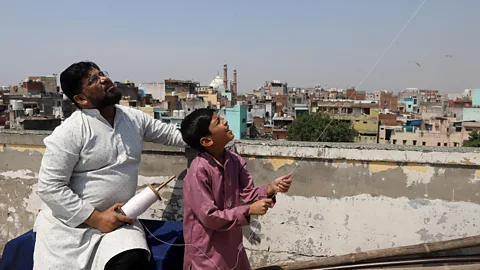
I watch as his son, Syed Jamaluddin flips through an old file of certificates, photographs and newspaper clippings. He recalls how his father loved to fly kites from the terrace of their home. "I used to be with him, holding the spool," Jamaluddin says. Eventually, Jamaluddin flew his own kites – and delighted his father by making one in the shape of an aeroplane.
But kite-flying in India is a dying art, argues Jamaluddin. Patangbaazi, as it's called locally, is a tradition that dates back centuries. It has survived wars, colonialism, partition and pandemics. But the unstoppable rise of digital technology, climate change – and, shockingly, reports of injuries and even deaths caused by kite strings, appear to be slackening people's enthusiasm for kites. Those who still take to the roof tops and open spaces to send their kites into the sky now fear that the tradition may soon disappear forever – and take a vital part of Indian history with it.
 Vijay Pandey
No-one knows where kite-flying came from. Some say it emerged in China and that Buddhist missionaries, travelling the Silk Road trade routes brought it to Southeast Asia and the Indian subcontinent. "The journey of the kite has been like an exploration," says Nikita Desai, author of the book A Different Freedom: Kite Flying in Western India.
Desai writes about how kites were mentioned in the earliest writings of Namdev, a 12th Century Marathi poet-saint from India. Various popular Hindi songs also reference kite-flying. Today, some communities in India fly kites to celebrate the country's independence. And during Uttarayan, or Makar Sankranti, a Hindu festival at the end of winter, kite-flying marks the beginning of good times. The past-time has also evolved into a form of sport.
Kite fighting involves players who must manoeuvre their kite in such a way to bring an opponents' kite by cutting its string. Tournaments are mostly organised in open fields and crowds often gather to watch players fly against one another. Specially toughened strings are used, sometimes coated in crushed glass or other abrasive materials. In its rawest form, it's a test of attention and patience.
"It depends on the kite fighter's mind, just like in boxing – you anticipate the opponent's attack, here you do the same, with quick reflexes as your opponent nears his kite to yours," says Mukhtar Ahmad, Jamaluddin's elder brother. "It is also important to have body balance and a perfect angle to hold your string steadily. The quality of the kite also matters."
 Vijay Pandey
Both Jamaluddin and his elder brother inherited a love of kite-flying from their famous father. They travelled to various countries, competing and promoting the sport – just as he had done in India.
Bhai Mian, who founded the Delhi Kite Flying Association in 1985, always called kite-flying a "serious business". But life caught up with his sons, who are both jewellers, so they struggle to find the time to do much kite-flying these days. "We became involved in our work and we couldn't indulge in it anymore," says Ahmad. "Kite-flying is time-consuming and if you devote your time to it, there is going to be financial difficulty when you have a family to feed."
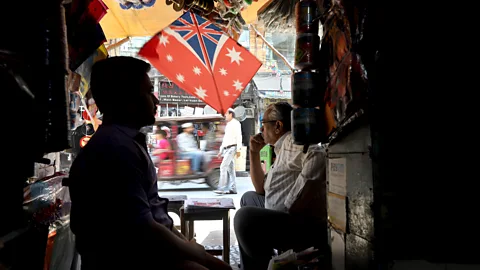
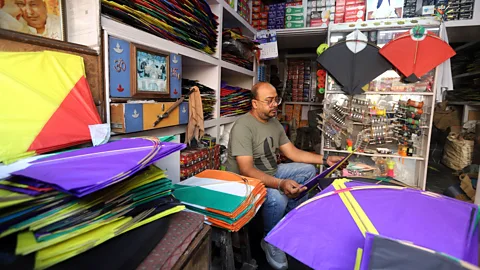
Many people find it hard to invest their time and money in kites. The kite-sellers of Lal Kuan, a wholesale market in Old Delhi, know this all too well. There used to be more than 20 kite shops here. Now, just five remain.
"It was good in the beginning. There was a good sale of kites back in those days," says Mohammad Khalid, a kite seller in the market. His shop, opened by his father in 1972, is stuffed full of colourful kites, some with cartoon figures on them. But now, he says, his business seems to decline with each passing day. "Only during festivals, especially during Independence Day, do people come here to buy kites. It has become an occasional thing now."
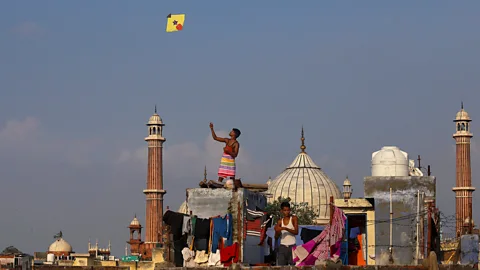
"Mobile, internet, and TV" are to blame, he adds. But so too are rising temperatures in India, a symptom of climate change. Heatwaves increasingly force people to shelter indoors, says Khalid. It's no weather for flying kites.
 Vijay Pandey
"It is our legacy," laments Khalid's son, Mohammad Ahmad – who left academic studies to help his father run his business. "If things remain the same, we will move on from this." The pair sit idle in their shop, watching social media videos, or reels, on their phones, while the traffic rushes outside. Their unsold kites hang motionless.
Another kite seller in the market, Himanshu Gupta, tells me he is worried about his business's future. His shop was opened by his grandfather 65 years ago, when kites were greatly in demand. While there was a spike in kite-flying during the first years of the Covid-19 pandemic, since then sales have declined again. "People […] were buying kites to pass the time," says Gupta.
 Vijay Pandey
Gupta says digital gadgets and increasingly urban lifestyles are drawing people away from kites. "The world has moved pretty fast," he says. Kites will soon go the way of hand-written letters, he predicts. Once ubiquitous, now antiquated and rare.
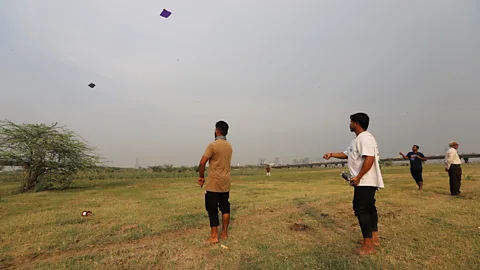
But there's another reason why some people are turning their backs on kite-flying. The sport is, tragically, killing people. In June 2025, a 22 year-old man was slashed in the neck by a glass-coated kite string while travelling home from work on his scooter. He was rushed to hospital but declared dead, according to local media. Dozens of other deaths and many gruesome injuries have been reported in recent years, also apparently caused by synthetic or plastic kite strings coated with sharp pieces of metal or glass, called manjha. Fliers sometimes use such strings for kite-fighting – the object being to slice your opponent's kite free of its tether. The cords are like thin razors suspended across significant distances.
This year, despite a ban on the sale and use of plastic manjha, there have been multiple reported deaths across the Indian states.
 Vijay Pandey
"If it gets entangled around your neck, it is so sharp that it can cut through it and cause death on the spot," says Devender Singh, an endovascular surgeon in Hyderabad, India, who was the lead author on a 2022 study of kite string injuries. He explains how the strings are strong enough to cut through a person's skin, arteries and veins. Many birds have also been killed by these deadly strands, according to some reports.
In 2017, the government in the state of Delhi banned the "manufacture, sale, storage, purchase, and use" of sharp kite strings. Other states followed suit, but the strings are still widely traded, illicitly.
The people most at risk from wayward kite strings are pedestrians and people travelling on vehicles such as scooters, says Singh. But there could be a simple solution for scooter-riders – a metal loop rising from the front of the vehicle, protecting riders from lines that might cut across their path. "When I was in Ahmedabad, I saw people using this aluminium [loop], and I thought this type of mechanism is not used by people in the rest of India," says Snehal Prakash, a scientist at the Indian Council of Medical Research, Pune. He co-authored a 2022 study exploring the efficacy of this approach.
The kite sellers I spoke to say that the fatalities caused by deadly kite strings have, unsurprisingly, affected their business. "It has scared people, and now everyone looks at kites with suspicion," adds Khalid.
With people dying because of kite-flying, the sport might seem best consigned to history. But there are good reasons to keep kite-flying alive, say its proponents.
 Vijay Pandey
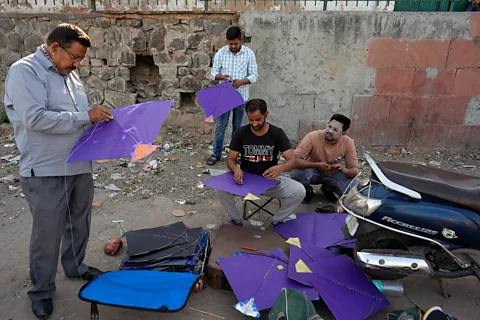
Kite-flying has become an integral part of the country's cultural heritage. It brings together people of all faiths to fly kites and gives them a sense of community, especially during India's Independence Day, where they symbolised freedom and the country's break from colonial rule. During the Simon Commission's visit to India in 1928, kites with the slogan "Go Back Simon" were flown to send a message and were used as an expression of silent resistance by the people. Decades later, kite-flyers want to keep that history alive – and also as an expression of joy.
"There is joy in flying kites. It involves both physical and mental activity," Jamaluddin says. This is particularly true when it comes to kite fighting, he says. "It makes you think about the opponent's mind and steps as you want to stay in the game till the end. It also tests and increases your focus, attention, and sight as you see kites high and distant in the sky," he adds.
Kite-flyers like Jamaluddin and others believe that kite-flying can also be used to keep children and youngsters away from mobile phones and digital gadgets, as India's digital addiction is on the rise in recent years. Collectively, Indians logged more than 1.1 trillion hours of screentime in 2024, according to one report and a recent economic report from the Indian government raised concerns around the mental health effects of digital addiction.
 Vijay Pandey
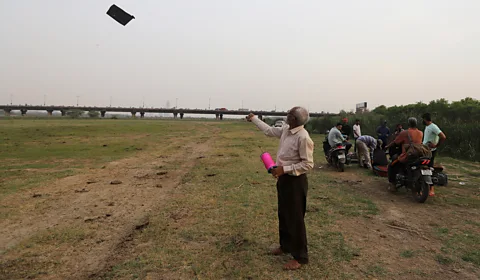
In Old Delhi, I meet Mohammad Ghayas, a man who describes himself as a proud "kite fighter". Kite-flying is a true skill, he says. And one that he has spent his life honing: "Nothing has come so close to this passion". His father's attempts to stop Ghayas flying kites – even, he claims, "chaining" him up at one point – failed. "We were seven siblings, and I was the only one infected with this passion," he laughs. "My father couldn't understand."
More like this:
- Pakistan's famous kite festival makes a cautious return after 19-year ban
- The women tackling India's worm poachers
- Did a flatbreak help end British rule in India?
Over the years, Ghayas has won dozens of medals and certificates in kite-flying competitions. Aware of the waning interest in his sport within India, Ghayas says that, today, he feels lost. "It is […] something that is looked down upon by people and seen as a waste of time and energy."
The use of manjha strings have also had an impact, something Ghayas believes should be completely banned. "It has brought a bad name to kite-flying," he says.
This contrasts sharply with what kite-flying means to Ghayas – and how it has shaped his life. I watch as he silently arranges his old medals. He opens a wooden container, which he has kept in the basement of his house, and takes out multiple, dusty old kites, which he has preserved over the years as mementos. Now he is in his sixties, kite-flying has taken on a new significance for Ghayas, espeially after he was diagnosed with kidney cancer nine years ago.
"Now, I do it to forget about this disease," says the veteran kite-flyer. "It motivates me to live longer – and to fly more kites." Some things soar even in the face of death. A kite on the wind. A tether held firm.
--
If you liked this story, sign up for The Essential List newsletter – a handpicked selection of features, videos and can't-miss news, delivered to your inbox twice a week.
For more science, technology, environment and health stories from the BBC, follow us on Facebook and Instagram.
