Research finds men are better at reading maps, but there’s a catch

 Getty Images
The author of a new study discusses the reasons for men's slightly superior navigation skills (as spoofed this week on Saturday Night Live), and the answers might surprise you.
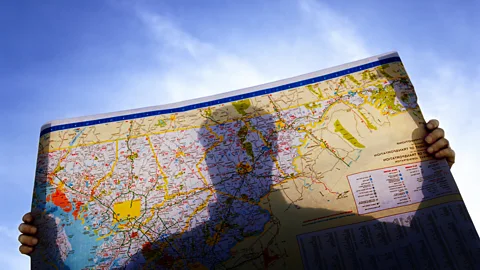
On a recent episode of Saturday Night Live, Colin Jost, who co-anchors the Weekend Update segment, joked that men are better than women at reading maps, according to a new study. Researchers indeed found this map-reading sex gap to be true, but not for the reasons one might think.
The new research review, published in Royal Society of Open Science, finds no genetic advantage in one sex having better navigation skills than the other. Instead, researchers say their findings suggest a "nurture" not "nature" cause for this disparity that the sketch comedy show recently satirised.
"That's where the misogyny comes in," study author Justin Rhodes, a professor at the University of Illinois Urbana-Champaign, tells the BBC. "We've chosen this tiny difference where the males end up at the top and have hundreds of studies and people arguing this is somehow biological. I think that has some cultural implications."
Through their analysis, Rhodes and colleagues highlight the flaws regarding theories of "male superiority" in navigation and wayfinding, and instead suggest a theory of practice makes perfect.
The scientists built upon previous research and included 66 studies in their analysis, featuring data on 21 species, including humans. Animal species ranged from the Asian small-clawed otter and the brilliant-thighed poison frog to the rusty crayfish and the Talas tuco-tuco (a big-toothed rodent local to coastal areas of Argentina). They compiled the data for each species’ spatial navigation and home range size, the area where a species generally lives and moves. Across species, the researchers found that either males outperformed females or no difference existed in spatial ability, with one exception: female chimpanzees outperformed males.
When looking at human studies, the researchers only included data from subsistence, or hunter-gatherer, cultures, although this phenomenon had previously been observed in Western, industrialized populations as well. In populations where males engage in the hunting and gathering to a greater extent than females, the males showed spatial orientation advantages. However, no difference existed across the sexes in populations where males and females travelled and foraged equally.
The Hadza people of northern Tanzania have two different populations within their culture: one in which males do most of the hunting and gathering and one where males and females do so equally. Comparing the two in the research was telling, says Rhodes.
"Where there was a difference in experience," he explains, "then you did see the difference in performance. It's basically learning. When we do certain things, we figure things out and we get better at it." Other factors, like language, also affect our ability to navigate.
Rhodes and fellow researchers suggest that neuroplasticity is at play. Our brains restructure based on our experience with a concept or task by growing new synapses. Rhodes shares the examples of navigating while hiking, or performing other spatial tasks, like building with children's construction bricks. The more you do these things, the better you'll likely be at them, he explains.
"Males are just encouraged more, because of our cultures, to do more of those kinds of things, and so they're slightly better at it," Rhodes says. "All the data suggests that's the case." He also notes that with GPS apps on our smartphones, people in Western cultures rarely read maps anymore. So, he says, that map-reading sex gap will likely narrow further.
Meanwhile, researchers wondered if men gained an evolutionary advantage over time. In cultures where men have historically been the hunters and gatherers, and perhaps ranged farther than women, did they pass these skills down to their male offspring through the generations?
That story, Rhodes explains, "fails on two counts. One, the data doesn't fit the story. Two, the story doesn't really make sense."
If that theory were correct, the data would show that in species where males range farther than females, they'd have better abilities, and vice versa. "We looked at that across species and found there was no relationship," he says.
Additionally, if an evolutionary theory were correct, then female offspring would also gain the evolutionary advantage. "Basically, when you select on one sex, then the other sex gets that as a side effect, even though they may not need it for anything," Rhodes says. For example, he adds, men have nipples, which serve no function, but they aren't harmful. For an evolutionary advantage theory to make sense, he continues, researchers must explain why spatial navigation skills are somehow bad for females – otherwise they would also inherit them.
On SNL, Jost stated that the new study "suggests that men are better than women at using a map." He added a punchline: "While women are better at sitting silently for the rest of the car ride after you tell them that."
"The argument, when you start thinking about it – it's just silly," Rhodes says, adding that the added attention has distorted the findings. "It's gotten so far away from the study, it's unbelievable." He also indicates that some people might not be happy with his findings. "People have devoted their careers to arguing this biological difference," he explains, so he won't be surprised if more research follows. "For me, I'm pretty confident that this is not a biological or evolutionarily significant difference," he says, explaining that girls who hunt and build things more than their boy peers will be better at those skills.
"It's time to settle that it has nothing to do with biology in humans,” Rhodes concludes. “There is maybe a difference in our Western cultures. And if you want to solve that, then solve the culture."